Skip to content
ScienceBlog.com
  • Featured Blogs
    • EU Horizon Blog
    • ESA Tracker
    • Experimental Frontiers
    • Josh Mitteldorf’s Aging Matters
    • Dr. Lu Zhang’s Gondwanaland
    • NeuroEdge
    • NIAAA
    • SciChi
    • The Poetry of Science
    • Wild Science
  • Topics
    • Brain & Behavior
    • Earth, Energy & Environment
    • Health
    • Life & Non-humans
    • Physics & Mathematics
    • Social Sciences
    • Space
    • Technology
  • Our Substack
  • Follow Us!
    • Bluesky
    • Threads
    • FaceBook
    • Google News
    • Twitter/X
  • Contribute/Contact

Astronomy

A lunar zircon grain under a microscope. Credit: Jennika Greer

The moon is 40M years older than previously thought

Artist’s illustration of the extremely energetic cosmic ray observed by a surface detector array of the Telescope Array experiment, named “Amaterasu particle.”

Mysterious Cosmic Ray Defies Origins and Energies

University of Michigan astronomer Sally Oey studied a star-forming region in host galaxy, NGC 2366, which is a typical dwarf irregular galaxy. Image courtesy: Observatorio de Calar Alto, J. van Eymeren (AIRUB, ATNF) & Á.R. López-Sánchez

Dwarf galaxies use 10-million-year quiet period to churn out stars

Illustration of Saturn rings

Using eclipses to calculate the transparency of Saturn’s rings

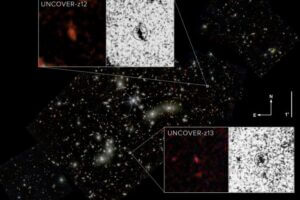
The second- and fourth-most distant galaxies ever seen (UNCOVER z-13 and UNCOVER z-12) have been confirmed using the James Webb Space Telescope’s Near-Infrared Camera (NIRCam). The galaxies are located in Pandora’s Cluster (Abell 2744), show here as near-infrared wavelengths of light that have been translated to visible-light colors. The scale of the main cluster image is labelled in arcseconds, which is a measure of angular distance in the sky. The circles on the black-and-white images, showing the galaxies in the NIRCam-F277W filter band onboard JWST, indicate an aperture size of 0.32 arcsec.

Second-most distant galaxy discovered using James Webb Space Telescope

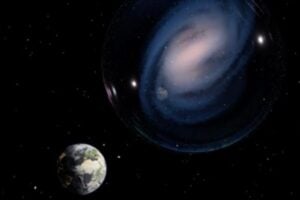
Artistic representation of the spiral barred galaxy ceers-2112, observed in the early universe. The Earth is reflected on an illusive bubble surrounding the galaxy, recalling the connection between the Milky Way and ceers-2112.

Milky Way-like galaxy found in the early universe

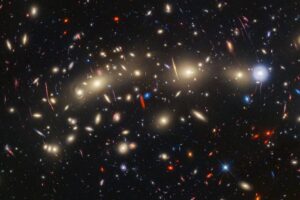
Panchromatic view of MACS0416, a galaxy cluster about 4.3 billion light-years from Earth. The image was created by combining infrared observations from NASA’s James Webb Space Telescope with visible-light data from NASA’s Hubble Space Telescope. The resulting prismatic panorama of blues and reds give clues to the distances of the galaxies.

NASA’s Webb, Hubble telescopes combine to create most colorful view of universe

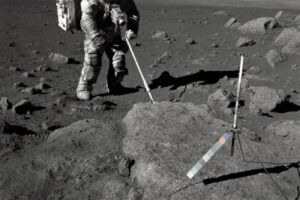
Apollo 17 astronaut Harrison Schmitt in 1972, covered in lunar dust.

Crystals brought back by astronauts show that the Moon is 40 million years older than scientists thought

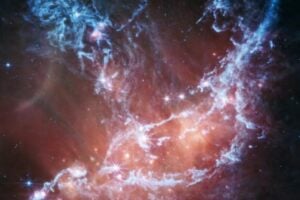
This new infrared image of NGC 346 from NASA’s James Webb Space Telescope’s Mid-Infrared Instrument (MIRI) traces emission from cool gas and dust. In this image blue represents silicates and sooty chemical molecules known as polycyclic aromatic hydrocarbons, or PAHs. More diffuse red emission shines from warm dust heated by the brightest and most massive stars in the heart of the region. Bright patches and filaments mark areas with abundant numbers of protostars. This image includes 7.7-micron light shown in blue, 10 microns in cyan, 11.3 microns in green, 15 microns in yellow, and 21 microns in red (770W, 1000W, 1130W, 1500W, and 2100W filters, respectively).

NASA’s Webb captures an ethereal view of NGC 346

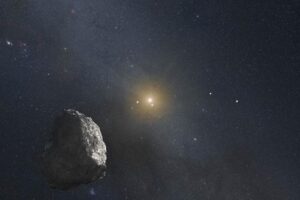
Plot thickens in hunt for ninth planet

Plot thickens in hunt for ninth planet

Keck Cosmic Web Imager offers best glimpse yet of the filamentous network that connects galaxies

Cosmic Web Lights Up in the Darkness of Space

Ohio State logo

Study sheds new light on strange lava worlds

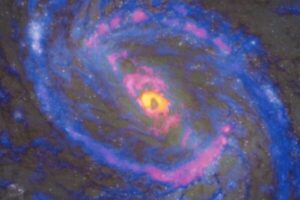
Spiral galaxy

Distilling a Galaxy

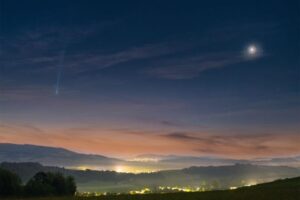
This scene would be beautiful even without the comet. By itself, the sunrise sky is an elegant deep blue on high, with faint white stars peeking through, while near the horizon is a pleasing tan. By itself, the foreground hills of eastern Slovakia are appealingly green, with the Zadňa hura and Veľká hora hills in the distance, and with the lights of small towns along the way. Venus, by itself on the right, appears unusually exquisite, surrounded by a colorful atmospheric corona. But what attracts the eye most is the comet. On the left, in this composite image taken just before dawn yesterday morning, is Comet Nishimura. On recent mornings around the globe, its bright coma and long ion tail make many a morning panoramic photo unusually beautiful. Tomorrow, C/2023 P1 (Nishimura) will pass its nearest to the Earth for about the next 434 years.

Beautiful Comet Nishimura

Older posts
Newer posts
← Previous Page1 … Page6 Page7 Page8 … Page12 Next →
Substack subscription form sign up

Comments

  • Karoly Mirnics on Common Prescription Drugs May Disrupt Cholesterol Pathways in the Womb and Raise Autism Risk
  • Aizen on Laziness helped lead to extinction of Homo erectus
  • Norwood johnson on Electrons in New Crystals Behave as If They Live in Four Dimensions
  • ScienceBlog.com on Hidden Geometry Could Finally Fix Quantum Computers
  • Theo Prinse on America Is Going Back to the Moon. This Time, It Plans to Stay
© 2026 ScienceBlog.com | Follow our RSS / XML feed