Skip to content
ScienceBlog.com
  • Featured Blogs
    • EU Horizon Blog
    • ESA Tracker
    • Experimental Frontiers
    • Josh Mitteldorf’s Aging Matters
    • Dr. Lu Zhang’s Gondwanaland
    • NeuroEdge
    • NIAAA
    • SciChi
    • The Poetry of Science
    • Wild Science
  • Topics
    • Brain & Behavior
    • Earth, Energy & Environment
    • Health
    • Life & Non-humans
    • Physics & Mathematics
    • Social Sciences
    • Space
    • Technology
  • Our Substack
  • Follow Us!
    • Bluesky
    • Threads
    • FaceBook
    • Google News
    • Twitter/X
  • Contribute/Contact

Astronomy

Sample shapes of distant galaxies identified by the James Webb Space Telescope’s Cosmic Evolution Early Release Science (CEERS) survey. [(Credit: NASA, ESA, CSA, STScI, Steve Finkelstein (UT Austin), Micaela Bagley (UT Austin), Rebecca Larson (UT Austin)]

Most early galaxies looked like breadsticks rather than pizza pies or dough balls

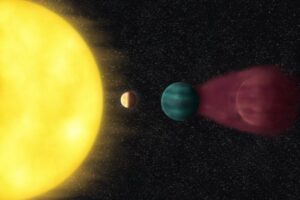
Young, hot, Earth-sized planet HD 63433d sits close to its star in the constellation Ursa Major, while two neighboring, mini-Neptune-sized planets — identified in 2020 — orbit farther out.

Earth-sized planet discovered in ‘our solar backyard’

space illustratioon

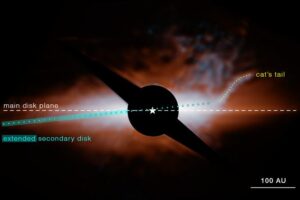
NASA’s Webb discovers dusty ‘cat’s tail’ in Beta Pictoris System

galaxies

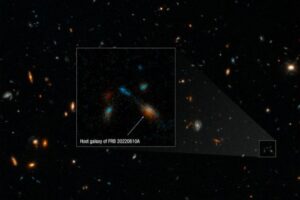
‘Blob-like’ home of farthest-known fast radio burst is collection of seven galaxies

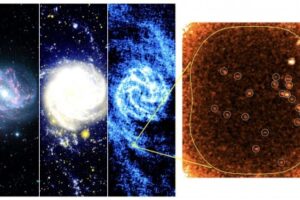
Research on the far edge of galaxy M83 reveals unusual star formation in an extreme environment. This area, outlined in yellow, is shown in data from several different instruments. From left to right: optical image from CTIO, ultraviolet image from GALEX, HI 21cm image from VLA and GBT, and CO(3-2) image from ALMA. In this last image, the star-forming “hearts” of molecular clouds, circled with white, are shown.

Mystery of Star Formation Revealed by Hearts of Molecular Clouds

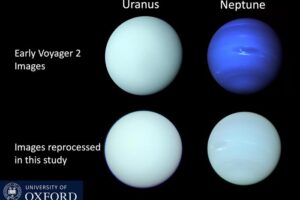
Voyager 2/ISS images of Uranus and Neptune released shortly after the Voyager 2 flybys in 1986 and 1989, respectively, compared with a reprocessing of the individual filter images in this study to determine the best estimate of the true colours of these planets.

New images reveal what Neptune and Uranus really look like

exoplanet

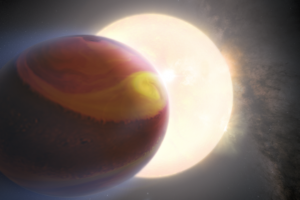
Hubble Reveals Dynamic Weather Patterns on Distant Exoplanet

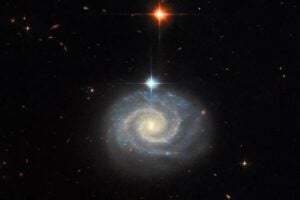
This NASA Hubble Space Telescope image features a bright spiral galaxy known as MCG-01-24-014, which is located about 275 million light-years from Earth.

Hubble sights a galaxy with ‘forbidden’ light

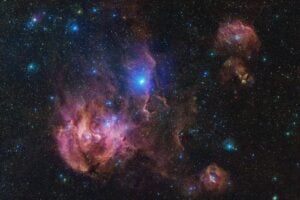
The Running Chicken Nebula comprises several clouds, all of which we can see in this vast image from the VLT Survey Telescope (VST), hosted at ESO’s Paranal site. This 1.5-billion pixel image spans an area in the sky of about 25 full Moons. The clouds shown in wispy pink plumes are full of gas and dust, illuminated by the young and hot stars within them.

New 1.5-billion-pixel image shows Running Chicken in unprecedented detail

uranus

NASA’s Webb rings in holidays with ringed planet Uranus

Illustration of a star and space rocks

Extreme conditions in stars produce the universe’s heaviest elements

Top space telescope from Europe seeks to solve riddles of the universe

Color composite of galaxy AzTECC71 from multiple color filters in the NIRCam instrument on the James Webb Space Telescope. Credit: J. McKinney/M. Franco/C. Casey/University of Texas at Austin.

Ghostlike dusty galaxy reappears in James Webb Space Telescope image

Nitrogen illustration

Meteorites likely source of nitrogen for early Earth

Older posts
Newer posts
← Previous Page1 … Page5 Page6 Page7 … Page12 Next →
Substack subscription form sign up

Comments

  • Mark Mellinger on Living Plastic Can Self-Destruct on Command
  • Marie Feret on The Silent Frequency That Makes Old Buildings Feel Haunted
  • Dax on The Silent Frequency That Makes Old Buildings Feel Haunted
  • Karoly Mirnics on Common Prescription Drugs May Disrupt Cholesterol Pathways in the Womb and Raise Autism Risk
  • Aizen on Laziness helped lead to extinction of Homo erectus
© 2026 ScienceBlog.com | Follow our RSS / XML feed