Skip to content
ScienceBlog.com
  • Featured Blogs
    • EU Horizon Blog
    • ESA Tracker
    • Experimental Frontiers
    • Josh Mitteldorf’s Aging Matters
    • Dr. Lu Zhang’s Gondwanaland
    • NeuroEdge
    • NIAAA
    • SciChi
    • The Poetry of Science
    • Wild Science
  • Topics
    • Brain & Behavior
    • Earth, Energy & Environment
    • Health
    • Life & Non-humans
    • Physics & Mathematics
    • Social Sciences
    • Space
    • Technology
  • Our Substack
  • Follow Us!
    • Bluesky
    • Threads
    • FaceBook
    • Google News
    • Twitter/X
  • Contribute/Contact

Astronomy

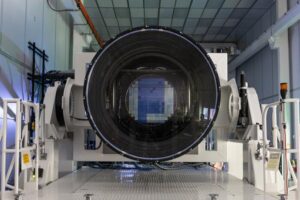
A front view of the completed LSST Camera, showing the 3,200-megapixel focal plane within.

SLAC completes construction of the largest digital camera ever built for astronomy

Ohio State logo

A total eclipse, with a partial failure

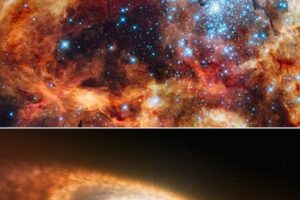
The ULLYSES program studied two types of young stars: super-hot, massive, blue stars and cooler, redder, less massive stars than our Sun. The top panel is a Hubble Space Telescope image of a star-forming region containing massive, young, blue stars in 30 Doradus, the Tarantula Nebula. Located within the Large Magellanic Cloud, this is one of the regions observed by ULLYSES. The bottom panel shows an artist's concept of a cooler, redder, young star that's less massive than our Sun. This type of star is still gathering material from its surrounding, planet-forming disk.

Hubble Telescope’s Ambitious Survey Provides Unprecedented Insights into the Lives of Stars

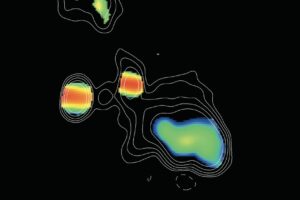
This image, taken by the Very Long Baseline Array (VLBA), shows two supermassive black holes, which appear as the blobs with red strips. The black holes are in the center of an elliptical galaxy. Colors represent different spectral slopes in radio emission, with red showing the most dense regions surrounding the black holes. The black hole on the right has likely recently devoured a massive star, which caused it to shoot out two ultrafast jets. The ends of those jets appear as green blobs above and below the black hole. This object, called J0405+3803, is referred to as a Compact Symmetric Object (CSO), because its jets are relatively close-in (or compact), compared to other black holes with much larger jets.

Sleeping supermassive black holes awakened briefly by shredded stars

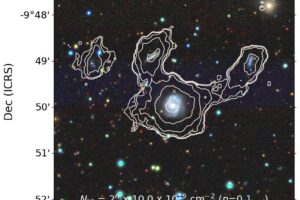
Four nearby galaxies as part of the set of 49 found by MeerKAT, shown by the white contours. Three of the galaxies are connected together by their gas content. The largest galaxy is stealing gas from two neighbouring galaxies. The background colour image is from the DECaLS DR10 optical survey. Glowacki et al. 2024

Astronomers discover 49 new galaxies in under three hours

Ohio State logo

What to expect when total solar eclipse passes through Ohio

Satellite astronomy dishes pointed at the night sky

Astronomers reveal a new link between water and planet formation

Illustration of the Star Wars planet Tatooine

A new beginning: The search for more temperate Tatooines

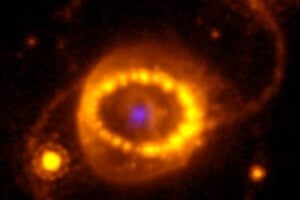
Fig. 1. Combination of a Hubble image of SN 1987A and the compact highly ionized argon source in Fig. 2. The faint blue source in the centre was detected by the NIRSpec instrument on JWST. Outside of this is the rest of the supernova, which contains the most mass and is expanding at thousands of kilometers every second. The inner bright "string of pearls" is gas from the star's outer layers that was ejected about 20,000 years before the explosion. The collision between the rapidly expanding supernova remnant and the ring gives rise to the heated clumps in the ring. Outside the inner ring are two outer rings, which probably arose at the same time as the inner ring was formed. The bright stars to the left and right of the inner ring are unrelated to the supernova. (Illustration: HST, JWST/NIRSpec, J. Larsson)

James Webb telescope detects neutron star in the remnant of a supernova

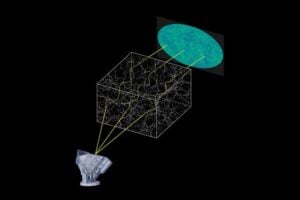
The cosmic microwave background — the universe’s oldest light — has traversed vast distances before reaching us. During its extended journey, gravitational forces from massive cosmic structures caused its trajectory to bend before being captured by the South Pole Telescope.

Results from South Pole Telescope’s new camera emerge

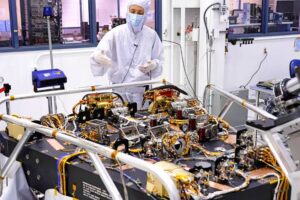
JPL scientist Vanessa Bailey stands behind the Nancy Grace Roman Coronagraph, which has been undergoing testing at JPL. About the size of a baby grand piano, the Coronagraph is designed to block starlight and allow scientists to see the faint light from planets outside our solar system. Credit: NASA/JPL-Caltech

NASA Puts Next-Gen Exoplanet-Imaging Technology to the Test

Ohio State logo

Researchers spying for signs of life among exoplanet atmospheres

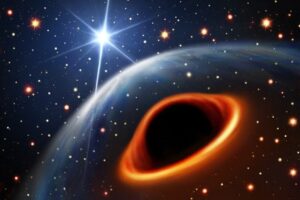
An artist’s impression of the system assuming that the massive companion star is a black hole. The brightest background star is its orbital companion, the radio pulsar PSR J0514-4002E. The two stars are separated by 8 million km and orbit each other every 7 days.

Astronomers Discover Most Massive Neutron Star—or Least Massive Black Hole

Ohio State logo

Study delivers detailed photos of galaxies’ inner structures

Older posts
Newer posts
← Previous Page1 … Page4 Page5 Page6 … Page12 Next →
Substack subscription form sign up

Comments

  • Karoly Mirnics on Common Prescription Drugs May Disrupt Cholesterol Pathways in the Womb and Raise Autism Risk
  • Aizen on Laziness helped lead to extinction of Homo erectus
  • Norwood johnson on Electrons in New Crystals Behave as If They Live in Four Dimensions
  • ScienceBlog.com on Hidden Geometry Could Finally Fix Quantum Computers
  • Theo Prinse on America Is Going Back to the Moon. This Time, It Plans to Stay
© 2026 ScienceBlog.com | Follow our RSS / XML feed