Skip to content
ScienceBlog.com
  • Featured Blogs
    • EU Horizon Blog
    • ESA Tracker
    • Experimental Frontiers
    • Josh Mitteldorf’s Aging Matters
    • Dr. Lu Zhang’s Gondwanaland
    • NeuroEdge
    • NIAAA
    • SciChi
    • The Poetry of Science
    • Wild Science
  • Topics
    • Brain & Behavior
    • Earth, Energy & Environment
    • Health
    • Life & Non-humans
    • Physics & Mathematics
    • Social Sciences
    • Space
    • Technology
  • Our Substack
  • Follow Us!
    • Bluesky
    • Threads
    • FaceBook
    • Google News
    • Twitter/X
  • Contribute/Contact

Astronomy

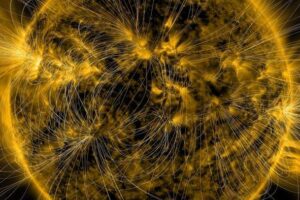
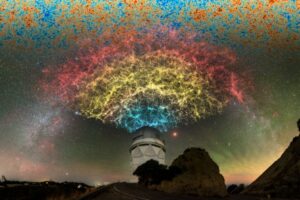
This image combines a depiction of the sun's magnetic fields with a photograph taken by NASA's Solar Dynamics Observatory. The intricate pattern of lines reveals how the sun's magnetism shifts and adapts in response to its constant internal and surface movements.

Discovery Pinpoints Origin of Sun’s Magnetic Field, Improving Solar Storm Predictions

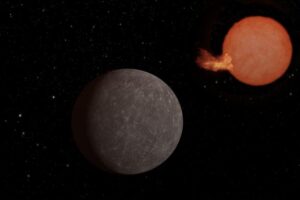
Earth-sized exoplanet orbiting the ultracool dwarf star SPECULOOS-3

Astronomers Unveil New Earth-Sized Exoplanet Orbiting Ultra-Cool Dwarf Star

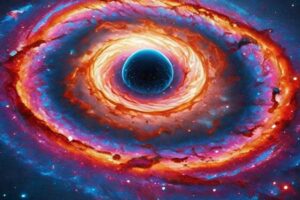
A 3D rendered image of the spiral galaxy NGC 4151, with a bright central region representing the active galactic nucleus. The image zooms in to show a glowing accretion disk surrounding a supermassive black hole, with twin jets of particles emanating from the disk's center. Colorful spectral lines are overlaid on the image, highlighting the iron fingerprints detected by XRISM's Resolve instrument.

XRISM Telescope Reveals Iron Fingerprints in Nearby Galaxy

Ohio State logo

First year of DESI results unveil new clues about dark energy

[Image: A computer-generated visualization of a galaxy, with visible matter represented in bright colors and dark matter represented as a translucent halo surrounding the galaxy, accompanied by a graph showing the relationship between visible and dark matter in the simulations.]

Astronomers’ Simulations Bolster Case for Dark Matter’s Existence

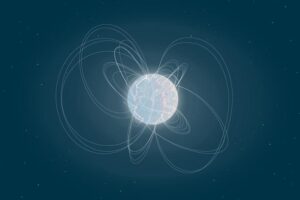
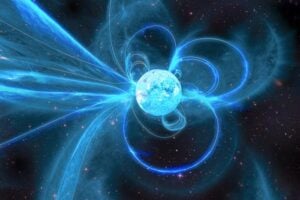
Artist's impression of a magnetar. Magnetars are the cosmic objects with the strongest magnetic fields ever measured in the Universe.

Rare Magnetar Flare Spotted in Nearby Galaxy M82

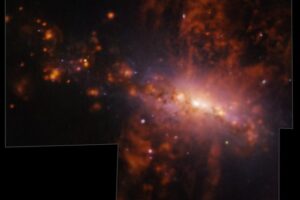
Galaxy NGC 4383 evolving strangely. Gas is flowing from its core at a rate of over 200 km/s. This mysterious gas eruption has a unique cause: star formation.

Astronomers Discover Colossal Gas Outflow Spanning 20,000 Light-Years in Nearby Galaxy

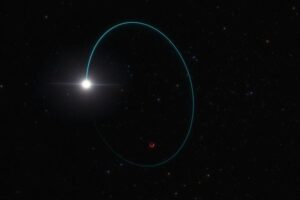
giant black hole against the darkness of space

Gaia Mission Discovers Monstrous Black Hole in the Milky Way

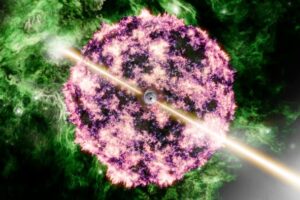
Artist's visualization of GRB 221009A showing the narrow relativistic jets — emerging from a central black hole — that gave rise to the GRB and the expanding remains of the original star ejected via the supernova explosion. Using the James Webb Space Telescope, Northwestern University postdoctoral fellow Peter Blanchard and his team detected the supernova for the first time, confirming GRB 221009A was the result of the collapse of a massive star. The study’s co-authors also found that the event occurred in a dense star forming region of its host galaxy as depicted by the background nebula.

Unraveling the Mysteries of the Brightest Gamma-Ray Burst: A Supernova Without Heavy Elements

The attached image shows the sky goddess Nut, covered in stars, is held aloft by her father, Shu, and is arched over Geb, her brother the Earth god. On the left, the rising sun (the falcon-headed god Re) sails up Nut’s legs. On the right, the setting sun sails down her arms towards the outstretched arms of Osiris, who will regenerate the sun in the netherworld during the night.

The hidden role of the Milky Way in ancient Egyptian mythology

Artist’s impression of a magnetar.

Mysterious Radio Signals from Nearby Magnetar Baffle Scientists

colorful sky

Unlocking the Secrets of the Universe: DESI’s Groundbreaking 3D Map Reveals Dark Energy Mysteries

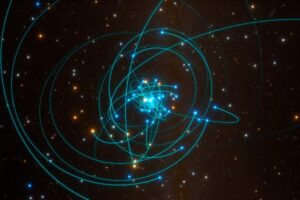
This illustration shows the orbits of stars very close to Sagittarius A*, a supermassive black hole at the heart of the Milky Way.

Zombie Stars in the Milky Way Eat Their Neighbors to Stay Young

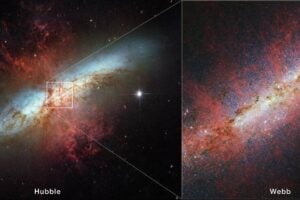
On the left is the starburst galaxy M82 as observed by NASA’s Hubble Space Telescope in 2006. The small box at the galaxy’s core corresponds to the area captured so far by the NIRCam (Near-Infrared Camera) instrument on NASA’s James Webb Space Telescope. The red filaments as seen by Webb are the polycyclic aromatic hydrocarbon emission, which traces the shape of the galactic wind. In the Hubble image, light at .814 microns is colored red, .658 microns is red-orange, .555 microns is green, and .435 microns is blue (filters F814W, F658N, F555W, and F435W, respectively). In the Webb image, light at 3.35 microns is colored red, 2.50 microns is green, and 1.64 microns is blue (filters F335M, F250M, and F164N, respectively). NASA, ESA, CSA, STScI, A. Bolatto (University of Maryland)

NASA’s James Webb Space Telescope Uncovers Secrets of Starburst Galaxy

Older posts
Newer posts
← Previous Page1 … Page3 Page4 Page5 … Page12 Next →
Substack subscription form sign up

Comments

  • Kidreadytobreed on Global warming reduces available wind energy
  • James on Global warming reduces available wind energy
  • James on Global warming reduces available wind energy
  • Booklet AI on Key to online education: Test early and often
  • Karoly Mirnics on Common Prescription Drugs May Disrupt Cholesterol Pathways in the Womb and Raise Autism Risk
© 2026 ScienceBlog.com | Follow our RSS / XML feed