Skip to content
ScienceBlog.com
  • Featured Blogs
    • EU Horizon Blog
    • ESA Tracker
    • Experimental Frontiers
    • Josh Mitteldorf’s Aging Matters
    • Dr. Lu Zhang’s Gondwanaland
    • NeuroEdge
    • NIAAA
    • SciChi
    • The Poetry of Science
    • Wild Science
  • Topics
    • Brain & Behavior
    • Earth, Energy & Environment
    • Health
    • Life & Non-humans
    • Physics & Mathematics
    • Social Sciences
    • Space
    • Technology
  • Our Substack
  • Follow Us!
    • Bluesky
    • Threads
    • FaceBook
    • Google News
    • Twitter/X
  • Contribute/Contact

Astronomy

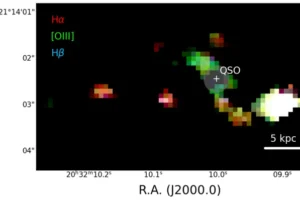
Here's a clearer version of the image caption: Colored map of the PJ308-21 system showing gas emissions: - Hydrogen: Red and blue - Oxygen: Green The central quasar's light has been masked out. Color variations in the quasar's host galaxy and its companions indicate different gas properties in each region.

Webb Space Telescope captures staggering quasar-galaxy merger in remote universe

T Corona Borealis (TCrB)

A nova is coming: learn more about this stellar explosion

A black hole and spiral wind

Cosmic Growth Spurt: Supermassive Black Hole Mimics Star Formation

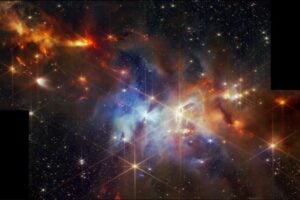
NASA's Webb telescope captures a stunning image of the Serpens Nebula, revealing a cluster of baby stars in the top left corner. These stars are still forming and shooting out powerful jets of gas in a surprising, aligned pattern. Unlike some nebulae, Serpens doesn't create its own light. Instead, it glows by reflecting light from nearby stars.

Webb Telescope Sees “Baby Stars” Blasting Jets in Perfect Alignment

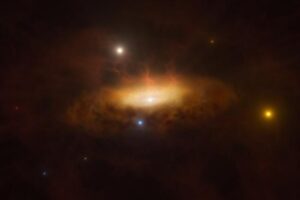
A galaxy suddenly became much brighter in late 2019. This reveals a giant black hole at its center that's woken up and started feeding on surrounding gas, making the whole galaxy light up. This is the first time scientists have observed this awakening happen.

Astronomers Witness a Massive Black Hole Awakening in Real-Time for the First Time

This illustration depicts two quasars in the process of merging. Using both the Gemini North telescope, one half of the International Gemini Observatory, which is supported in part by the U.S. National Science Foundation and operated by NSF NOIRLab, and the Subaru Telescope, a team of astronomers have discovered a pair of merging quasars seen only 900 million years after the Big Bang. Not only is this the most distant pair of merging quasars ever found, but also the first confirmed pair found in the period of the Universe known as Cosmic Dawn.

Astronomers Discover Earliest Known Pair of Merging Quasars, Shedding Light on Cosmic Dawn

Juliette Becker

Watery planets orbiting dead stars may be good candidates for studying life — if they can survive long enough

An international team of astronomers has utilized NASA's James Webb Space Telescope to investigate the disk of gas and dust surrounding a young, low-mass star called ISO-ChaI 147. Their findings, depicted in this artist's impression, show the most diverse and abundant collection of carbon-containing molecules ever observed in a planet-forming disk around a star.

Webb finds plethora of carbon molecules around young star

Artist’s depiction of CSIRO’s ASKAP radio telescope with two versions of the mysterious celestial object: neutron star or white dwarf

Astronomers Discover Slowest Spinning Neutron Star, Defying Expectations

Composite colour image of the interacting galaxy cluster El Gordo, showing X-ray light from NASA's Chandra X-ray Observatory in blue, optical data from the European Southern Observatory's Very Large Telescope in red, green, and blue, and infrared emission from NASA's Spitzer Space Telescope in red and orange.

Study Suggests Dark Matter May Be Self-Interacting in Massive Galaxy Cluster Collisions

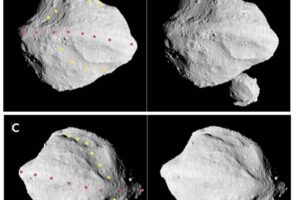
Panels a, b, and c each show stereographic image pairs of the asteroid Dinkinesh taken by the NASA Lucy Spacecraft’s L’LORRI Instrument in the minutes around closest approach on Nov. 1, 2023. The yellow and rose dots indicate the trough and ridge features, respectively. These images have been sharpened and processed to enhance contrast. Panel d shows a side view of Dinkinesh and its satellite Selam taken a few minutes after closest approach. Credit: NASA/SwRI/Johns Hopkins APL/NOIRLab.

Lucy Spacecraft Discovers Unexpected Contact Binary Orbiting Asteroid Dinkinesh

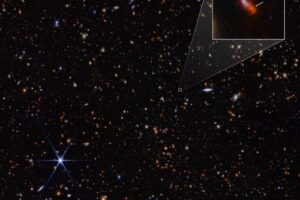
infrared image from NASA’s James Webb Space Telescope (JWST)

Astronomers Uncover Surprisingly Massive Galaxy from the Dawn of the Universe

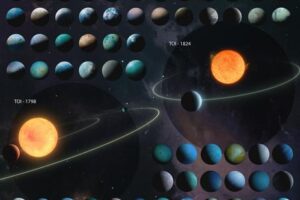
Artist conception of 126 planets in the latest TESS-Keck Survey catalog is based on data including planet radius, mass, density, and temperature. Question marks represent planets requiring more data for full characterization.

NASA’s TESS-Keck Survey Unveils 126 Diverse Worlds, Offering Insights into Planet Formation, Habitability

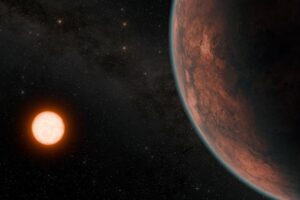
gliese 12 b

Astronomers Discover Potentially Habitable Earth-like Exoplanet Just 40 Light-Years Away

Older posts
Newer posts
← Previous Page1 Page2 Page3 Page4 … Page12 Next →
Substack subscription form sign up

Comments

  • Kidreadytobreed on Global warming reduces available wind energy
  • James on Global warming reduces available wind energy
  • James on Global warming reduces available wind energy
  • Booklet AI on Key to online education: Test early and often
  • Karoly Mirnics on Common Prescription Drugs May Disrupt Cholesterol Pathways in the Womb and Raise Autism Risk
© 2026 ScienceBlog.com | Follow our RSS / XML feed