Skip to content
ScienceBlog.com
  • Featured Blogs
    • EU Horizon Blog
    • ESA Tracker
    • Experimental Frontiers
    • Josh Mitteldorf’s Aging Matters
    • Dr. Lu Zhang’s Gondwanaland
    • NeuroEdge
    • NIAAA
    • SciChi
    • The Poetry of Science
    • Wild Science
  • Topics
    • Brain & Behavior
    • Earth, Energy & Environment
    • Health
    • Life & Non-humans
    • Physics & Mathematics
    • Social Sciences
    • Space
    • Technology
  • Our Substack
  • Follow Us!
    • Bluesky
    • Threads
    • FaceBook
    • Google News
    • Twitter/X
  • Contribute/Contact

bacteria

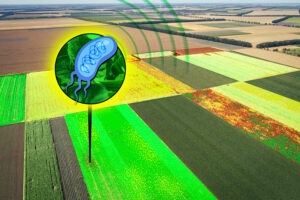
MIT engineers engineered bacteria to produce hyperspectral signals that can be detected as far as 90 meters away. Their work could lead to the development of bacterial sensors for agricultural to monitor crop health, for example. Credits:Image: Jose-Luis Olivares, MIT; iStock

Engineered bacteria emit signals that can be spotted from a distance

woman on her cell phone

Keeping your phone clean can help prevent you from getting sick

The team analyzed genetic material from microbes in a one-of-a-kind archive of water samples collected over 20 years from Lake Mendota in Wisconsin.

Lake Bacteria Reveal a Stunning Seasonal Evolution Loop That Defies Expectations

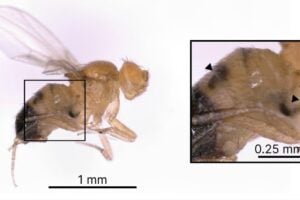
Fruit flies are typically vulnerable to parasitic wasps, but some have acquired a bacterial gene that grants them resistance. This adult Drosophila melanogaster has two dark, melanin-coated cysts in its abdomen, marking the remains of wasp eggs that the fly successfully neutralized.

Fruit Flies Steal Bacterial Genes to Fight Off Parasitic Wasps

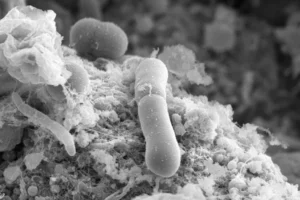
Scanning Electron Microscopy image of C. difficile in the gut of an infected animal - The University of Sheffield

The Looming Crisis of Antibiotic Resistance

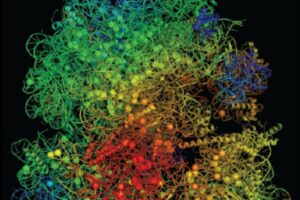
A model structure of a ribosome noted with color-coded flexibility indicators; red highlights ribosome regions that become more flexible, while blue depicts more rigid areas.

Scientists Discover ‘Achilles Heel’ of Antibiotic-Resistant Bacteria in Magnesium Battle

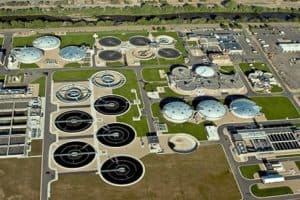
Wastewater treatment facility

Materials of the future can be extracted from wastewater

Comamonas bacteria live in wastewater, where they break down plastic waste for food.

Wastewater bacteria can breakdown plastic for food

Professor Simon Heilbronner is head of the new study. | © LMU / LCProductions

Nasal microbiome: depriving multi-resistant bugs of iron

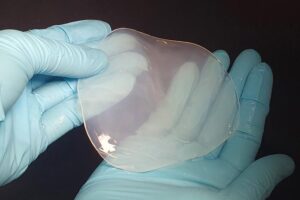
Bacterial cellulose in the wet state.

How researchers turn bacteria into cellulose-producing mini-factories

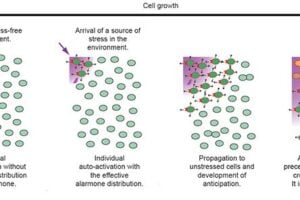
A (light green) bacterial cell detects a source of stress and becomes activated (dark green). It then produces alarmones (depicted as red triangles) and can transmit them to neighboring cells via cell-to-cell contact (black arrows). As the source of stress arrives, the percentage of activated cells increases, converting unstressed neighboring cells and triggering the stress response mechanism.

Bacteria’s Secret ‘Alarm System’ Against Antibiotics Uncovered

Professor Elena Martín-García

Gut Bacteria Linked to Food Addiction: New Hope for Obesity Treatment

Illustration of mouthwash bottle

Listerine disrupts the balance of your oral microbiome, scientists say

Ohio State logo

Study details a common bacterial defense against viral infection

Older posts
Page1 Page2 Next →
Substack subscription form sign up

Comments

  • Karoly Mirnics on Common Prescription Drugs May Disrupt Cholesterol Pathways in the Womb and Raise Autism Risk
  • Aizen on Laziness helped lead to extinction of Homo erectus
  • Norwood johnson on Electrons in New Crystals Behave as If They Live in Four Dimensions
  • ScienceBlog.com on Hidden Geometry Could Finally Fix Quantum Computers
  • Theo Prinse on America Is Going Back to the Moon. This Time, It Plans to Stay
© 2026 ScienceBlog.com | Follow our RSS / XML feed