Skip to content
ScienceBlog.com
  • Featured Blogs
    • EU Horizon Blog
    • ESA Tracker
    • Experimental Frontiers
    • Josh Mitteldorf’s Aging Matters
    • Dr. Lu Zhang’s Gondwanaland
    • NeuroEdge
    • NIAAA
    • SciChi
    • The Poetry of Science
    • Wild Science
  • Topics
    • Brain & Behavior
    • Earth, Energy & Environment
    • Health
    • Life & Non-humans
    • Physics & Mathematics
    • Social Sciences
    • Space
    • Technology
  • Our Substack
  • Follow Us!
    • Bluesky
    • Threads
    • FaceBook
    • Google News
    • Twitter/X
  • Contribute/Contact

brain activity

A brain scan of a neurofibromatosis type 1 (NF1) patient reveals a tumor on the optic nerve connecting the left eye to the brain (right side of the image). Researchers at Washington University School of Medicine in St. Louis have discovered that an FDA-approved epilepsy drug can prevent or slow the growth of NF1-linked optic gliomas in mice, laying the groundwork for a clinical trial.

Brain Scans Outperform Behavior in Predicting What Markets Really Want

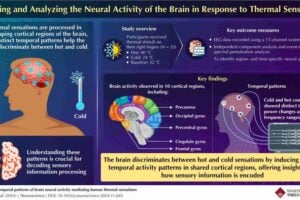
The brain discriminates between hot and cold sensations by inducing distinct temporal activity patterns in shared cortical regions, offering insights into how sensory information is encoded.

Your Brain’s Secret Code for Hot and Cold Finally Cracked

human brain illustration

Scientists ‘Write’ New Learning Patterns Directly into the Human Brain

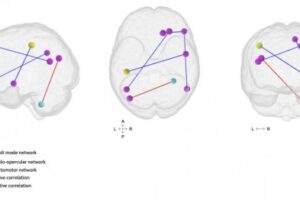
Restless sleep correlates with lower connectivity between the default mode network nodes, and default mode network and somatomotor network nodes. The default mode network is a group of brain regions that are active when we are at rest, not focusing on any specific task. The somatomotor network involves brain regions that are responsible for controlling movement and processing sensations from the body, such as touch and physical feedback.

Long-Term Brain Study Reveals Lasting Effects of Daily Activities on Cognition

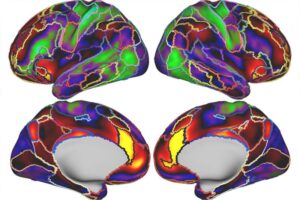
The image displays four views of a person's brain, highlighting the boundaries between different functional brain networks, each represented by different colored lines, as mapped using functional MRI. This map is overlaid on a salience network connectivity heat map, where warmer colors indicate stronger connectivity within the salience network. Researchers discovered that a larger salience network may be associated with an increased risk of depression. Credit: Lynch/Liston Labs.

Brain Scans Reveal Neuronal ‘Wiring’ Linked to Depression Risk

Brain and clock hybrid illustration

Study Unravels How Our Brains Track Time

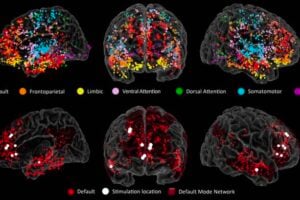
Electrodes at multiple brain regions reveal brain activity in real time. Colored dots show the locations of all of the electrodes across all patients, color-coded by brain region. Red dots in the lower images show the locations of the electrodes in the DMN.

Study pinpoints origins of creativity in the brain

Sad looking girl held by a man, likely her father

Run screaming or slow retreat? New study advances understanding of brain responses to emotionally-charged scenes

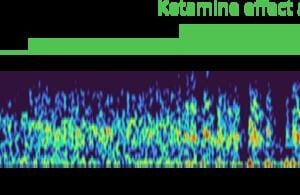
A spectrogram of brain rhythm frequencies over time predicted by the team's model. After a first, moderate dose of ketamine gamma brain rhythm power (warmer colors) emerges. Then as the dose increases, the gamma rhythms become periodically interrupted, leaving only very low freqeuncy waves, and then resume.

Computational Model Unveils the Inner Workings of Ketamine

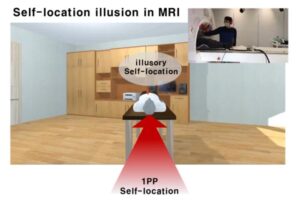
Controlled induction of self-location illusion through multisensory VR in the MRI scanner.

Multisensory Stimulation Induces Self-Location Illusions in the MRI Scanner

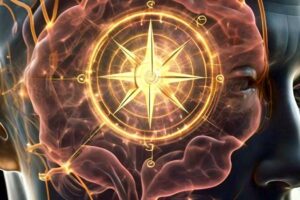
a human head with a transparent brain, revealing a glowing compass-like structure within the hippocampus and surrounding regions.

Scientists Discover Internal Neural Compass in the Human Brain

Middle aged man exercising

Physical activity reduces stress-related brain activity to lower cardiovascular disease risk

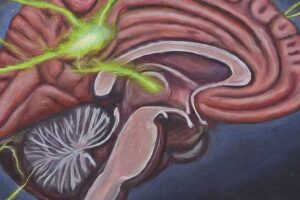
an illustration depicting a stylized cross-section of the human brain, highlighting the hippocampus region.

Brain’s Tagging System Determines Which Memories Become Permanent

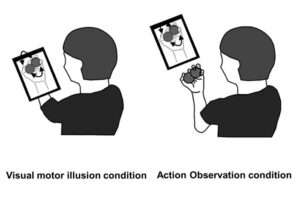
Volunteers were asked to try to rotate two balls around each other on their hands under two different learning conditions.

Power of illusion can help with learning new movements

Older posts
Page1 Page2 Page3 Next →
Substack subscription form sign up

Comments

  • Norwood johnson on Electrons in New Crystals Behave as If They Live in Four Dimensions
  • ScienceBlog.com on Hidden Geometry Could Finally Fix Quantum Computers
  • Theo Prinse on America Is Going Back to the Moon. This Time, It Plans to Stay
  • george w on Hidden Geometry Could Finally Fix Quantum Computers
  • Tom Hughes on Years of Exercise, Blood Pressure Drugs Failed to Slow Cognitive Decline in Seniors at Dementia Risk
© 2026 ScienceBlog.com | Follow our RSS / XML feed