Skip to content
ScienceBlog.com
  • Featured Blogs
    • EU Horizon Blog
    • ESA Tracker
    • Experimental Frontiers
    • Josh Mitteldorf’s Aging Matters
    • Dr. Lu Zhang’s Gondwanaland
    • NeuroEdge
    • NIAAA
    • SciChi
    • The Poetry of Science
    • Wild Science
  • Topics
    • Brain & Behavior
    • Earth, Energy & Environment
    • Health
    • Life & Non-humans
    • Physics & Mathematics
    • Social Sciences
    • Space
    • Technology
  • Our Substack
  • Follow Us!
    • Bluesky
    • Threads
    • FaceBook
    • Google News
    • Twitter/X
  • Contribute/Contact

brain processing

Shot of a young businessman using a smartphone in a modern office

Your Brain Decodes Hidden Messages in Speech Melody

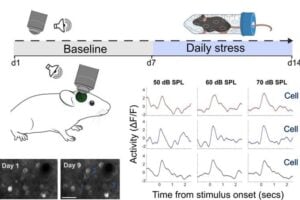
Physiological and behavioral evidence of stress. Left: Schematics of two-photon imaging during baseline and repetitive stress conditions. In repetitive stress sessions, the mice were placed in a 50 ml tube for 30 min to achieve mild stress. The imaging session started directly after the restraint. Individual cells were tracked over imaging days. Shown are examples of 2 imaging planes on day 1 and day 9 (scale bar, 50 μm) and the noise-evoked responses of 3 exemplar cells (mean ± SE).

“I can’t hear you, I’m too stressed”

Microscopic view of cells in the inferior colliculus region of the brain

How Deaf Musicians Can ‘Hear’ Through Touch

visual clutter illustration (Illustration by Michael S. Helfenbein)

Visual Clutter Disrupts Brain’s Information Processing, Yale Study Reveals

AI brain illustration

Evolution wired human brains to act like supercomputers

A recent study shows that every lonely person processes the world in their own, idiosyncratic way. (Image Source: iStock.)

Brain scans reveal that lonely people process the world in unique ways

Artificial neural networks are computing systems inspired by biological neural networks that constitute animal brains. Like biological models, they can learn (be trained) by processing examples and forming probability associations, then apply that information to other tasks.

Artificial neural networks need sleep too

Substack subscription form sign up

Comments

  • Norwood johnson on Electrons in New Crystals Behave as If They Live in Four Dimensions
  • ScienceBlog.com on Hidden Geometry Could Finally Fix Quantum Computers
  • Theo Prinse on America Is Going Back to the Moon. This Time, It Plans to Stay
  • george w on Hidden Geometry Could Finally Fix Quantum Computers
  • Tom Hughes on Years of Exercise, Blood Pressure Drugs Failed to Slow Cognitive Decline in Seniors at Dementia Risk
© 2026 ScienceBlog.com | Follow our RSS / XML feed