Skip to content
ScienceBlog.com
  • Featured Blogs
    • EU Horizon Blog
    • ESA Tracker
    • Experimental Frontiers
    • Josh Mitteldorf’s Aging Matters
    • Dr. Lu Zhang’s Gondwanaland
    • NeuroEdge
    • NIAAA
    • SciChi
    • The Poetry of Science
    • Wild Science
  • Topics
    • Brain & Behavior
    • Earth, Energy & Environment
    • Health
    • Life & Non-humans
    • Physics & Mathematics
    • Social Sciences
    • Space
    • Technology
  • Our Substack
  • Follow Us!
    • Bluesky
    • Threads
    • FaceBook
    • Google News
    • Twitter/X
  • Contribute/Contact

Cosmology

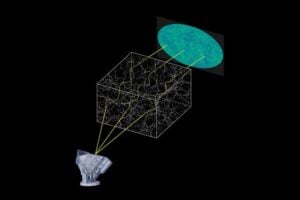
The cosmic microwave background — the universe’s oldest light — has traversed vast distances before reaching us. During its extended journey, gravitational forces from massive cosmic structures caused its trajectory to bend before being captured by the South Pole Telescope.

Results from South Pole Telescope’s new camera emerge

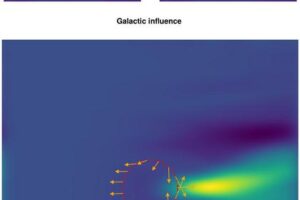
Dynamical friction. The panels depict sparse areas of the universe with dark colour and dense areas with light colour. The upper panels show the density around a galaxy if the galaxy's gravity bends (left) or does not bend (right) the trajectories of dark matter particles. The lower panel shows the difference between them, or how the galaxy affects the distribution of dark matter. The arrows represent the acceleration caused by the overdensity behind the galaxy, from which the friction on the centre of the galaxy is deducted. Since the arrows have different directions and strengths in different areas, the tidal forces are able to change the shape of a galaxy.

Lopsided galaxies shed light on the speed of dark matter

Wormhole illustration

Astrophysicists say they’ve proven passable wormholes possible

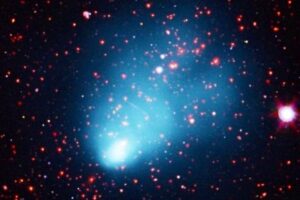
Composite colour image of the interacting galaxy cluster El Gordo, showing X-ray light from NASA's Chandra X-ray Observatory in blue, optical data from the European Southern Observatory's Very Large Telescope in red, green, and blue, and infrared emission from NASA's Spitzer Space Telescope in red and orange.

Titanic galaxy cluster collision in the early Universe challenges standard cosmology

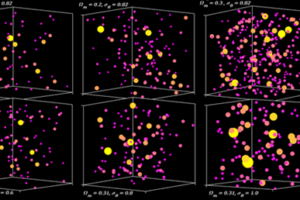
Like Goldilocks, the team compared the number of galaxy clusters measured with predictions from numerical simulations to determine which answer was “just right.”

Matter comprises of 31% of the total amount of stuff in the universe

All together now…

The red region (left) shows the shell enclosed by the Baryon Acoustic Oscillation, with individual galaxies depicted as luminous tiny specks. The blue filaments show the greater Cosmic Web, with previously known features like Laniākea highlighted.

Vast bubble of galaxies discovered, given Hawaiian name

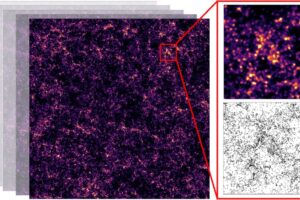
A line intensity image appears smeared compared to traditional galaxy survey images. (Patrick Breysse)

The universe’s missing teenage pictures

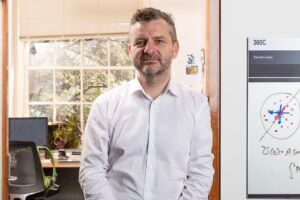
Professor Geraint Lewis in the Sydney Institute for Astronomy in the School of Physics at the University of Sydney.

Quasar ‘clocks’ show Universe was five times slower soon after the Big Bang

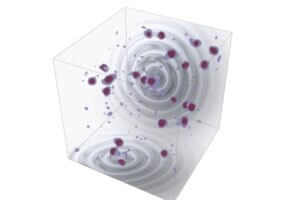
Schematic of the inflaton field fragmented into oscillons, with superimposed gravitational waves. (Credit: Kavli IPMU, Volodymyr Takhistov)

Scientists Uncover Universe’s Hidden Waves from Ancient Times

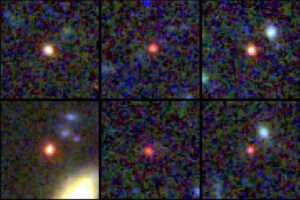
Images of six candidate massive galaxies, seen 500-800 million years after the Big Bang. Image credit: NASA/ESA/CSA/I. Labbe

Webb images challenge theories of how universe evolved

galaxy clusters

Galaxy clusters yield new evidence for standard model of cosmology

Many chemical elements are formed during a supernova explosion, so studying them can give scientists insight into the universe's chemical make-up.

Galactic explosion offers astrophysicists new insight into the cosmos

Halton Arp: Looking at the sky with an open mind

Older posts
Newer posts
← Previous Page1 Page2 Page3 Next →
Substack subscription form sign up

Comments

  • Karoly Mirnics on Common Prescription Drugs May Disrupt Cholesterol Pathways in the Womb and Raise Autism Risk
  • Aizen on Laziness helped lead to extinction of Homo erectus
  • Norwood johnson on Electrons in New Crystals Behave as If They Live in Four Dimensions
  • ScienceBlog.com on Hidden Geometry Could Finally Fix Quantum Computers
  • Theo Prinse on America Is Going Back to the Moon. This Time, It Plans to Stay
© 2026 ScienceBlog.com | Follow our RSS / XML feed