Skip to content
ScienceBlog.com
  • Featured Blogs
    • EU Horizon Blog
    • ESA Tracker
    • Experimental Frontiers
    • Josh Mitteldorf’s Aging Matters
    • Dr. Lu Zhang’s Gondwanaland
    • NeuroEdge
    • NIAAA
    • SciChi
    • The Poetry of Science
    • Wild Science
  • Topics
    • Brain & Behavior
    • Earth, Energy & Environment
    • Health
    • Life & Non-humans
    • Physics & Mathematics
    • Social Sciences
    • Space
    • Technology
  • Our Substack
  • Follow Us!
    • Bluesky
    • Threads
    • FaceBook
    • Google News
    • Twitter/X
  • Contribute/Contact

Dark Matter

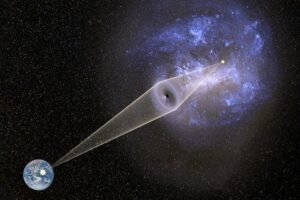
Artist's impression of a microlensing event caused by a black hole observed from Earth toward the Large Magellanic Cloud. The light of a background star located in the LMC is bent by a putative primordial black hole (lens) in the Galactic halo and magnified when observed from the Earth. Microlensing causes very characteristic variation of brightness of the background star, enabling the determination of the lens's mass and distance. Credit: J. Skowron / OGLE. Background image of the Large Magellanic Cloud: generated with bsrender written by Kevin Loch, using the ESA/Gaia database

Is dark matter made of black holes?

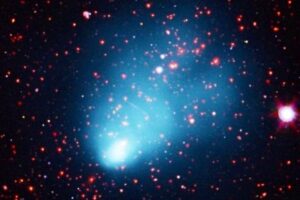
Composite colour image of the interacting galaxy cluster El Gordo, showing X-ray light from NASA's Chandra X-ray Observatory in blue, optical data from the European Southern Observatory's Very Large Telescope in red, green, and blue, and infrared emission from NASA's Spitzer Space Telescope in red and orange.

Study Suggests Dark Matter May Be Self-Interacting in Massive Galaxy Cluster Collisions

[Image: A computer-generated visualization of a galaxy, with visible matter represented in bright colors and dark matter represented as a translucent halo surrounding the galaxy, accompanied by a graph showing the relationship between visible and dark matter in the simulations.]

Astronomers’ Simulations Bolster Case for Dark Matter’s Existence

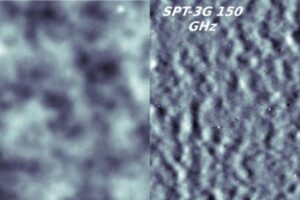
Comparison between CMB data resolution collected by Planck and SPT-3G

Cosmologists Grapple with Growing Tension in Understanding Universe’s Expansion

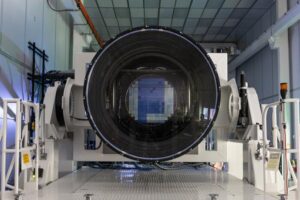
A front view of the completed LSST Camera, showing the 3,200-megapixel focal plane within.

SLAC completes construction of the largest digital camera ever built for astronomy

The cosmic microwave background — the universe’s oldest light — has traversed vast distances before reaching us. During its extended journey, gravitational forces from massive cosmic structures caused its trajectory to bend before being captured by the South Pole Telescope.

Results from South Pole Telescope’s new camera emerge

galaxy seen from the side

Stars travel more slowly at Milky Way’s edge

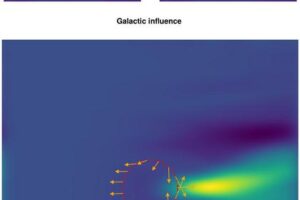
Dynamical friction. The panels depict sparse areas of the universe with dark colour and dense areas with light colour. The upper panels show the density around a galaxy if the galaxy's gravity bends (left) or does not bend (right) the trajectories of dark matter particles. The lower panel shows the difference between them, or how the galaxy affects the distribution of dark matter. The arrows represent the acceleration caused by the overdensity behind the galaxy, from which the friction on the centre of the galaxy is deducted. Since the arrows have different directions and strengths in different areas, the tidal forces are able to change the shape of a galaxy.

Lopsided galaxies shed light on the speed of dark matter

Top space telescope from Europe seeks to solve riddles of the universe

Composite colour image of the interacting galaxy cluster El Gordo, showing X-ray light from NASA's Chandra X-ray Observatory in blue, optical data from the European Southern Observatory's Very Large Telescope in red, green, and blue, and infrared emission from NASA's Spitzer Space Telescope in red and orange.

Titanic galaxy cluster collision in the early Universe challenges standard cosmology

Like Goldilocks, the team compared the number of galaxy clusters measured with predictions from numerical simulations to determine which answer was “just right.”

Matter comprises of 31% of the total amount of stuff in the universe

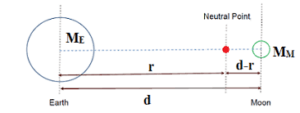
An adjustment to Newton’s gravity?

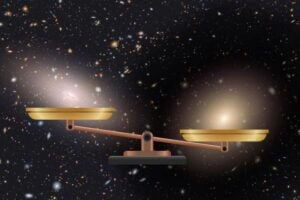
Comparison between a conventional galaxy (ESO 325-G004) enveloped in a halo of dark matter, occupying the heaviest plate on the weight scale, and the galaxy NGC 1277 (on the left), in which the study of the mass distribution reveals the absence of dark matter.

The puzzle of the galaxy with no dark matter

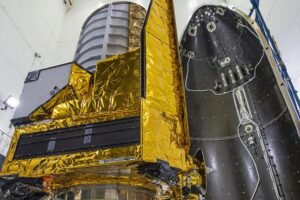
Last glimpse of Euclid on Earth Credit: ESA

Mission to map the dark Universe sets off on space journey

Older posts
Newer posts
← Previous Page1 Page2 Page3 Next →
Substack subscription form sign up

Comments

  • Sue Ann Hayes on Hidden Nuclear Protein Fuels Pancreatic Cancer’s Deadly Aggression
  • Curtis Webber on The GPS-Killer? This Quantum Device ‘Feels’ Motion Like a Brain—Down to the Atomic Level
  • Ran on How the Age You First Had Sex Could Shape How You Age Decades Later
  • Sparty on How the Age You First Had Sex Could Shape How You Age Decades Later
  • Josh Mitteldorf on A Single TV Segment Sent Leucovorin Prescriptions for Autistic Children Soaring 2,000 Percent
© 2026 ScienceBlog.com | Follow our RSS / XML feed