Skip to content
ScienceBlog.com
  • Featured Blogs
    • EU Horizon Blog
    • ESA Tracker
    • Experimental Frontiers
    • Josh Mitteldorf’s Aging Matters
    • Dr. Lu Zhang’s Gondwanaland
    • NeuroEdge
    • NIAAA
    • SciChi
    • The Poetry of Science
    • Wild Science
  • Topics
    • Brain & Behavior
    • Earth, Energy & Environment
    • Health
    • Life & Non-humans
    • Physics & Mathematics
    • Social Sciences
    • Space
    • Technology
  • Our Substack
  • Follow Us!
    • Bluesky
    • Threads
    • FaceBook
    • Google News
    • Twitter/X
  • Contribute/Contact

Dark Matter

Einstein illustration

Testing Universe’s Mysteries: Are Einstein and Euler’s Equations Up to the Task?

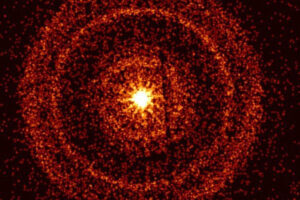
The afterglow of the Brightest of All Time gamma-ray burst, captured by the Neil Gehrels Swift Observatory’s X-Ray Telescope. Credit: NASA/Swift/A. Beardmore (University of Leicester)

Unprecedented Cosmic Blast Stuns Scientists with Unusual Brilliance and Enigmatic Afterglow

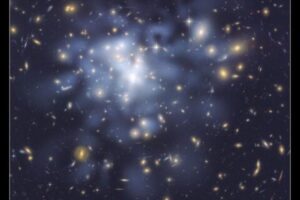
This NASA Hubble Space Telescope image shows the distribution of dark matter in the center of the giant galaxy cluster Abell 1689, containing about 1,000 galaxies and trillions of stars. Dark matter is an invisible form of matter that accounts for most of the universe’s mass. Hubble cannot see the dark matter directly. Astronomers inferred its location by analyzing the effect of gravitational lensing, where light from galaxies behind Abell 1689 is distorted by intervening matter within the cluster. Researchers used the observed positions of 135 lensed images of 42 background galaxies to calculate the location and amount of dark matter in the cluster. They superimposed a map of these inferred dark matter concentrations, tinted blue, on an image of the cluster taken by Hubble’s Advanced Camera for Surveys. If the cluster’s gravity came only from the visible galaxies, the lensing distortions would be much weaker. The map reveals that the densest concentration of dark matter is in the cluster’s core. Abell 1689 resides 2.2 billion light-years from Earth. The image was taken in June 2002. Image credit: NASA, ESA, D. Coe (NASA Jet Propulsion Laboratory/California Institute of Technology, and Space Telescope Science Institute), N. Benitez (Institute of Astrophysics of Andalusia, Spain), T. Broadhurst (University of the Basque Country, Spain), and H. Ford (Johns Hopkins University)

A new model for dark matter

Halton Arp: Looking at the sky with an open mind

Is the Universe Symmetric?

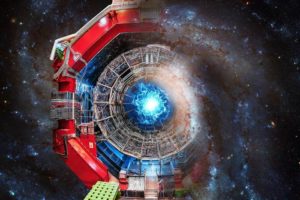
Illustration of antihelium annihilation in the ALICE detector at CERN as well as in the universe.

Anti-helium nuclei carry messages from the depths of the galaxy

Illustration of a clock floating in blue background

Clocks to detect dark matter in space

Newer posts
← Previous Page1 Page2 Page3
Substack subscription form sign up

Comments

  • Karoly Mirnics on Common Prescription Drugs May Disrupt Cholesterol Pathways in the Womb and Raise Autism Risk
  • Aizen on Laziness helped lead to extinction of Homo erectus
  • Norwood johnson on Electrons in New Crystals Behave as If They Live in Four Dimensions
  • ScienceBlog.com on Hidden Geometry Could Finally Fix Quantum Computers
  • Theo Prinse on America Is Going Back to the Moon. This Time, It Plans to Stay
© 2026 ScienceBlog.com | Follow our RSS / XML feed