Skip to content
ScienceBlog.com
  • Featured Blogs
    • EU Horizon Blog
    • ESA Tracker
    • Experimental Frontiers
    • Josh Mitteldorf’s Aging Matters
    • Dr. Lu Zhang’s Gondwanaland
    • NeuroEdge
    • NIAAA
    • SciChi
    • The Poetry of Science
    • Wild Science
  • Topics
    • Brain & Behavior
    • Earth, Energy & Environment
    • Health
    • Life & Non-humans
    • Physics & Mathematics
    • Social Sciences
    • Space
    • Technology
  • Our Substack
  • Follow Us!
    • Bluesky
    • Threads
    • FaceBook
    • Google News
    • Twitter/X
  • Contribute/Contact

diagnostics

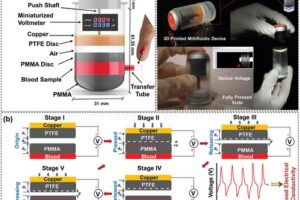
Vision of the proposed research for developing a self-powered, millifluidic lab-on-a-chip device to determine blood conductivity. a) Schematics and dimensions of the proposed device. The blood layer, copper electrodes, PTFE disc, and PMMA elements form a contact-separation mode TENG system. The blood sample is sandwiched between two PMMA layers and serves as one of the conductive layers. Any change in its electrical conductivity would theoretically change the voltage signal generated by the device. b) Operating principle of this blood-based TENG device. c) The 3D printed device and the type of voltage signal generated by it.

Novel blood-powered chip offers real-time health monitoring

Brain disorders trigger search for new clues and cures

Eye with tears

COVID-19 virus can be detected in tears

Substack subscription form sign up

Comments

  • Curtis Webber on The GPS-Killer? This Quantum Device ‘Feels’ Motion Like a Brain—Down to the Atomic Level
  • Ran on How the Age You First Had Sex Could Shape How You Age Decades Later
  • Sparty on How the Age You First Had Sex Could Shape How You Age Decades Later
  • Josh Mitteldorf on A Single TV Segment Sent Leucovorin Prescriptions for Autistic Children Soaring 2,000 Percent
  • Josh Mitteldorf on A Single TV Segment Sent Leucovorin Prescriptions for Autistic Children Soaring 2,000 Percent
© 2026 ScienceBlog.com | Follow our RSS / XML feed