Skip to content
ScienceBlog.com
  • Featured Blogs
    • EU Horizon Blog
    • ESA Tracker
    • Experimental Frontiers
    • Josh Mitteldorf’s Aging Matters
    • Dr. Lu Zhang’s Gondwanaland
    • NeuroEdge
    • NIAAA
    • SciChi
    • The Poetry of Science
    • Wild Science
  • Topics
    • Brain & Behavior
    • Earth, Energy & Environment
    • Health
    • Life & Non-humans
    • Physics & Mathematics
    • Social Sciences
    • Space
    • Technology
  • Our Substack
  • Follow Us!
    • Bluesky
    • Threads
    • FaceBook
    • Google News
    • Twitter/X
  • Contribute/Contact

early Universe

Three spectra taken by the JWST/NIRSpec superimposed on an image taken by the JWST/NIRCam, two instruments on board the James Webb Space Telescope. The record galaxy is shown in the middle. It appears in red in the image and its spectrum decreases towards the left (short wavelengths). For comparison, the spectra at the top and bottom, in blue and violet, show typical star-forming galaxies at a similar time in cosmic history.

Galaxies die earlier than expected

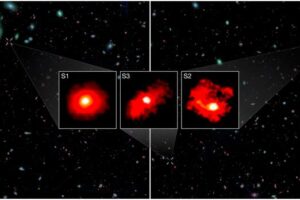
The three Red Monsters represent the core findings of this work – these extremely massive and dusty galaxies in the first billion years after the Big Bang indicate that the early Universe is forming stars more efficiently than expected. Image taken by the James Webb Space Telescope.

Three Massive Ancient Galaxies Defy Laws of Star Formation

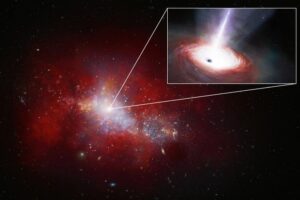
Artist’s Impression of Fastest-feeding Black Hole in the Early Universe

Astronomers Discover Unprecedented ‘Feasting’ Black Hole in Early Universe

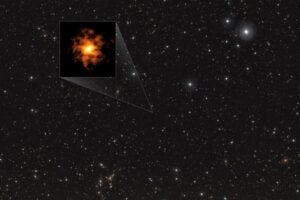
This image shows the galaxy REBELS-25 as seen by the Atacama Large Millimeter/submillimeter Array (ALMA), overlaid on an infrared image of other stars and galaxies. The infrared image was taken by ESO’s Visible and Infrared Survey Telescope for Astronomy (VISTA). In a recent study, researchers found evidence that REBELS-25 is a strongly rotating disc galaxy existing only 700 million years after the Big Bang. This makes it the most distant and earliest known Milky Way-like galaxy found to date.

Rebel Star: Ancient Galaxy Defies Time, Dances Like the Milky Way

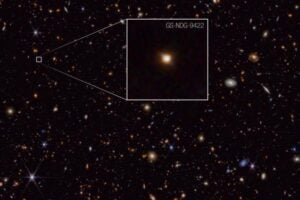
This image of galaxy GS-NDG-9422, captured by the James Webb Space Telescope's NIRCam (Near-Infrared Camera) instrument, is presented with compass arrows, scale bar, and colour key for reference.

Webb Telescope Unveils Unprecedented ‘Weird’ Galaxy from Early Universe

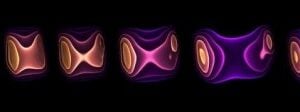
A snapshot of a computer simulation showing how energy density changes over time in the collision of a lead ion with a photon emitted by another lead ion.

Photon Collisions at LHC May Produce Miniature Drops of Primordial Universe Fluid

Artist’s depiction of the spray of particles arising from the collision of two heavy atoms. As the hot subatomic soup cools, newly formed particles shower off into space.

Discovery Sheds Light on the Origins of Matter in the Early Universe

The Cosmic Gems arc as observed by the JWST. Credit: ESA/Webb, NASA & CSA, L. Bradley (STScI), A. Adamo (Stockholm University) and the Cosmic Spring collaboration.

Star clusters observed within a galaxy in the early Universe for the first time

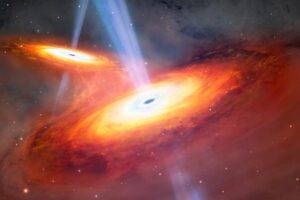
This illustration depicts two quasars in the process of merging. Using both the Gemini North telescope, one half of the International Gemini Observatory, which is supported in part by the U.S. National Science Foundation and operated by NSF NOIRLab, and the Subaru Telescope, a team of astronomers have discovered a pair of merging quasars seen only 900 million years after the Big Bang. Not only is this the most distant pair of merging quasars ever found, but also the first confirmed pair found in the period of the Universe known as Cosmic Dawn.

Astronomers Discover Earliest Known Pair of Merging Quasars, Shedding Light on Cosmic Dawn

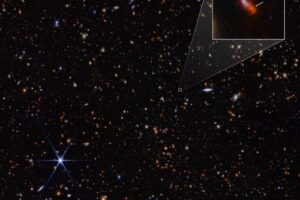
infrared image from NASA’s James Webb Space Telescope (JWST)

Astronomers Uncover Surprisingly Massive Galaxy from the Dawn of the Universe

Sample shapes of distant galaxies identified by the James Webb Space Telescope’s Cosmic Evolution Early Release Science (CEERS) survey. [(Credit: NASA, ESA, CSA, STScI, Steve Finkelstein (UT Austin), Micaela Bagley (UT Austin), Rebecca Larson (UT Austin)]

Most early galaxies looked like breadsticks rather than pizza pies or dough balls

Color composite of galaxy AzTECC71 from multiple color filters in the NIRCam instrument on the James Webb Space Telescope. Credit: J. McKinney/M. Franco/C. Casey/University of Texas at Austin.

Ghostlike dusty galaxy reappears in James Webb Space Telescope image

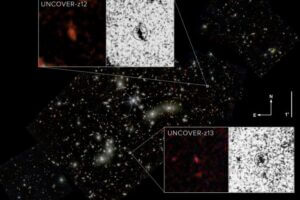
The second- and fourth-most distant galaxies ever seen (UNCOVER z-13 and UNCOVER z-12) have been confirmed using the James Webb Space Telescope’s Near-Infrared Camera (NIRCam). The galaxies are located in Pandora’s Cluster (Abell 2744), show here as near-infrared wavelengths of light that have been translated to visible-light colors. The scale of the main cluster image is labelled in arcseconds, which is a measure of angular distance in the sky. The circles on the black-and-white images, showing the galaxies in the NIRCam-F277W filter band onboard JWST, indicate an aperture size of 0.32 arcsec.

Second-most distant galaxy discovered using James Webb Space Telescope

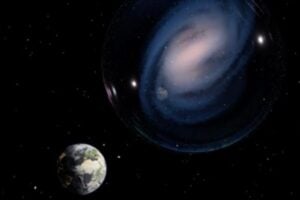
Artistic representation of the spiral barred galaxy ceers-2112, observed in the early universe. The Earth is reflected on an illusive bubble surrounding the galaxy, recalling the connection between the Milky Way and ceers-2112.

Milky Way-like galaxy found in the early universe

Older posts
Page1 Page2 Next →
Substack subscription form sign up

Comments

  • Karoly Mirnics on Common Prescription Drugs May Disrupt Cholesterol Pathways in the Womb and Raise Autism Risk
  • Aizen on Laziness helped lead to extinction of Homo erectus
  • Norwood johnson on Electrons in New Crystals Behave as If They Live in Four Dimensions
  • ScienceBlog.com on Hidden Geometry Could Finally Fix Quantum Computers
  • Theo Prinse on America Is Going Back to the Moon. This Time, It Plans to Stay
© 2026 ScienceBlog.com | Follow our RSS / XML feed