Skip to content
ScienceBlog.com
  • Featured Blogs
    • EU Horizon Blog
    • ESA Tracker
    • Experimental Frontiers
    • Josh Mitteldorf’s Aging Matters
    • Dr. Lu Zhang’s Gondwanaland
    • NeuroEdge
    • NIAAA
    • SciChi
    • The Poetry of Science
    • Wild Science
  • Topics
    • Brain & Behavior
    • Earth, Energy & Environment
    • Health
    • Life & Non-humans
    • Physics & Mathematics
    • Social Sciences
    • Space
    • Technology
  • Our Substack
  • Follow Us!
    • Bluesky
    • Threads
    • FaceBook
    • Google News
    • Twitter/X
  • Contribute/Contact

early Universe

Spectroscopic observations reveal that Maisie’s galaxy, named after Steven Finkelstein’s daughter, was detected 390 million years after the Big Bang. That makes it one of the four earliest confirmed galaxies ever observed.

Astronomers confirm Maisie’s galaxy is among earliest ever observed

Professor Geraint Lewis in the Sydney Institute for Astronomy in the School of Physics at the University of Sydney.

Quasar ‘clocks’ show Universe was five times slower soon after the Big Bang

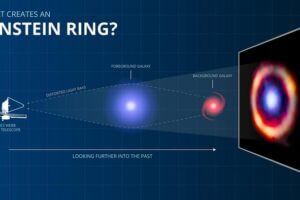
The galaxy observed by Webb shows an Einstein ring caused by a phenomenon known as lensing, which occurs when two galaxies are almost perfectly aligned from our perspective on Earth. The gravity from the galaxy in the foreground causes the light from the background galaxy to be distorted and magnified, like looking through the stem of a wine glass. Because they are magnified, lensing allows astronomers to study very distant galaxies in more detail than otherwise possible.

Webb telescope detects universe’s most distant organic molecules

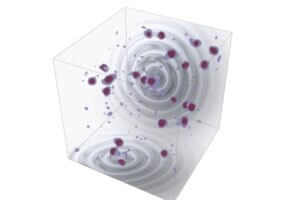
Schematic of the inflaton field fragmented into oscillons, with superimposed gravitational waves. (Credit: Kavli IPMU, Volodymyr Takhistov)

Scientists Uncover Universe’s Hidden Waves from Ancient Times

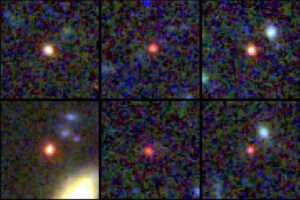
Images of six candidate massive galaxies, seen 500-800 million years after the Big Bang. Image credit: NASA/ESA/CSA/I. Labbe

Webb images challenge theories of how universe evolved

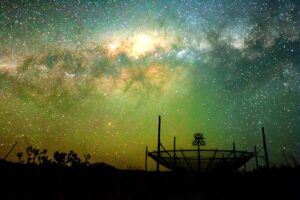
The HERA radio telescope, located in Karoo in South Africa, consists of 350 dishes pointed upward to detect radio waves from the early universe.

How different were galaxies in the early universe?

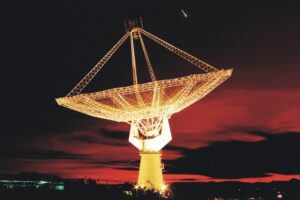
Astronomers capture radio signal from distant galaxy

Newer posts
← Previous Page1 Page2
Substack subscription form sign up

Comments

  • Karoly Mirnics on Common Prescription Drugs May Disrupt Cholesterol Pathways in the Womb and Raise Autism Risk
  • Aizen on Laziness helped lead to extinction of Homo erectus
  • Norwood johnson on Electrons in New Crystals Behave as If They Live in Four Dimensions
  • ScienceBlog.com on Hidden Geometry Could Finally Fix Quantum Computers
  • Theo Prinse on America Is Going Back to the Moon. This Time, It Plans to Stay
© 2026 ScienceBlog.com | Follow our RSS / XML feed