Skip to content
ScienceBlog.com
  • Featured Blogs
    • EU Horizon Blog
    • ESA Tracker
    • Experimental Frontiers
    • Josh Mitteldorf’s Aging Matters
    • Dr. Lu Zhang’s Gondwanaland
    • NeuroEdge
    • NIAAA
    • SciChi
    • The Poetry of Science
    • Wild Science
  • Topics
    • Brain & Behavior
    • Earth, Energy & Environment
    • Health
    • Life & Non-humans
    • Physics & Mathematics
    • Social Sciences
    • Space
    • Technology
  • Our Substack
  • Follow Us!
    • Bluesky
    • Threads
    • FaceBook
    • Google News
    • Twitter/X
  • Contribute/Contact

Evolution

Fossil – the whole specimen showing the skull (left) and skeleton (base of specimen)

Fossil discovery in storeroom cupboard shifts origin of modern lizard back 35 million years

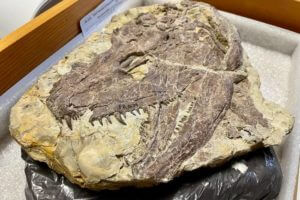
A Whatcheeria skull in the collections of the Field Museum, with its many sharp teeth visible

Ancient superpredator got big by front-loading its growth in its youth

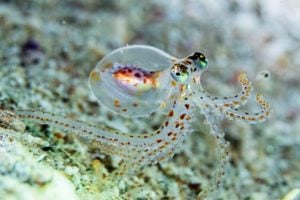
Octopuses have complex “camera” eyes, as seen here in a juvenile animal

What octopus and human brains have in common

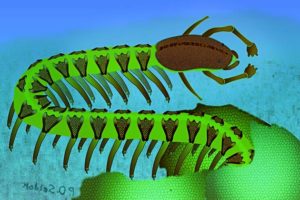
Artist's impression of an individual 525-million-year-old Cardiodictyon catenulum on the shallow coastal sea floor, emerging from the shelter of a small stromatolite built by photosynthetic bacteria.

525-million-year-old fossil defies textbook explanation for brain evolution

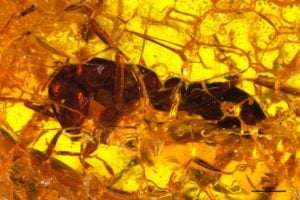
Researchers at New Jersey Institute of Technology and Colorado State University have reported the discovery of the oldest army ant on record, preserved in Baltic amber dating to the Eocene (~35 million years ago).

Oldest army ant ever discovered reveals iconic predator once raided Europe

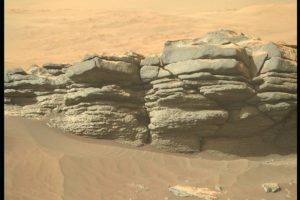
Mars rover Perseverance helped scientists study layered rocks like these in Jezero Crater on the Martian surface. Scientists initially thought they were sedimentary rocks, but further examination showed them to be igneous rocks – solidified lava. These rocks show evidence of interaction with water, but on a limited basis. They date back nearly 4 billion years, giving scientists a window into what conditions on the early planets were like. (Image/NASA/JPL-Caltech/ASU)

Mars was covered by 300 meter deep oceans

Newer posts
← Previous Page1 … Page9 Page10
Substack subscription form sign up

Comments

  • Kidreadytobreed on Global warming reduces available wind energy
  • James on Global warming reduces available wind energy
  • James on Global warming reduces available wind energy
  • Booklet AI on Key to online education: Test early and often
  • Karoly Mirnics on Common Prescription Drugs May Disrupt Cholesterol Pathways in the Womb and Raise Autism Risk
© 2026 ScienceBlog.com | Follow our RSS / XML feed