Skip to content
ScienceBlog.com
  • Featured Blogs
    • EU Horizon Blog
    • ESA Tracker
    • Experimental Frontiers
    • Josh Mitteldorf’s Aging Matters
    • Dr. Lu Zhang’s Gondwanaland
    • NeuroEdge
    • NIAAA
    • SciChi
    • The Poetry of Science
    • Wild Science
  • Topics
    • Brain & Behavior
    • Earth, Energy & Environment
    • Health
    • Life & Non-humans
    • Physics & Mathematics
    • Social Sciences
    • Space
    • Technology
  • Our Substack
  • Follow Us!
    • Bluesky
    • Threads
    • FaceBook
    • Google News
    • Twitter/X
  • Contribute/Contact

exoplanets

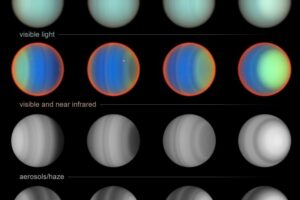
The image columns show the change of Uranus for the four years that STIS observed Uranus across a 20-year period. Over that span of time, the researchers watched the seasons of Uranus as the south polar region darkened going into winter shadow while the north polar region brightened as northern summer approaches.

20-Year Hubble Study of Uranus Yields New Atmospheric Insights

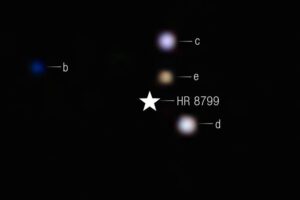
The clearest look in the infrared yet at the iconic multi-planet system HR 8799. Colors are applied to filters from Webb’s NIRCam (Near-Infrared Camera). A star symbol marks the location of the host star HR 8799, whose light has been blocked by the coronagraph. In this image, the color blue is assigned to 4.1 micron light, green to 4.3 micron light, and red to the 4.6 micron light

Webb Spies First Direct Images of CO2 Outside Solar System

Hot Jupiter

Temperamental stars are distorting our view of distant planets

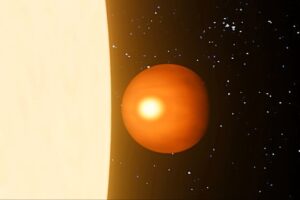
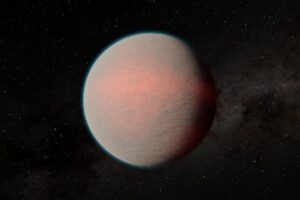
An artistic impression of Trappist-1 b shortly before it passes behind the cool, red dwarf star, Trappist-1. Such stars are known for their activity with large starspots and eruptions. Trappist-1 b may experience intense volcanism.

TRAPPIST-1 b: A Barren Rock or a World Wrapped in Haze?

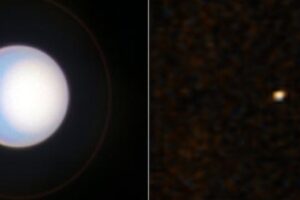
NASA's Hubble Space Telescope (left) and NASA's New Horizon's spacecraft (right) image the planet Uranus.

NASA Teams Up for a Double Take on Uranus: Hubble and New Horizons Get Up Close and Personal

Physicists at The University of Texas at Arlington have published a study of F-type star systems, in which they explored systems where the planets spend at least part of their orbits in the stellar habitable zones.

Alien Life Hotspots? UTA Study Reveals Overlooked Star Systems with Habitable Potential

Xenopmorph from Alien franchise

Lab-Created Gases Challenge Assumptions About Alien Life Detection

Ohio State logo

Astronomy project co-led by Ohio State receives $4.3 million

Ohio State logo

Formation of super-Earths proven limited near metal-poor stars

Expoplanet hotspot

Iron Winds Sweep Across Ultra-Hot Exoplanet WASP-76 b

Magma ocean planets that contain water – like the earthlike exoplanet GJ 1214 b in this artist’s concept – will only host a tiny fraction of this water on their surface. The majority of it is stored deep in their interiors.

Planets Harbor More Water Than Previously Thought, Study Reveals

Juliette Becker

Watery planets orbiting dead stars may be good candidates for studying life — if they can survive long enough

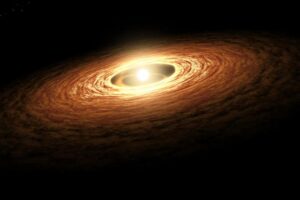
An international team of astronomers has utilized NASA's James Webb Space Telescope to investigate the disk of gas and dust surrounding a young, low-mass star called ISO-ChaI 147. Their findings, depicted in this artist's impression, show the most diverse and abundant collection of carbon-containing molecules ever observed in a planet-forming disk around a star.

Webb finds plethora of carbon molecules around young star

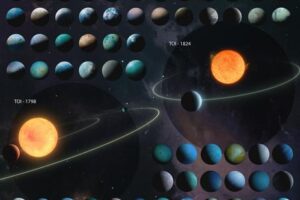
Artist conception of 126 planets in the latest TESS-Keck Survey catalog is based on data including planet radius, mass, density, and temperature. Question marks represent planets requiring more data for full characterization.

NASA’s TESS-Keck Survey Unveils 126 Diverse Worlds, Offering Insights into Planet Formation, Habitability

Older posts
Page1 Page2 Page3 Next →
Substack subscription form sign up

Comments

  • Karoly Mirnics on Common Prescription Drugs May Disrupt Cholesterol Pathways in the Womb and Raise Autism Risk
  • Aizen on Laziness helped lead to extinction of Homo erectus
  • Norwood johnson on Electrons in New Crystals Behave as If They Live in Four Dimensions
  • ScienceBlog.com on Hidden Geometry Could Finally Fix Quantum Computers
  • Theo Prinse on America Is Going Back to the Moon. This Time, It Plans to Stay
© 2026 ScienceBlog.com | Follow our RSS / XML feed