Skip to content
ScienceBlog.com
  • Featured Blogs
    • EU Horizon Blog
    • ESA Tracker
    • Experimental Frontiers
    • Josh Mitteldorf’s Aging Matters
    • Dr. Lu Zhang’s Gondwanaland
    • NeuroEdge
    • NIAAA
    • SciChi
    • The Poetry of Science
    • Wild Science
  • Topics
    • Brain & Behavior
    • Earth, Energy & Environment
    • Health
    • Life & Non-humans
    • Physics & Mathematics
    • Social Sciences
    • Space
    • Technology
  • Our Substack
  • Follow Us!
    • Bluesky
    • Threads
    • FaceBook
    • Google News
    • Twitter/X
  • Contribute/Contact

exoplanets

Life requires repetition of chemical reactions. Describing the kinds of reactions and conditions required for self-sustaining repetition — called autocatalysis — could focus the search for life on other planets.

New recipes for origin of life may point way to distant, inhabited planets

Ohio State logo

Using cosmic weather to study which worlds could support life

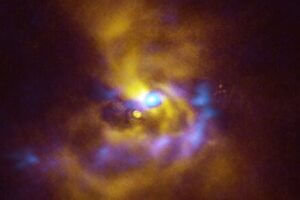
Combined SPHERE and ALMA image of material orbiting V960 Mon

New image reveals secrets of planet birth

Ohio State logo

Astronomers discover striking evidence of ‘unusual’ stellar evolution

Galaxy illustration

Hawaiʻi astronomers find a planet that shouldn’t exist

Ohio State logo

Planet orbiting 2 stars discovered using new technique

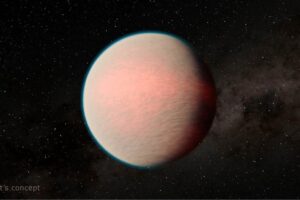
Artist’s concept of the planet GJ 1214 b, a “mini-Neptune” with what is likely a steamy, hazy atmosphere. Credit: NASA/JPL-Caltech/R. Hurt (IPAC)

Planet has surprisingly cool attitude: ‘I’m not hot, I’m just reflective’

The Hubble Space Telescope has captured images of gas-and-dust disks around the young star TW Hydrae. These images show shadows moving across the disks surrounding the system. Scientists believe that these shadows are being cast by inner disks that are slightly tilted and blocking the light from reaching the outer disk. This tilt is due to the gravitational pull of unseen planets that are changing the structure of the disks.

Two Baby Planets May Be Playing Hide-and-Seek in Distant Star System

Illustration: Bibiana Prinoth

Scientists discover rare element terbium in exoplanet’s atmosphere

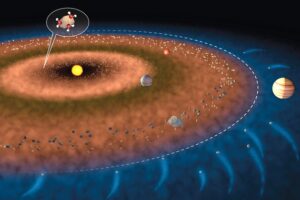
Earth’s water did not come from melted meteorites, according to a new study that analyzed melted meteorites that had been floating around in space since the solar system’s formation four and a half billion years ago. These meteorites had extremely low water content, regardless of their origin in the outer or inner solar system, ruling them out as the primary source of Earth’s water. The dashed white line in the attached illustration is the boundary with the outer solar system showing material transport from the outer solar system to the inner solar system.

Where did Earth’s water come from? Not melted meteorites, study reports

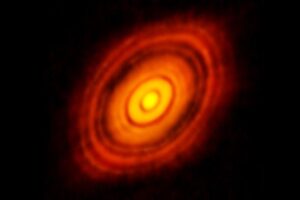
ALMA image of the protoplanetary disc around HL Tauri Credit: ALMA (ESO/NAOJ/NRAO)

Astronomers use ‘little hurricanes’ to weigh and date planets around young stars

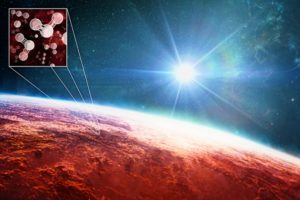
New observations of WASP-39b with the JWST have provided a clearer picture of the exoplanet, showing the presence of sodium, potassium, water, carbon dioxide, carbon monoxide and sulfur dioxide in the planet's atmosphere. This artist's illustration also displays newly detected patches of clouds scattered across the planet.

Webb spies an exoplanet atmosphere as never seen before

Newer posts
← Previous Page1 Page2 Page3
Substack subscription form sign up

Comments

  • Karoly Mirnics on Common Prescription Drugs May Disrupt Cholesterol Pathways in the Womb and Raise Autism Risk
  • Aizen on Laziness helped lead to extinction of Homo erectus
  • Norwood johnson on Electrons in New Crystals Behave as If They Live in Four Dimensions
  • ScienceBlog.com on Hidden Geometry Could Finally Fix Quantum Computers
  • Theo Prinse on America Is Going Back to the Moon. This Time, It Plans to Stay
© 2026 ScienceBlog.com | Follow our RSS / XML feed