Skip to content
ScienceBlog.com
  • Featured Blogs
    • EU Horizon Blog
    • ESA Tracker
    • Experimental Frontiers
    • Josh Mitteldorf’s Aging Matters
    • Dr. Lu Zhang’s Gondwanaland
    • NeuroEdge
    • NIAAA
    • SciChi
    • The Poetry of Science
    • Wild Science
  • Topics
    • Brain & Behavior
    • Earth, Energy & Environment
    • Health
    • Life & Non-humans
    • Physics & Mathematics
    • Social Sciences
    • Space
    • Technology
  • Our Substack
  • Follow Us!
    • Bluesky
    • Threads
    • FaceBook
    • Google News
    • Twitter/X
  • Contribute/Contact

experimental physics

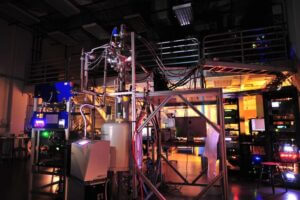
By building a unique, advanced machine, Rutgers scientists have created a structure with quantum qualities. The green window (right) is the main growth chamber where synthesis of the quantum "sandwiches" occurs. Within the amber window (left) are advanced characterization tools that uncover chemical and electronic properties of the grown quantum thin films without exposing them to air.

Scientists Merge Two “Impossible” Materials Into New Artificial Structure

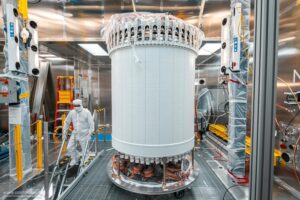
LUX-ZEPLIN Experiment Narrows the Search for Elusive Dark Matter

LUX-ZEPLIN Experiment Narrows the Search for Elusive Dark Matter

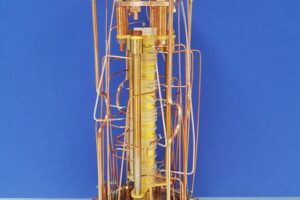
PENTATRAP

Scientists Take a Step Closer to Solving the Mystery of Neutrino Masses

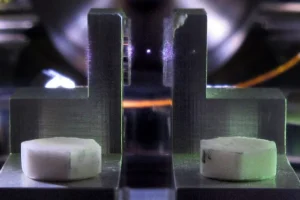
A trapped nanoparticle in vacuum at Wright Lab. (Credit: Tom Penny)

What goes up, must… be quantum? Experiment to test gravity’s quantum chops

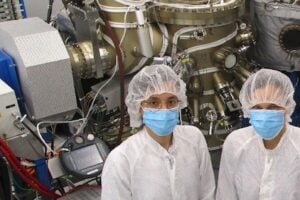
Graduate student Emine Bakali (left) and her supervisor Silke Paschen of TU Wien in front of the molecular beam epitaxy chamber of TU Wien’s clean room that was used for the growth of the YbRh2Si2 thin films. (Photo by Maxwell Andrews/TU Wien)

Unraveling the Puzzle of ‘Strange Metals’: Surprising Insights into Electric Charge Movement

Cyclotron Radiation Emission Spectroscopy (CRES), seen here, is the key to a totally new method that aims to pin down the mass of the elusive neutrino.

Closing in on the Elusive Neutrino

Researchers have discovered Pines' demon, a collection of electrons in a metal that behaves like a massless wave.

Demon Hunting: Physicists confirm 67-year-old prediction of massless, neutral composite particle

Quantum vacuum fluctuations, conceptual illustration.

Exploring vacuum energy

Vacuum chamber containing the atom chip

Paradoxical quantum phenomenon measured for the first time

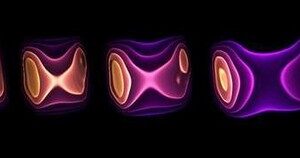
This graphic shows the energy density (yellow is high; purple is low) at different times during the hydrodynamic evolution of matter created in a collision of a lead ion (moving to the left) with a photon emitted from another lead ion (moving to the right

Hitting nuclei with light may create fluid primordial matter

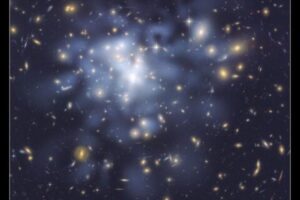
This NASA Hubble Space Telescope image shows the distribution of dark matter in the center of the giant galaxy cluster Abell 1689, containing about 1,000 galaxies and trillions of stars. Dark matter is an invisible form of matter that accounts for most of the universe’s mass. Hubble cannot see the dark matter directly. Astronomers inferred its location by analyzing the effect of gravitational lensing, where light from galaxies behind Abell 1689 is distorted by intervening matter within the cluster. Researchers used the observed positions of 135 lensed images of 42 background galaxies to calculate the location and amount of dark matter in the cluster. They superimposed a map of these inferred dark matter concentrations, tinted blue, on an image of the cluster taken by Hubble’s Advanced Camera for Surveys. If the cluster’s gravity came only from the visible galaxies, the lensing distortions would be much weaker. The map reveals that the densest concentration of dark matter is in the cluster’s core. Abell 1689 resides 2.2 billion light-years from Earth. The image was taken in June 2002. Image credit: NASA, ESA, D. Coe (NASA Jet Propulsion Laboratory/California Institute of Technology, and Space Telescope Science Institute), N. Benitez (Institute of Astrophysics of Andalusia, Spain), T. Broadhurst (University of the Basque Country, Spain), and H. Ford (Johns Hopkins University)

A new model for dark matter
Substack subscription form sign up

Comments

  • Karoly Mirnics on Common Prescription Drugs May Disrupt Cholesterol Pathways in the Womb and Raise Autism Risk
  • Aizen on Laziness helped lead to extinction of Homo erectus
  • Norwood johnson on Electrons in New Crystals Behave as If They Live in Four Dimensions
  • ScienceBlog.com on Hidden Geometry Could Finally Fix Quantum Computers
  • Theo Prinse on America Is Going Back to the Moon. This Time, It Plans to Stay
© 2026 ScienceBlog.com | Follow our RSS / XML feed