Skip to content
ScienceBlog.com
  • Featured Blogs
    • EU Horizon Blog
    • ESA Tracker
    • Experimental Frontiers
    • Josh Mitteldorf’s Aging Matters
    • Dr. Lu Zhang’s Gondwanaland
    • NeuroEdge
    • NIAAA
    • SciChi
    • The Poetry of Science
    • Wild Science
  • Topics
    • Brain & Behavior
    • Earth, Energy & Environment
    • Health
    • Life & Non-humans
    • Physics & Mathematics
    • Social Sciences
    • Space
    • Technology
  • Our Substack
  • Follow Us!
    • Bluesky
    • Threads
    • FaceBook
    • Google News
    • Twitter/X
  • Contribute/Contact

galaxies

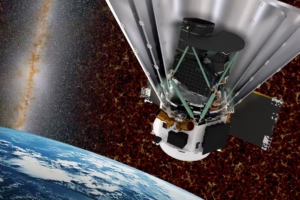
NASA's SPHEREx mission will provide new clues about the explosive, inflationary phase of our universe

What Hundreds of Millions of Galaxies Can Teach Us About the Big Bang

Ohio State logo

Novel supernova observations grant astronomers a peek into the cosmic past

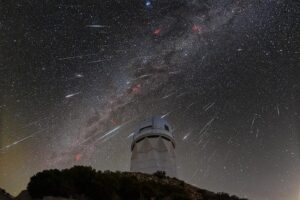
DESI observes the sky from the Mayall Telescope, shown here during the 2023 Geminid meteor shower.

DESI’s Galactic Survey Confirms Einstein’s Theory of Gravity at Cosmic Scales

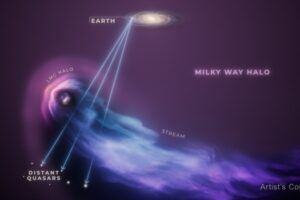
This artist's illustration depicts the Large Magellanic Cloud (LMC) in the foreground as it passes through the gaseous halo of the much larger Milky Way galaxy. The encounter has stripped away much of the LMC's spherical gas halo, leaving a trailing gas stream resembling a comet's tail. However, a compact halo remains intact, and scientists predict this residual halo will not dissipate entirely. The research team studied the LMC's halo by analyzing the light from 28 quasars, exceptionally bright active galactic nuclei that act as "lighthouse beacons" across the universe. This light enables scientists to detect the halo gas indirectly, as the gas absorbs some of the quasars' light. The lines in the illustration represent the path of the Hubble Space Telescope's observations, from its orbit around Earth to the distant quasars, passing through the LMC's gas halo.

Hubble Reveals Impact of Galaxy’s Close Encounter with Milky Way

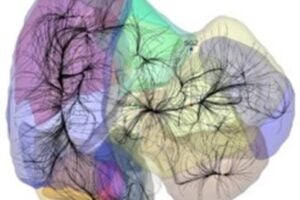
Velocity streamlines within the reconstructed volume, with colored envelopes associated with the prominent nearby basins of attraction. The map and streamlines have been cropped to the region covered by Cosmicflows-4 data. The streamlines within a given basin converge onto the region of high concentration of galaxies.

New Study Maps Gravitational ‘Basins of Attraction’ in the Local Universe

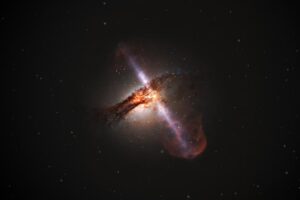
An artist’s impression showing bi-polar jets of gas originating from a supermassive black hole at the centre of a galaxy.

How the ‘heart and lungs’ of a galaxy extend its life

The Cosmic Gems arc as observed by the JWST. Credit: ESA/Webb, NASA & CSA, L. Bradley (STScI), A. Adamo (Stockholm University) and the Cosmic Spring collaboration.

Star clusters observed within a galaxy in the early Universe for the first time

colorful sky

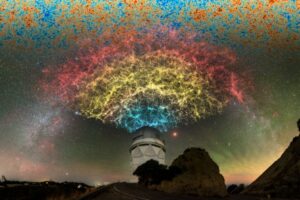
Unlocking the Secrets of the Universe: DESI’s Groundbreaking 3D Map Reveals Dark Energy Mysteries

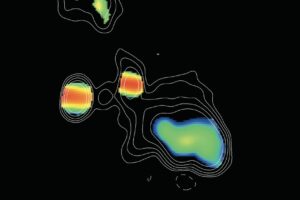
This image, taken by the Very Long Baseline Array (VLBA), shows two supermassive black holes, which appear as the blobs with red strips. The black holes are in the center of an elliptical galaxy. Colors represent different spectral slopes in radio emission, with red showing the most dense regions surrounding the black holes. The black hole on the right has likely recently devoured a massive star, which caused it to shoot out two ultrafast jets. The ends of those jets appear as green blobs above and below the black hole. This object, called J0405+3803, is referred to as a Compact Symmetric Object (CSO), because its jets are relatively close-in (or compact), compared to other black holes with much larger jets.

Sleeping supermassive black holes awakened briefly by shredded stars

Ohio State logo

Study delivers detailed photos of galaxies’ inner structures

Sample shapes of distant galaxies identified by the James Webb Space Telescope’s Cosmic Evolution Early Release Science (CEERS) survey. [(Credit: NASA, ESA, CSA, STScI, Steve Finkelstein (UT Austin), Micaela Bagley (UT Austin), Rebecca Larson (UT Austin)]

Most early galaxies looked like breadsticks rather than pizza pies or dough balls

galaxies

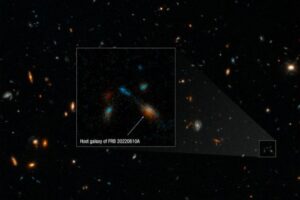
‘Blob-like’ home of farthest-known fast radio burst is collection of seven galaxies

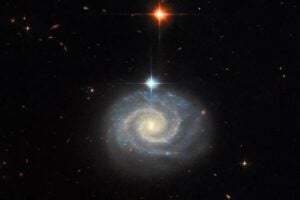
This NASA Hubble Space Telescope image features a bright spiral galaxy known as MCG-01-24-014, which is located about 275 million light-years from Earth.

Hubble sights a galaxy with ‘forbidden’ light

Color composite of galaxy AzTECC71 from multiple color filters in the NIRCam instrument on the James Webb Space Telescope. Credit: J. McKinney/M. Franco/C. Casey/University of Texas at Austin.

Ghostlike dusty galaxy reappears in James Webb Space Telescope image

Older posts
Page1 Page2 Next →
Substack subscription form sign up

Comments

  • Not Buying Yer Bullshit on More Than a Third of Americans Have Lost Relationships Over Politics
  • Marco Messina on More Than a Third of Americans Have Lost Relationships Over Politics
  • Anon on Why Fructose Behaves Less Like a Calorie and More Like a Hormone
  • Mark Mellinger on Living Plastic Can Self-Destruct on Command
  • Marie Feret on The Silent Frequency That Makes Old Buildings Feel Haunted
© 2026 ScienceBlog.com | Follow our RSS / XML feed