Skip to content
ScienceBlog.com
  • Featured Blogs
    • EU Horizon Blog
    • ESA Tracker
    • Experimental Frontiers
    • Josh Mitteldorf’s Aging Matters
    • Dr. Lu Zhang’s Gondwanaland
    • NeuroEdge
    • NIAAA
    • SciChi
    • The Poetry of Science
    • Wild Science
  • Topics
    • Brain & Behavior
    • Earth, Energy & Environment
    • Health
    • Life & Non-humans
    • Physics & Mathematics
    • Social Sciences
    • Space
    • Technology
  • Our Substack
  • Follow Us!
    • Bluesky
    • Threads
    • FaceBook
    • Google News
    • Twitter/X
  • Contribute/Contact

galaxies

University of Michigan astronomer Sally Oey studied a star-forming region in host galaxy, NGC 2366, which is a typical dwarf irregular galaxy. Image courtesy: Observatorio de Calar Alto, J. van Eymeren (AIRUB, ATNF) & Á.R. López-Sánchez

Dwarf galaxies use 10-million-year quiet period to churn out stars

Artist conception of early starbursting galaxies. The image is rendered from FIRE simulation data used for this research that can explain recent JWST results. Stars and galaxies are shown in the bright white points of light, while the more diffuse dark matter and gas are shown in purples and reds.

Bursts of star formation explain mysterious brightness at cosmic dawn

Keck Cosmic Web Imager offers best glimpse yet of the filamentous network that connects galaxies

Cosmic Web Lights Up in the Darkness of Space

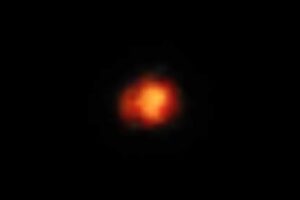
Spectroscopic observations reveal that Maisie’s galaxy, named after Steven Finkelstein’s daughter, was detected 390 million years after the Big Bang. That makes it one of the four earliest confirmed galaxies ever observed.

Astronomers confirm Maisie’s galaxy is among earliest ever observed

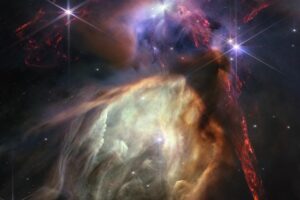
The first anniversary image from NASA’s James Webb Space Telescope displays star birth like it’s never been seen before, full of detailed, impressionistic texture. The subject is the Rho Ophiuchi cloud complex, the closest star-forming region to Earth. It is a relatively small, quiet stellar nursery, but you’d never know it from Webb’s chaotic close-up. Jets bursting from young stars crisscross the image, impacting the surrounding interstellar gas and lighting up molecular hydrogen, shown in red. Some stars display the telltale shadow of a circumstellar disk, the makings of future planetary systems. Download the full-resolution, uncompressed version and supporting visuals from the Space Telescope Science Institute: https://webbtelescope.org/contents/media/images/2023/128/01H449193V5Q4Q6GFBKXAZ3S03?news=true

Webb celebrates first year of science with close-up on birth of sun-like stars

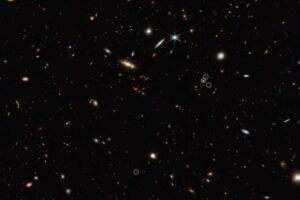
This deep galaxy field from Webb’s NIRCam (Near-Infrared Camera) shows an arrangement of 10 distant galaxies marked by eight white circles in a diagonal, thread-like line. (Two of the circles contain more than one galaxy.) This 3 million light-year-long filament is anchored by a very distant and luminous quasar – a galaxy with an active, supermassive black hole at its core. The quasar, called J0305-3150, appears in the middle of the cluster of three circles on the right side of the image. Its brightness outshines its host galaxy. The 10 marked galaxies existed just 830 million years after the big bang. The team believes the filament will eventually evolve into a massive cluster of galaxies.

NASA’s Webb identifies the earliest strands of the cosmic web

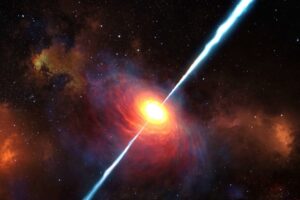
An artist's rendering of quasar P172+18

Mystery of quasars solved: Most powerful objects in the Universe ignited by colliding galaxies

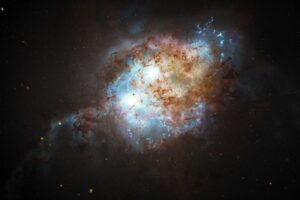
This artist's concept shows the brilliant glare of two quasars residing in the cores of two galaxies that are in the chaotic process of merging. The gravitational tug-of-war between the two galaxies ignites a firestorm of star birth.

Hubble unexpectedly finds double quasar in distant universe

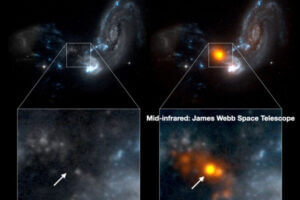
Astronomers from an international team have used the James Webb Space Telescope to reveal, for the first time, the exact location of the source powering colliding galaxies. Curiously, this source lies outside of the main parts of the galaxies and is not visible at all in the ultraviolet or visible light observed with the Hubble Space Telescope.

‘Engine’ of luminous merging galaxies pinpointed for the first time

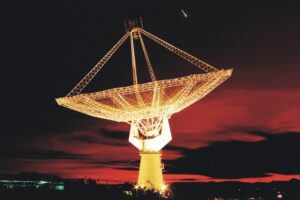
Astronomers capture radio signal from distant galaxy

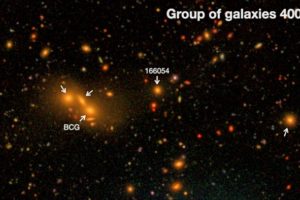
Light 'between' the groups of galaxies – the 'intra-group light' – however dim, is radiated from stars stripped from their home galaxy. Image: Supplied.

Astronomers observe intra-group light – the elusive glow between distant galaxies

Newer posts
← Previous Page1 Page2
Substack subscription form sign up

Comments

  • Simon on A New Theory Says DMT Entities Might Be Real, and Proposes How to Test It
  • Sue Ann Hayes on Hidden Nuclear Protein Fuels Pancreatic Cancer’s Deadly Aggression
  • Curtis Webber on The GPS-Killer? This Quantum Device ‘Feels’ Motion Like a Brain—Down to the Atomic Level
  • Ran on How the Age You First Had Sex Could Shape How You Age Decades Later
  • Sparty on How the Age You First Had Sex Could Shape How You Age Decades Later
© 2026 ScienceBlog.com | Follow our RSS / XML feed