Skip to content
ScienceBlog.com
  • Featured Blogs
    • EU Horizon Blog
    • ESA Tracker
    • Experimental Frontiers
    • Josh Mitteldorf’s Aging Matters
    • Dr. Lu Zhang’s Gondwanaland
    • NeuroEdge
    • NIAAA
    • SciChi
    • The Poetry of Science
    • Wild Science
  • Topics
    • Brain & Behavior
    • Earth, Energy & Environment
    • Health
    • Life & Non-humans
    • Physics & Mathematics
    • Social Sciences
    • Space
    • Technology
  • Our Substack
  • Follow Us!
    • Bluesky
    • Threads
    • FaceBook
    • Google News
    • Twitter/X
  • Contribute/Contact

Habitability

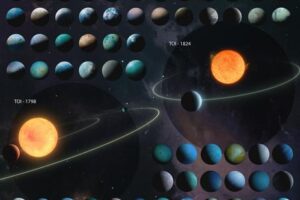
Artist conception of 126 planets in the latest TESS-Keck Survey catalog is based on data including planet radius, mass, density, and temperature. Question marks represent planets requiring more data for full characterization.

NASA’s TESS-Keck Survey Unveils 126 Diverse Worlds, Offering Insights into Planet Formation, Habitability

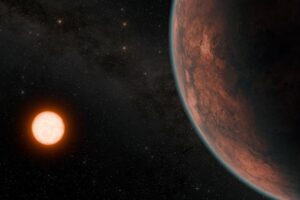
gliese 12 b

Astronomers Discover Potentially Habitable Earth-like Exoplanet Just 40 Light-Years Away

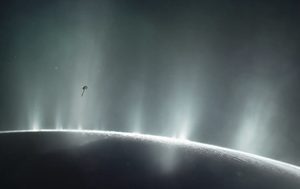
Dramatic plumes spray water ice and vapor from many locations along the famed "tiger stripes" near the south pole of Saturn's moon Enceladus. The tiger stripes are four prominent, approximately 84-mile- (135-kilometer-) long fractures that cross the moon's south polar terrain. Credit: NASA/JPL-Caltech/Space Science Institute

A New Way to Characterize Habitable Planets

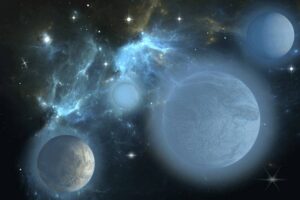
In the search for extraterrestrial life, MIT scientists say a planet’s carbon-lite atmosphere, relative to its neighbors, could be a sure and detectable signal of habitability. Credits:Image: Christine Daniloff, MIT; iStock

A carbon-lite atmosphere could be a sign of water and life on other terrestrial planets

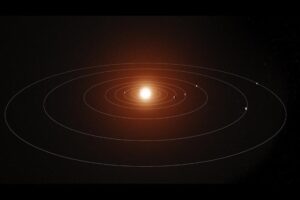
Artist’s concept of Kepler-385, the seven-planet system revealed in a new catalog of planet candidates discovered by NASA’s Kepler space telescope. Credit: Daniel Rutter/NASA. All Rights Reserved.

Many planets beyond our solar system follow nearly circular orbital paths

Substack subscription form sign up

Comments

  • Marco Messina on More Than a Third of Americans Have Lost Relationships Over Politics
  • Anon on Why Fructose Behaves Less Like a Calorie and More Like a Hormone
  • Mark Mellinger on Living Plastic Can Self-Destruct on Command
  • Marie Feret on The Silent Frequency That Makes Old Buildings Feel Haunted
  • Dax on The Silent Frequency That Makes Old Buildings Feel Haunted
© 2026 ScienceBlog.com | Follow our RSS / XML feed