Skip to content
ScienceBlog.com
  • Featured Blogs
    • EU Horizon Blog
    • ESA Tracker
    • Experimental Frontiers
    • Josh Mitteldorf’s Aging Matters
    • Dr. Lu Zhang’s Gondwanaland
    • NeuroEdge
    • NIAAA
    • SciChi
    • The Poetry of Science
    • Wild Science
  • Topics
    • Brain & Behavior
    • Earth, Energy & Environment
    • Health
    • Life & Non-humans
    • Physics & Mathematics
    • Social Sciences
    • Space
    • Technology
  • Our Substack
  • Follow Us!
    • Bluesky
    • Threads
    • FaceBook
    • Google News
    • Twitter/X
  • Contribute/Contact

healthcare

Researchers argue that the adoption of LLMs into medical curricula can significantly contribute to the acquisition of moral knowledge and the cultivation of virtue, two main aspects of medical ethics.

ChatGPT Shows Promise as Medical Ethics Teacher

A new study shows that an open-source AI model performs on par with the leading closed-source tool in its ability to solve tough medical cases. The shift portends greater competition that should benefit for patients and clinicians.

Free Open-Source Tool Matches Big Tech’s Best in Cracking Tough Patient Cases

Design and control of the mechanical patient and tremor-suppression mechanism

Soft Artificial Muscles Show Promise in Quieting Hand Tremors

About 6 in 10 adults who borrowed money for healthcare borrowed $500 or more.

Americans borrowed $74 billion last year to cover healthcare costs

Colin Walsh, MD, MA, at Vanderbilt University Medical Center, led a team that tested whether an AI system could effectively prompt doctors in three neurology clinics to screen patients for suicide risk during regular clinic visits.

AI System Successfully Flags Patients at Risk for Suicide During Routine Doctor Visits

Artificial intelligence software gleans insights from health records to shed light on chronic COVID symptoms

AI Tool Reveals Higher Numbers of Long COVID Cases in Patient Records

patient in hospital bed

Words Doctors Should Never Say to Seriously Ill Patients

ambulance at hospital

When it comes to emergency care, ChatGPT overprescribes

Couple walking on road

Lifestyle Advice: A Questionable Approach to Public Health

woman with arm in sling on phone looking at bill

Study Finds High Success Rate for Patients Who Challenge Medical Bills

Ohio State logo

A human-centered AI tool to improve sepsis management

Kristiina Tammimies

AI Model Shows Promise in Early Autism Detection, Achieving 80% Accuracy

Scanning Electron Microscopy image of C. difficile in the gut of an infected animal - The University of Sheffield

Scientists discover superbug’s rapid path to antibiotic resistance

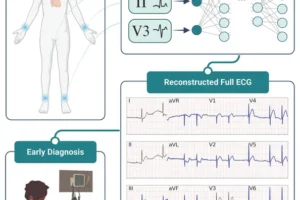
Researchers at Scripps Research have created a new way to check heart health. Instead of using the usual 12 sensors, they found that just 3 sensors, combined with a smart computer program, can spot heart problems almost as well. This simpler method could make it easier for more people to get their hearts checked.

AI Simplifies Heart Monitoring: 3-Lead ECG as Accurate as 12

Older posts
Page1 Page2 … Page5 Next →
Substack subscription form sign up

Comments

  • Norwood johnson on Electrons in New Crystals Behave as If They Live in Four Dimensions
  • ScienceBlog.com on Hidden Geometry Could Finally Fix Quantum Computers
  • Theo Prinse on America Is Going Back to the Moon. This Time, It Plans to Stay
  • george w on Hidden Geometry Could Finally Fix Quantum Computers
  • Tom Hughes on Years of Exercise, Blood Pressure Drugs Failed to Slow Cognitive Decline in Seniors at Dementia Risk
© 2026 ScienceBlog.com | Follow our RSS / XML feed