Skip to content
ScienceBlog.com
  • Featured Blogs
    • EU Horizon Blog
    • ESA Tracker
    • Experimental Frontiers
    • Josh Mitteldorf’s Aging Matters
    • Dr. Lu Zhang’s Gondwanaland
    • NeuroEdge
    • NIAAA
    • SciChi
    • The Poetry of Science
    • Wild Science
  • Topics
    • Brain & Behavior
    • Earth, Energy & Environment
    • Health
    • Life & Non-humans
    • Physics & Mathematics
    • Social Sciences
    • Space
    • Technology
  • Our Substack
  • Follow Us!
    • Bluesky
    • Threads
    • FaceBook
    • Google News
    • Twitter/X
  • Contribute/Contact

James Webb Space Telescope

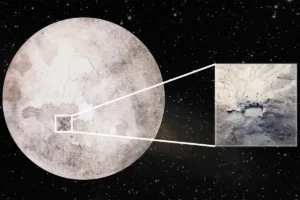
Artistic conception of a recently exposed methane ice region on Eris’s surface. Credits: Angela Ramirez & Megan Hernandez (FSI/UCF).

Researchers Help Find Evidence of Geothermal Activity within Icy Dwarf Planets

Ohio State logo

Study delivers detailed photos of galaxies’ inner structures

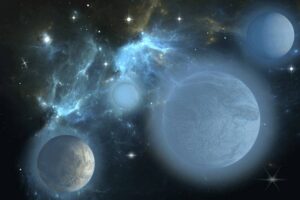
In the search for extraterrestrial life, MIT scientists say a planet’s carbon-lite atmosphere, relative to its neighbors, could be a sure and detectable signal of habitability. Credits:Image: Christine Daniloff, MIT; iStock

A carbon-lite atmosphere could be a sign of water and life on other terrestrial planets

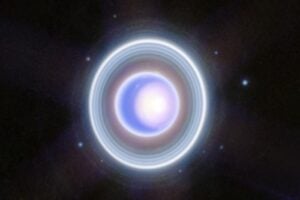
uranus

NASA’s Webb rings in holidays with ringed planet Uranus

Color composite of galaxy AzTECC71 from multiple color filters in the NIRCam instrument on the James Webb Space Telescope. Credit: J. McKinney/M. Franco/C. Casey/University of Texas at Austin.

Ghostlike dusty galaxy reappears in James Webb Space Telescope image

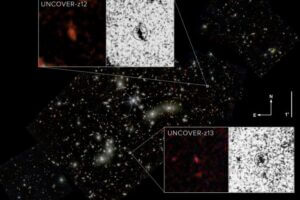
The second- and fourth-most distant galaxies ever seen (UNCOVER z-13 and UNCOVER z-12) have been confirmed using the James Webb Space Telescope’s Near-Infrared Camera (NIRCam). The galaxies are located in Pandora’s Cluster (Abell 2744), show here as near-infrared wavelengths of light that have been translated to visible-light colors. The scale of the main cluster image is labelled in arcseconds, which is a measure of angular distance in the sky. The circles on the black-and-white images, showing the galaxies in the NIRCam-F277W filter band onboard JWST, indicate an aperture size of 0.32 arcsec.

Second-most distant galaxy discovered using James Webb Space Telescope

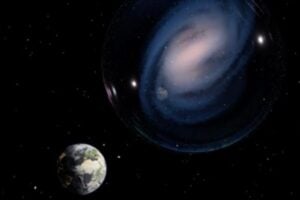
Artistic representation of the spiral barred galaxy ceers-2112, observed in the early universe. The Earth is reflected on an illusive bubble surrounding the galaxy, recalling the connection between the Milky Way and ceers-2112.

Milky Way-like galaxy found in the early universe

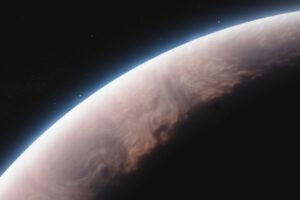
The atmosphere of the hot gas giant planet WASP-17 b, depicted in this artist’s concept, is composed primarily of hydrogen and helium, along with small amounts of water vapor and hints of carbon dioxide and other molecules. Credit: NASA, ESA, CSA, and R. Crawford (STScI)

Webb Detects Tiny Quartz Crystals in Clouds of Hot Gas Giant

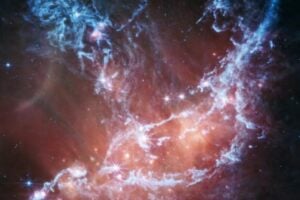
This new infrared image of NGC 346 from NASA’s James Webb Space Telescope’s Mid-Infrared Instrument (MIRI) traces emission from cool gas and dust. In this image blue represents silicates and sooty chemical molecules known as polycyclic aromatic hydrocarbons, or PAHs. More diffuse red emission shines from warm dust heated by the brightest and most massive stars in the heart of the region. Bright patches and filaments mark areas with abundant numbers of protostars. This image includes 7.7-micron light shown in blue, 10 microns in cyan, 11.3 microns in green, 15 microns in yellow, and 21 microns in red (770W, 1000W, 1130W, 1500W, and 2100W filters, respectively).

NASA’s Webb captures an ethereal view of NGC 346

Artist conception of early starbursting galaxies. The image is rendered from FIRE simulation data used for this research that can explain recent JWST results. Stars and galaxies are shown in the bright white points of light, while the more diffuse dark matter and gas are shown in purples and reds.

Bursts of star formation explain mysterious brightness at cosmic dawn

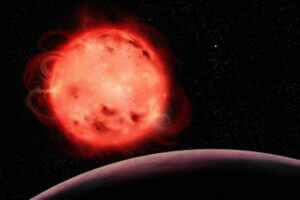
This artistic representation of the TRAPPIST-1 red dwarf star showcases its very active nature. The star appears to have many stellar spots (colder regions of its surface, similar to sunspots) and flares. The exoplanet TRAPPIST-1 b, the closest planet to the system’s central star, can be seen in the foreground with no apparent atmosphere. The exoplanet TRAPPIST-1 g, one of the planets in the system’s habitable zone, can be seen in the background to the right of the star. The TRAPPIST-1 system contains seven Earth-sized exoplanets.

New insights into the atmosphere and star of an exoplanet

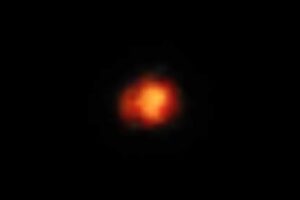
Spectroscopic observations reveal that Maisie’s galaxy, named after Steven Finkelstein’s daughter, was detected 390 million years after the Big Bang. That makes it one of the four earliest confirmed galaxies ever observed.

Astronomers confirm Maisie’s galaxy is among earliest ever observed

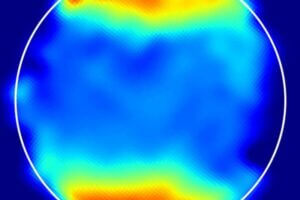
A spectroscopic map of Ganymede derived from JWST measurements shows light absorption around the poles characteristic of the molecule hydrogen peroxide. The circle outlines the surfaces of the moon.

James Webb Space Telescope sees Jupiter moons in a new light

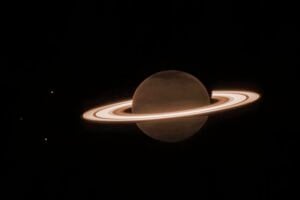
Image of Saturn and some of its moons, captured by the James Webb Space Telescope’s NIRCam instrument on June 25, 2023. In this monochrome image, NIRCam filter F323N (3.23 microns) was color mapped with an orange hue.

Webb Space Telescope reveals astonishing Saturn and its rings

Older posts
Newer posts
← Previous Page1 Page2 Page3 Next →
Substack subscription form sign up

Comments

  • Marco Messina on More Than a Third of Americans Have Lost Relationships Over Politics
  • Anon on Why Fructose Behaves Less Like a Calorie and More Like a Hormone
  • Mark Mellinger on Living Plastic Can Self-Destruct on Command
  • Marie Feret on The Silent Frequency That Makes Old Buildings Feel Haunted
  • Dax on The Silent Frequency That Makes Old Buildings Feel Haunted
© 2026 ScienceBlog.com | Follow our RSS / XML feed