Skip to content
ScienceBlog.com
  • Featured Blogs
    • EU Horizon Blog
    • ESA Tracker
    • Experimental Frontiers
    • Josh Mitteldorf’s Aging Matters
    • Dr. Lu Zhang’s Gondwanaland
    • NeuroEdge
    • NIAAA
    • SciChi
    • The Poetry of Science
    • Wild Science
  • Topics
    • Brain & Behavior
    • Earth, Energy & Environment
    • Health
    • Life & Non-humans
    • Physics & Mathematics
    • Social Sciences
    • Space
    • Technology
  • Our Substack
  • Follow Us!
    • Bluesky
    • Threads
    • FaceBook
    • Google News
    • Twitter/X
  • Contribute/Contact

James Webb Space Telescope

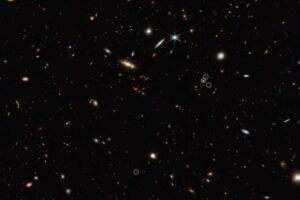
This deep galaxy field from Webb’s NIRCam (Near-Infrared Camera) shows an arrangement of 10 distant galaxies marked by eight white circles in a diagonal, thread-like line. (Two of the circles contain more than one galaxy.) This 3 million light-year-long filament is anchored by a very distant and luminous quasar – a galaxy with an active, supermassive black hole at its core. The quasar, called J0305-3150, appears in the middle of the cluster of three circles on the right side of the image. Its brightness outshines its host galaxy. The 10 marked galaxies existed just 830 million years after the big bang. The team believes the filament will eventually evolve into a massive cluster of galaxies.

NASA’s Webb identifies the earliest strands of the cosmic web

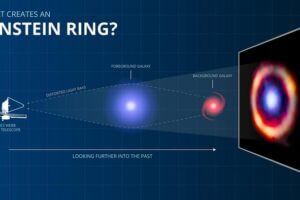
The galaxy observed by Webb shows an Einstein ring caused by a phenomenon known as lensing, which occurs when two galaxies are almost perfectly aligned from our perspective on Earth. The gravity from the galaxy in the foreground causes the light from the background galaxy to be distorted and magnified, like looking through the stem of a wine glass. Because they are magnified, lensing allows astronomers to study very distant galaxies in more detail than otherwise possible.

Webb telescope detects universe’s most distant organic molecules

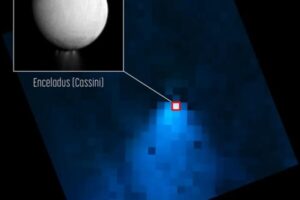
SwRI contributed to new Cycle 1 JWST findings that show the plume of water escaping from Saturn’s moon Enceladus extends 6,000 miles or more than 40 times the moon’s size. In light of this discovery, SwRI’s Dr. Christopher Glein was awarded a NASA JWST Cycle 2 allocation to study the plume as well as the icy surface of Enceladus, to better understand the potential habitability of this ocean world.

Saturn’s Moon Enceladus Throws Water Party Visible from Space

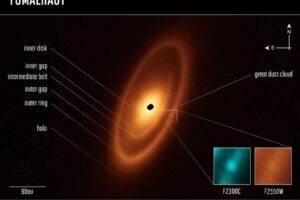
This image of the dusty debris disk surrounding the young star Fomalhaut is from Webb’s Mid-Infrared Instrument (MIRI). It reveals three nested belts extending out to 14 billion miles (23 billion kilometers) from the star. The inner belts – which had never been seen before – were revealed by Webb for the first time. Labels at left indicate the individual features. At right, a great dust cloud is highlighted and pullouts show it in two infrared wavelengths: 23 and 25.5 microns. Credits: NASA, ESA, CSA, A. Gáspár (University of Arizona). Image processing: A. Pagan (STScI)

Local Star Fomalhaut’s Dust Belts Nicer than Ours, May Have Invisible Flatmates

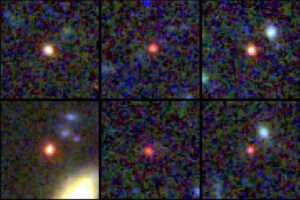
Images of six candidate massive galaxies, seen 500-800 million years after the Big Bang. Image credit: NASA/ESA/CSA/I. Labbe

Webb images challenge theories of how universe evolved

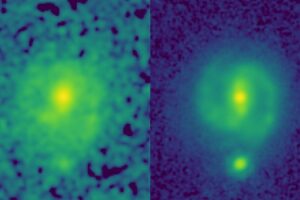
The power of JWST to map galaxies at high resolution and at longer infrared wavelengths than Hubble allows it look through dust and unveil the underlying structure and mass of distant galaxies. This can be seen in these two images of the galaxy EGS23205, seen as it was about 11 billion years ago. In the HST image (left, taken in the near-infrared filter), the galaxy is little more than a disk-shaped smudge obscured by dust and impacted by the glare of young stars, but in the corresponding JWST mid-infrared image (taken this past summer), it’s a beautiful spiral galaxy with a clear stellar bar.

Milky Way-like galaxies found in young universe

Newer posts
← Previous Page1 Page2 Page3
Substack subscription form sign up

Comments

  • Mark Mellinger on Living Plastic Can Self-Destruct on Command
  • Marie Feret on The Silent Frequency That Makes Old Buildings Feel Haunted
  • Dax on The Silent Frequency That Makes Old Buildings Feel Haunted
  • Karoly Mirnics on Common Prescription Drugs May Disrupt Cholesterol Pathways in the Womb and Raise Autism Risk
  • Aizen on Laziness helped lead to extinction of Homo erectus
© 2026 ScienceBlog.com | Follow our RSS / XML feed