Skip to content
ScienceBlog.com
  • Featured Blogs
    • EU Horizon Blog
    • ESA Tracker
    • Experimental Frontiers
    • Josh Mitteldorf’s Aging Matters
    • Dr. Lu Zhang’s Gondwanaland
    • NeuroEdge
    • NIAAA
    • SciChi
    • The Poetry of Science
    • Wild Science
  • Topics
    • Brain & Behavior
    • Earth, Energy & Environment
    • Health
    • Life & Non-humans
    • Physics & Mathematics
    • Social Sciences
    • Space
    • Technology
  • Our Substack
  • Follow Us!
    • Bluesky
    • Threads
    • FaceBook
    • Google News
    • Twitter/X
  • Contribute/Contact

Machine Learning

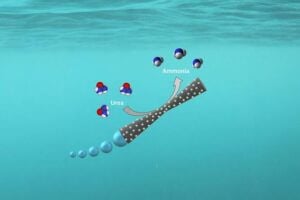
The outside of the micromotor in this study is coated with the chemical compound laccase. This enables the motor to convert the urea in the water into ammonia.

New water treatment method can generate green energy

The new platform technology modeled after the brain is composed of a tangled-up network of wires containing silver, laid on a bed of electrodes.

Experimental brain-like computing system more accurate with custom algorithm

Yong Suk Lee

AI can alert urban planners and policymakers to cities’ decay

This image, featured on the cover of the journal Patterns in reference to a paper published by a Penn State research team, illustrates a person mid-jump in a representation of joyous emotion. Human body movements convey emotions and play a role in everyday communication. Credit: James Z. Wang, Chenyan Wu, HstrongART/iStock. All Rights Reserved.

Human body movements may enable automated emotion recognition, researchers say

Ohio State logo

‘Dim-witted’ pigeons use the same principles as AI to solve tasks

Human tongue

Eyes may be the window to your soul, but the tongue mirrors your health

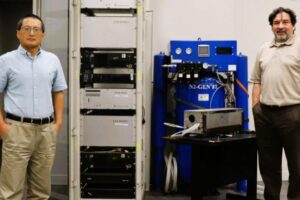
Lehigh University professor Carlos Romero (right), director of Lehigh's Energy Research Center, and Zheng Yao (left), principal research scientist at the ERC are collaborating on a research project, “Machine Learning Enhanced LIBS to Measure and Process Biofuels and Waste Coal for Gasifier Improved Operation,” that recently recieved Phase II funding from the Department of Energy. The proposal team includes Energy Research Co. (ERCo) in Plainfield, New Jersey (small business lead), GTI Energy and SpG Consultants.

A clean-energy future for legacy coal

The new device could be directly incorporated into smartwatches and fitness trackers for real-time data processing and near-instant diagnostics.

AI just got 100-fold more energy efficient

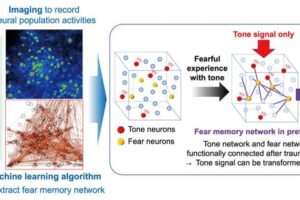
Detecting learning-dependent changes in neural networks to understand how memory is made in the prefrontal region of the brain

Traumatic memories can rewire the brain

Damage after a powerful earthquake in New Zealand in 2011. Researchers at UT Austin are working to forecast earthquakes with artificial intelligence.

AI-driven earthquake forecasting shows promise in trials

Mum who took part in pilot

Software can detect hidden and complex emotions in parents

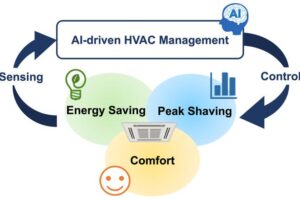
AI helps Japanese buildings save big on HVAC costs

AI helps Japanese buildings save big on HVAC costs

Image: A selfie, taken by the Curiosity rover on the surface of Mars in June 2016. The Curiosity rover used the pyrolysis-GCMS equipment described in this notice (Secondary Creator Credit: NASA/JPL-Caltech/MSSS).

Scientists develop AI method to identify life on other worlds

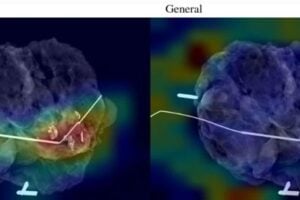
Analysis of pixel importance for radiology-specific and general models. Red/yellow indicates higher importance.

A new AI model has been developed to improve accuracy of breast cancer tumor removal

Older posts
Newer posts
← Previous Page1 … Page4 Page5 Page6 … Page9 Next →
Substack subscription form sign up

Comments

  • Simon on A New Theory Says DMT Entities Might Be Real, and Proposes How to Test It
  • Sue Ann Hayes on Hidden Nuclear Protein Fuels Pancreatic Cancer’s Deadly Aggression
  • Curtis Webber on The GPS-Killer? This Quantum Device ‘Feels’ Motion Like a Brain—Down to the Atomic Level
  • Ran on How the Age You First Had Sex Could Shape How You Age Decades Later
  • Sparty on How the Age You First Had Sex Could Shape How You Age Decades Later
© 2026 ScienceBlog.com | Follow our RSS / XML feed