Skip to content
ScienceBlog.com
  • Featured Blogs
    • EU Horizon Blog
    • ESA Tracker
    • Experimental Frontiers
    • Josh Mitteldorf’s Aging Matters
    • Dr. Lu Zhang’s Gondwanaland
    • NeuroEdge
    • NIAAA
    • SciChi
    • The Poetry of Science
    • Wild Science
  • Topics
    • Brain & Behavior
    • Earth, Energy & Environment
    • Health
    • Life & Non-humans
    • Physics & Mathematics
    • Social Sciences
    • Space
    • Technology
  • Our Substack
  • Follow Us!
    • Bluesky
    • Threads
    • FaceBook
    • Google News
    • Twitter/X
  • Contribute/Contact

Marine Biology

shark meat and dna test tube

Shark Meat Mislabelling Rampant in Australian Markets, Threatening Conservation Efforts

The worm Platynereis dumerilii in a box

Worms Have Unique Personalities, Study Finds

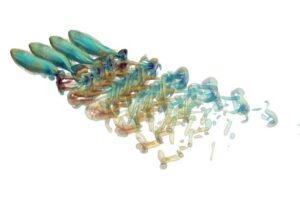
The single biggest key to sound reduction, the team found, was the synchronization of the school’s tail flapping—or actually the lack thereof. If fish moved in unison, flapping their tail fins at the same time, the sound added up and there was no reduction in total sound. But if they alternated tail flaps, the fish canceled out each other’s sound, the researchers found.

What’s quieter than a fish? A school of them

Illustration of the body plan of a toothed whale, with a cross section of the head showing the melon (dark yellow) and the extramandibular fat bodies (light yellow) which are key organs for using sound such as echolocation. (Hayate Takeuchi, Takashi Fritz Matsuishi, Takashi Hayakawa. Gene. January 20, 2024)

Toothed whale echolocation organs evolved from jaw muscles

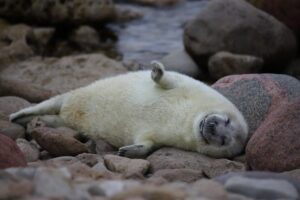
grey seal pup

Researchers warn: Kill fewer grey seals or risk extinction

Giant Antarctic sea spider (Photo credit: R. Robbins)

Giant Antarctic sea spiders reproductive mystery solved

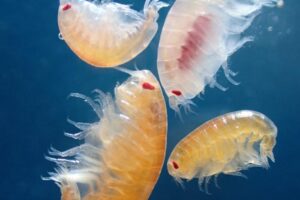
Scavenging amphipods from Kongsfjorden, Svalbard

Tiny crustaceans discovered preying on live jellyfish during harsh Arctic night

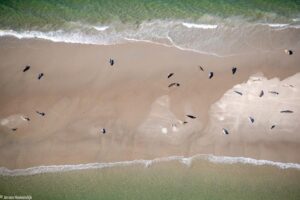
Aerial pictures of grey and harbour seals in the Dutch Wadden Sea. jeroen Hoekendijk

Computers are quick and reliable in counting seals

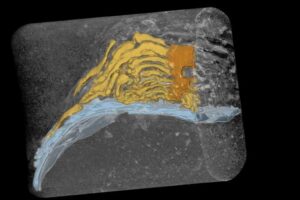
An X-ray reconstruction of a 32-million-year-old fossil kelp holdfast colored to show the base (orange), holdfast (yellow) and the bivalve shell to which it attached (blue).

Pacific kelp forests are far older that we thought

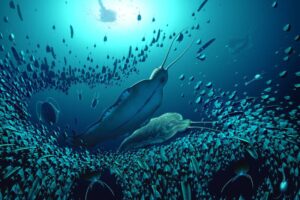
predator worms swimming under water

Ancient Predator Fossils Unearthed in Greenland

Believed to be predators in perpetual motion, grey reef sharks had previously only been observed in motion, leading most to believe they needed to swim in order to breath.

Some sharks don’t need to swim continuously to stay alive

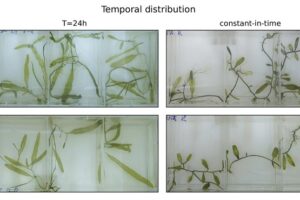
Can you tell which plants experienced a constant level of low light, and which cycled through the normal day-night routine?

Unraveling Caulerpa’s Growth Mysteries: Insights into a Single-Cell Algae’s Development

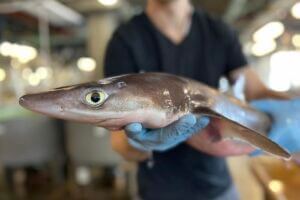
Spiny dogfish (Squalus acanthias), a small shark species, at the Marine Biological Laboratory, Woods Hole.

Sharks Display Unique Healing Abilities, Unlocking Potential Biomedical Applications

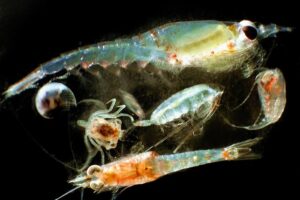
Zooplankton, tiny sea animals at the base of the food web, are on the move in the arctic as the North Pole’s ice cap retreats. Predators, including humans and whales, will follow.

Warming waters of the Arctic could pose a threat to Pacific right whales

Older posts
Newer posts
← Previous Page1 Page2 Page3 Page4 Next →
Substack subscription form sign up

Comments

  • Karoly Mirnics on Common Prescription Drugs May Disrupt Cholesterol Pathways in the Womb and Raise Autism Risk
  • Aizen on Laziness helped lead to extinction of Homo erectus
  • Norwood johnson on Electrons in New Crystals Behave as If They Live in Four Dimensions
  • ScienceBlog.com on Hidden Geometry Could Finally Fix Quantum Computers
  • Theo Prinse on America Is Going Back to the Moon. This Time, It Plans to Stay
© 2026 ScienceBlog.com | Follow our RSS / XML feed