Skip to content
ScienceBlog.com
  • Featured Blogs
    • EU Horizon Blog
    • ESA Tracker
    • Experimental Frontiers
    • Josh Mitteldorf’s Aging Matters
    • Dr. Lu Zhang’s Gondwanaland
    • NeuroEdge
    • NIAAA
    • SciChi
    • The Poetry of Science
    • Wild Science
  • Topics
    • Brain & Behavior
    • Earth, Energy & Environment
    • Health
    • Life & Non-humans
    • Physics & Mathematics
    • Social Sciences
    • Space
    • Technology
  • Our Substack
  • Follow Us!
    • Bluesky
    • Threads
    • FaceBook
    • Google News
    • Twitter/X
  • Contribute/Contact

Medical Technology

virtual neurosurgery simulator

AI Outperforms Human Instructors in Neurosurgical Training Study

This case highlights the effectiveness of using multimodality approaches for diagnosing iNPH, which not only saves the patient time but also reduces clinical costs. This approach is worth further promotion.

New Diagnostic Approach Improves Accuracy in Detecting Brain Fluid Buildup

scan of a woman's body

3D body volume scanner uses AI to help predict metabolic syndrome risk

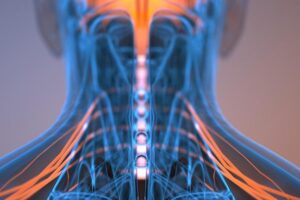
Researchers use Optically Pumped Magnetometers to non-invasively measure activity in human cervical nerves. The technology could help medical professionals tailor treatements for inflammatory conditions like sepsis and PTSD.

Researchers use non-invasive technique to record involuntary nervous system

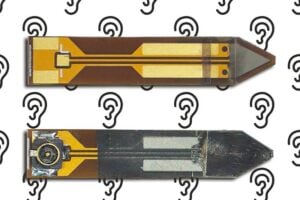
Pictured are the two sides of a prototype for the implantable microphone. Credits:Image: Courtesy of the researchers; iStock

Tiny Implantable Microphone Could Revolutionize Cochlear Implants

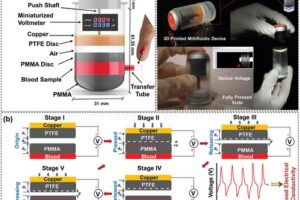
Vision of the proposed research for developing a self-powered, millifluidic lab-on-a-chip device to determine blood conductivity. a) Schematics and dimensions of the proposed device. The blood layer, copper electrodes, PTFE disc, and PMMA elements form a contact-separation mode TENG system. The blood sample is sandwiched between two PMMA layers and serves as one of the conductive layers. Any change in its electrical conductivity would theoretically change the voltage signal generated by the device. b) Operating principle of this blood-based TENG device. c) The 3D printed device and the type of voltage signal generated by it.

Novel blood-powered chip offers real-time health monitoring

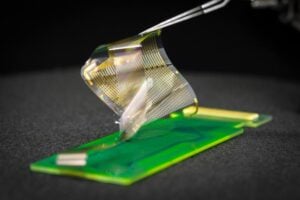
The PtNGrid features thin, flexible and densely packed grids of either 1,024 or 2,048 embedded electrocorticography (ECoG) sensors.

FDA Approves Clinical Trial for High-Resolution Brain Recorder

Dr. Shyh-Dar Li and Dr. Jiamin Wu

Oral insulin drops offer relief for diabetes patients

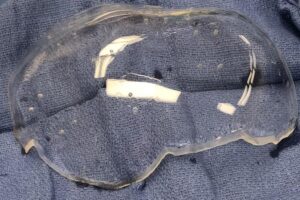
Clear experimental skull implant may enable functional ultrasound imaging of the brain for patients with serious head injuries.

Transparent Skull Implant Enables High-Resolution Brain Imaging in Awake Patients

ChatGPT screen in a hospital setting

ChatGPT’s Inconsistent Heart Risk Assessments Raise Concerns for Medical Use

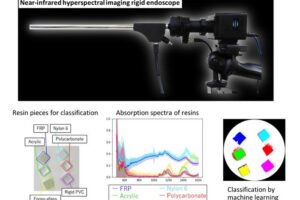
The novel hyperspectral imaging system accurately extracts the molecular vibrations of different resins and distinguishes between them with high reproducibility.

“Seeing the invisible”: new tech enables deep tissue imaging during surgery

Illustration of spinal cord

Flexible, Robotic Nerve ‘Cuffs’ Offer Potential for Minimally Invasive Monitoring and Treatment of Neurological Conditions

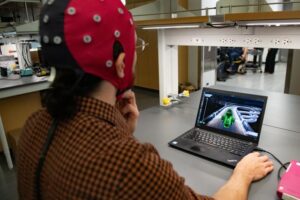
Hussein Alawieh, a graduate student in José del R. Millán's lab, wears a cap packed with electrodes that is hooked up to a computer. The electrodes gather data by measuring electrical signals from the brain, and the decoder interprets that information and translates it into game action.

Universal brain-computer interface lets people play games with just their thoughts

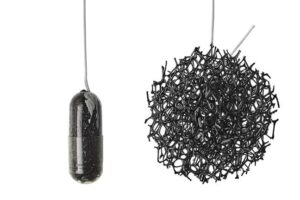
Capsule and sponge Credit: Cyted

Sponge-on-a-string test replaces need for endoscopy for thousands of patients

Older posts
Page1 Page2 Page3 Next →
Substack subscription form sign up

Comments

  • Norwood johnson on Electrons in New Crystals Behave as If They Live in Four Dimensions
  • ScienceBlog.com on Hidden Geometry Could Finally Fix Quantum Computers
  • Theo Prinse on America Is Going Back to the Moon. This Time, It Plans to Stay
  • george w on Hidden Geometry Could Finally Fix Quantum Computers
  • Tom Hughes on Years of Exercise, Blood Pressure Drugs Failed to Slow Cognitive Decline in Seniors at Dementia Risk
© 2026 ScienceBlog.com | Follow our RSS / XML feed