Skip to content
ScienceBlog.com
  • Featured Blogs
    • EU Horizon Blog
    • ESA Tracker
    • Experimental Frontiers
    • Josh Mitteldorf’s Aging Matters
    • Dr. Lu Zhang’s Gondwanaland
    • NeuroEdge
    • NIAAA
    • SciChi
    • The Poetry of Science
    • Wild Science
  • Topics
    • Brain & Behavior
    • Earth, Energy & Environment
    • Health
    • Life & Non-humans
    • Physics & Mathematics
    • Social Sciences
    • Space
    • Technology
  • Our Substack
  • Follow Us!
    • Bluesky
    • Threads
    • FaceBook
    • Google News
    • Twitter/X
  • Contribute/Contact

nanotechnology

Apigenin loaded nanoparticles for obesity

New Dual-Action Nanoparticles Turn Body Fat Into Calorie-Burning Machines

illustration of new type of entanglement

Researchers Discover a New Type of Quantum Entanglement

Professor Ly (back row, fourth from left) and her research team.

Novel Electric Field Discovery Points to Future of Quantum Computing, Nanotechnology

Scientists utilized zinc oxide nanowires to capture cancer-associated miRNAs in urinary extracellular vesicles. By integrating machine learning analysis, they identified specific miRNA ensembles that differentiate lung cancer patients from healthy individuals, showing promise as a non-invasive, early-stage cancer detection tool. This pioneering approach could transform cancer diagnosis, enhancing patient outcomes through earlier intervention.

New Nanowire Technology Detects Early-Stage Cancer Through Urine Test

Mass production of metal nanowires possible by breakthrough technique

Mass production of metal nanowires possible by breakthrough technique

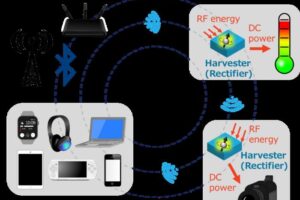
Schematic illustration of a wireless network with energy-harvesting modules. RF signals that are unused by electronic gadgets and would otherwise go to waste are used to generate usable DC power to drive sensors and devices.

Turning unused signals such as Wi-Fi into energy for electronics

The LANES lab's 2D device made of graphene and indium selenide © Alain Herzog

Ultra-Cold Quantum Cooling Breakthrough: New 2D Device Could Revolutionize Quantum Computing

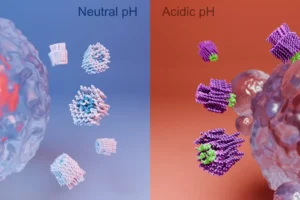
The nanorobot's weapon can only be exposed in the acidic environment found in and around a solid tumour. Illustration: Boxuan Shen

Stealthy Nanorobots Target and Destroy Cancer Cells in Mice

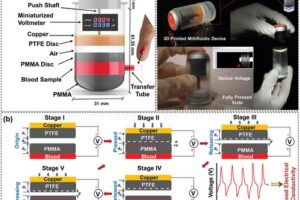
Vision of the proposed research for developing a self-powered, millifluidic lab-on-a-chip device to determine blood conductivity. a) Schematics and dimensions of the proposed device. The blood layer, copper electrodes, PTFE disc, and PMMA elements form a contact-separation mode TENG system. The blood sample is sandwiched between two PMMA layers and serves as one of the conductive layers. Any change in its electrical conductivity would theoretically change the voltage signal generated by the device. b) Operating principle of this blood-based TENG device. c) The 3D printed device and the type of voltage signal generated by it.

Novel blood-powered chip offers real-time health monitoring

Sound waves

New Drug Delivery Method Hits the Bullseye

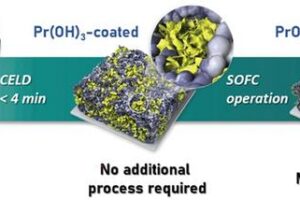
Schematic illustrations of the electrochemical coating process on LSM–YSZ electrode of SOFCs

Catalyst Coating Boosts Solid Oxide Fuel Cell Performance in Just 4 Minutes

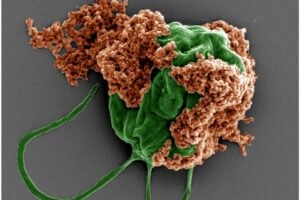
Colored SEM image of a microrobot made of an algae cell (green) covered with drug-filled nanoparticles (orange) coated with red blood cell membranes. Scale bar: 2 µm.

Microrobots Deliver Cancer-Fighting Drugs Directly to Lung Tumors, Boosting Survival in Mice

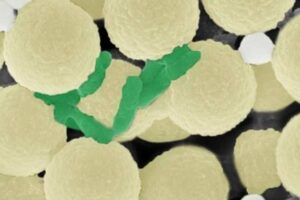
To clean water, researchers have designed swarms of tiny, spherical robots (light yellow) that collect bacteria (green) and small pieces of plastic (gray).

Microrobots Clean Microplastics and Bacteria from Water

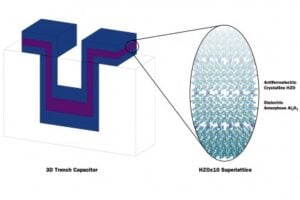
Microcapacitors made with engineered hafnium oxide/zirconium oxide films in 3D trench capacitor structures -- the same structures used in modern microelectronics -- achieve record-high energy storage and power density, paving the way for on-chip energy storage.

Groundbreaking Microcapacitors Could Power Chips of the Future

Older posts
Page1 Page2 … Page4 Next →
Substack subscription form sign up

Comments

  • Karoly Mirnics on Common Prescription Drugs May Disrupt Cholesterol Pathways in the Womb and Raise Autism Risk
  • Aizen on Laziness helped lead to extinction of Homo erectus
  • Norwood johnson on Electrons in New Crystals Behave as If They Live in Four Dimensions
  • ScienceBlog.com on Hidden Geometry Could Finally Fix Quantum Computers
  • Theo Prinse on America Is Going Back to the Moon. This Time, It Plans to Stay
© 2026 ScienceBlog.com | Follow our RSS / XML feed