Skip to content
ScienceBlog.com
  • Featured Blogs
    • EU Horizon Blog
    • ESA Tracker
    • Experimental Frontiers
    • Josh Mitteldorf’s Aging Matters
    • Dr. Lu Zhang’s Gondwanaland
    • NeuroEdge
    • NIAAA
    • SciChi
    • The Poetry of Science
    • Wild Science
  • Topics
    • Brain & Behavior
    • Earth, Energy & Environment
    • Health
    • Life & Non-humans
    • Physics & Mathematics
    • Social Sciences
    • Space
    • Technology
  • Our Substack
  • Follow Us!
    • Bluesky
    • Threads
    • FaceBook
    • Google News
    • Twitter/X
  • Contribute/Contact

Neurology

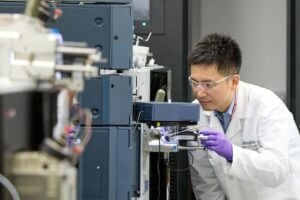
Kanta Horie, PhD, works with a mass spectrometer that he uses to measure protein levels in cerebrospinal fluid samples. Horie and colleagues at Washington University School of Medicine in St. Louis and Lund University in Sweden have discovered that a form of the protein tau in the cerebrospinal fluid known as MTBR-tau243 can be used to track the progression of Alzheimer's disease and could speed drug development.

Tau-based biomarker tracks Alzheimer’s progression

A boxer by his trade and he carries a reminder of every glove that laid him out or cut him til he cried out in his anger and his shame, I am leaving, I am leaving but the fighter still remained.

Among pro fighters, new criteria can ID who may develop CTE

A shaking hand

Exposure to TCE linked to increased risk of Parkinson’s

Network of dots

Drug teriflunomide may delay earliest symptoms of multiple sclerosis

Nerve bundles

Can fecal transplant help early-stage ALS? Study aims to find out

Women on a hammock looking at a pond

Sugar molecule in blood can predict Alzheimer’s disease

A blank face

COVID-19 can cause ‘face blindness’

Mediterranean diet

Mediterranean diet can help people with MS preserve thinking skills

Black physician speaking with female patient

Black people less likely to receive dementia-related medications

Lakeside

Living close to parks, water better for your brain

Toilet paper

Oh sh*!: People who regularly use laxatives may have an increased dementia risk

Woman with a headache

People with cluster headaches more likely to have other illnesses

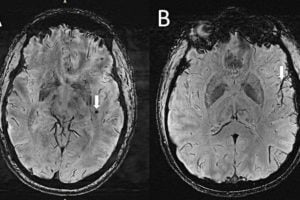
(A) Cerebral microbleeds (CMB) visualized as round, dark lesions (arrow) on SWI sequence in the left temporal lobe in a migraine case with aura. (B) Asymmetry in the appearance of the cortical vessels is more prominent on the left side (arrow) ipsilateral to the CMB.

Ultra-high-res MRI reveals migraine brain changes

green tea

Study: antioxidant flavonols linked to slower memory decline

Newer posts
← Previous Page1 Page2 Page3
Substack subscription form sign up

Comments

  • Karoly Mirnics on Common Prescription Drugs May Disrupt Cholesterol Pathways in the Womb and Raise Autism Risk
  • Aizen on Laziness helped lead to extinction of Homo erectus
  • Norwood johnson on Electrons in New Crystals Behave as If They Live in Four Dimensions
  • ScienceBlog.com on Hidden Geometry Could Finally Fix Quantum Computers
  • Theo Prinse on America Is Going Back to the Moon. This Time, It Plans to Stay
© 2026 ScienceBlog.com | Follow our RSS / XML feed