Skip to content
ScienceBlog.com
  • Featured Blogs
    • EU Horizon Blog
    • ESA Tracker
    • Experimental Frontiers
    • Josh Mitteldorf’s Aging Matters
    • Dr. Lu Zhang’s Gondwanaland
    • NeuroEdge
    • NIAAA
    • SciChi
    • The Poetry of Science
    • Wild Science
  • Topics
    • Brain & Behavior
    • Earth, Energy & Environment
    • Health
    • Life & Non-humans
    • Physics & Mathematics
    • Social Sciences
    • Space
    • Technology
  • Our Substack
  • Follow Us!
    • Bluesky
    • Threads
    • FaceBook
    • Google News
    • Twitter/X
  • Contribute/Contact

Paleontology

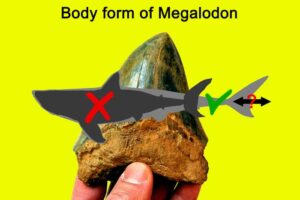
Study sheds new light on the body form of the Megalodon, and its role in shaping ancient marine life.

The megalodon was less mega than previously believed

wooly mammoth

Researchers chronicle lifetime travels of a single woolly mammoth which wandered the north more than 14,000 years ago

The Welsh countryside near the Coed Cochion Quarry, where the fossils were found. Picture: Anthony Clarke

Key moment in the evolution of life on Earth captured in fossils

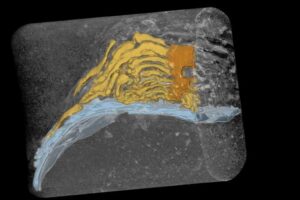
An X-ray reconstruction of a 32-million-year-old fossil kelp holdfast colored to show the base (orange), holdfast (yellow) and the bivalve shell to which it attached (blue).

Pacific kelp forests are far older that we thought

predator worms swimming under water

Ancient Predator Fossils Unearthed in Greenland

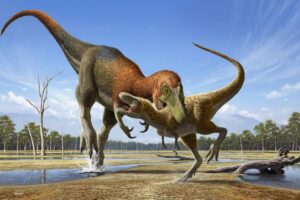
Artist illustration of Nanotyrannus attacking a juvenile T. rex.

“Juvenile T. rex” fossils are a distinct species of small tyrannosaur

Prehistoric people are attacking an elephant

People, not the climate, caused the decline of the giant mammals

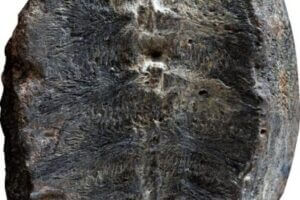
The fossil that was originally interpreted to be a plant, but researchers have now discovered is the inside of the shell of a baby turtle.

It turns out, this fossil plant is really a fossil baby turtle

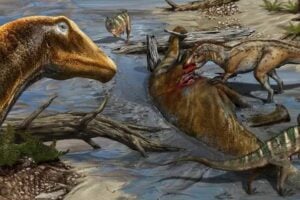
Bite and tooth marks on sauropod dinosaurs from the Morrison Formation

Surprising insights into feeding habits of carnivorous dinosaurs in North America

Ohio State logo

Advances in soft robotics usher in a new era of scientific analysis

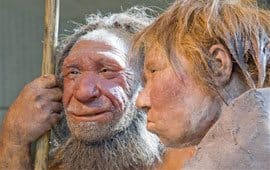
Neanderthal

The encounter between Neanderthals and Sapiens as told by their genomes

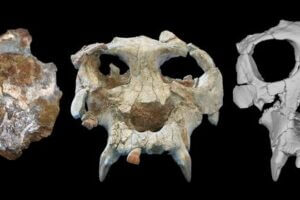
From left, the Pierolapithecus cranium shortly after discovery, after initial preparation, and after virtual reconstruction.

Extinct ape gets a facelift, 12 million years later

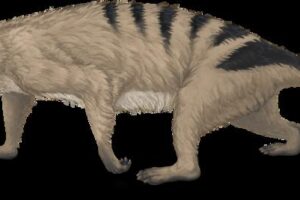
Life reconstruction of the ancient mammal relative Thrinaxodon from the Triassic Period of Earth history. Similar in size and shape to a modern mink, Thrinaxodon is close to the inferred size of the ancestor of the group of ancient mammal relatives called cynodonts, and it shared that ancestor’s likely preference for animal food. Image by April Neander.

Survival of the newest: the mammals that survive mass extinctions aren’t as “boring” as scientists thought

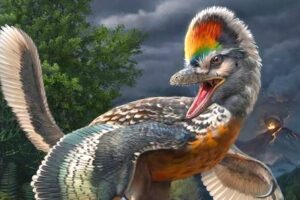
Life reconstruction of the 150-million-year-old avialan theropod Fujianvenator prodigiosus

Paleontologists find new fossil link in bird evolution

Older posts
Newer posts
← Previous Page1 Page2 Page3 Page4 … Page6 Next →
Substack subscription form sign up

Comments

  • Monte Dale Jr on Cracks Are Appearing in the Geometric Assumption Underlying All of Modern Cosmology
  • Monte Dale Jr on Cracks Are Appearing in the Geometric Assumption Underlying All of Modern Cosmology
  • Yehuda on A Pill That Keeps Your Throat Awake Could Transform Sleep Apnea Treatment
  • Jeffrey Erle Cunha on Cracks Are Appearing in the Geometric Assumption Underlying All of Modern Cosmology
  • Monte Dale Jr on Cracks Are Appearing in the Geometric Assumption Underlying All of Modern Cosmology
© 2026 ScienceBlog.com | Follow our RSS / XML feed