Skip to content
ScienceBlog.com
  • Featured Blogs
    • EU Horizon Blog
    • ESA Tracker
    • Experimental Frontiers
    • Josh Mitteldorf’s Aging Matters
    • Dr. Lu Zhang’s Gondwanaland
    • NeuroEdge
    • NIAAA
    • SciChi
    • The Poetry of Science
    • Wild Science
  • Topics
    • Brain & Behavior
    • Earth, Energy & Environment
    • Health
    • Life & Non-humans
    • Physics & Mathematics
    • Social Sciences
    • Space
    • Technology
  • Our Substack
  • Follow Us!
    • Bluesky
    • Threads
    • FaceBook
    • Google News
    • Twitter/X
  • Contribute/Contact

Paleontology

Prehistoric animals offer new evolutionary hints as riddles persist

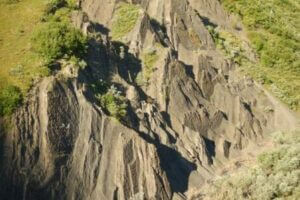
The Coliseum site is viewed from above. The once-horizontal rocks are now nearly vertical, exposing many hundreds of tracks on flatirons of resistant rock. The dimples on the rock faces are dinosaur tracks.

Scientists explore dinosaur ‘coliseum’ in Denali National Park

Bee

Bees likely evolved from ancient supercontinent, earlier than suspected

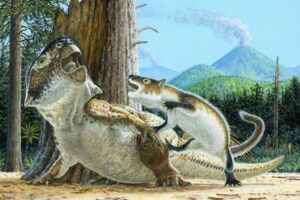
Illustration showing Repenomamus robustus as it attacks Psittacosaurus lujiatunensis moments before a volcanic debris flow buries them both, ca. 125 million years ago.

Unusual fossil shows rare evidence of a mammal attacking a dinosaur

New alligator identified in Asia. Image courtesy of Nature.

New ancient Asian alligator species identified

Apex predator of the Cambrian likely sought soft over crunchy prey

Ancient Sea Scourge Not So Fearsome After All

Present-day katydids of the genus Arethaea, pictured here, have the same internal structures as those seen in the fossil.

Exceptional Preservation of Internal Organs in 50-Million-Year-Old Katydid Fossil

A new species of early toothed whale

New Species of Ancient Toothed Whale Unveiled: Olympicetus thalassodon

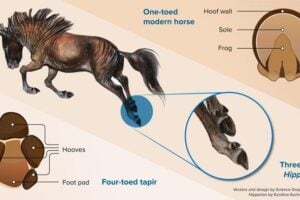
Plantar (underneath) view of feet of a four-toed tapir (left) and a one-toed horse (right) and in the middle, a reconstruction of the extinct three-toed horse

Modern horses have lost their additional toes, scientists confirm

Bone cavities called air sacs appeared in the ancestors of long-necked dinosaurs about 225 million years ago, according to the analysis of a specimen found in Rio Grande do Sul state, South Brazil. The study also shows that air sacs did not evolve as linearly as scientists believe (credit: Márcio L. Castro)

Brazilian fossil provides earliest evidence of evolutionary trait that enabled dinosaurs to become giants

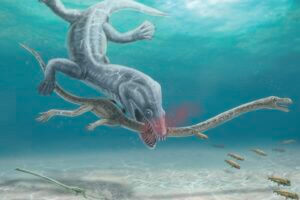
Artistic rendition of the decapitation scene of Tanystropheus hydroides

Decapitated Dinosaurs: Fossil Evidence Confirms Predators Exploited Long Necks of Ancient Marine Reptiles

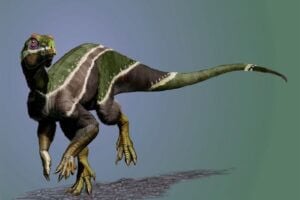
Iani Smithi

Iani smithi Ducks Out as Duckbills Take Over

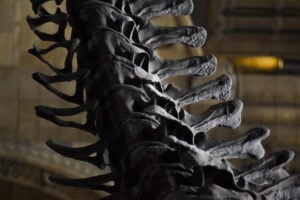
Dinosaur spine

Unveiling the Secrets of Ancient Dinosaurs: Cutting-Edge X-ray Technology Sheds Light on Prehistoric World


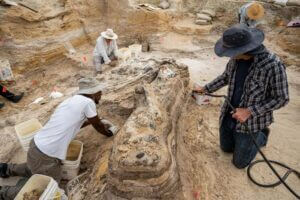
Researchers and volunteers with the Florida Museum of Natural History have discovered the ancient remains of several gomphotheres at a fossil site in North Florida.

Paleontologists discover elephant graveyard in North Florida

Older posts
Newer posts
← Previous Page1 … Page3 Page4 Page5 Page6 Next →
Substack subscription form sign up

Comments

  • Monte Dale Jr on Cracks Are Appearing in the Geometric Assumption Underlying All of Modern Cosmology
  • Monte Dale Jr on Cracks Are Appearing in the Geometric Assumption Underlying All of Modern Cosmology
  • Yehuda on A Pill That Keeps Your Throat Awake Could Transform Sleep Apnea Treatment
  • Jeffrey Erle Cunha on Cracks Are Appearing in the Geometric Assumption Underlying All of Modern Cosmology
  • Monte Dale Jr on Cracks Are Appearing in the Geometric Assumption Underlying All of Modern Cosmology
© 2026 ScienceBlog.com | Follow our RSS / XML feed