Skip to content
ScienceBlog.com
  • Featured Blogs
    • EU Horizon Blog
    • ESA Tracker
    • Experimental Frontiers
    • Josh Mitteldorf’s Aging Matters
    • Dr. Lu Zhang’s Gondwanaland
    • NeuroEdge
    • NIAAA
    • SciChi
    • The Poetry of Science
    • Wild Science
  • Topics
    • Brain & Behavior
    • Earth, Energy & Environment
    • Health
    • Life & Non-humans
    • Physics & Mathematics
    • Social Sciences
    • Space
    • Technology
  • Our Substack
  • Follow Us!
    • Bluesky
    • Threads
    • FaceBook
    • Google News
    • Twitter/X
  • Contribute/Contact

particle physics

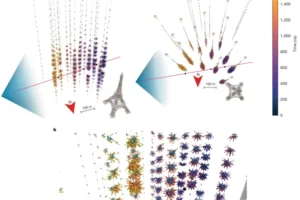
a, Side and top views of the event. The reconstructed trajectory of the muon is shown as a red line, along with an artist’s representation of the Cherenkov light cone. The hits of individual PMTs are represented by spheres stacked along the direction of the PMT orientations. Only the first five hits on each PMT are shown. As indicated in the legend, the spheres are coloured according to the detection time relative to the first triggered hit. The size of the spheres is proportional to the number of photons detected by the corresponding PMT. The locations of the secondary cascades, discussed in the Supplementary Material, are indicated by the black spheres along the muon trajectory. The north direction is indicated by a red arrow. A 100-m scale and the Eiffel Tower (330 m height, 125 m base width) are shown for size comparison. b, Zoomed-in view of the optical modules that are close to the first two observed secondary showers in the event. Here light-blue spheres represent hits that arrive within −5 to 25 ns of the expected Cherenkov arrival times.

Most Powerful Ghost Particle Ever Detected Unlocks New View of the Cosmos

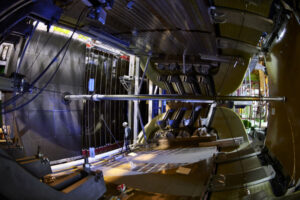
The LHCb detector seen in 2018 during its opening (Image: CERN)

Large Hadron Collider Makes Breakthrough in Universe’s Missing Antimatter Mystery

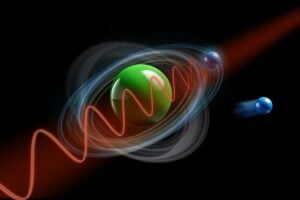
An atom is hit by a laser pulse. One electron is ripped out of the atom, another electron is shifted into a state with higher energy.

Scientists Track Quantum Entanglement at Nature’s Fastest Timescale

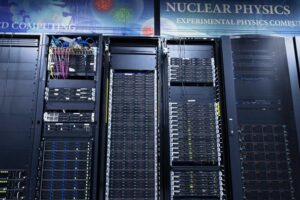
Nuclear theorists in the HadStruc Collaboration have been working on a mathematical description of the interactions of partons using supercomputers, including machines in Jefferson Lab's Data Center.

Physicists Map 3D Structure of Protons and Neutrons Using Supercomputers

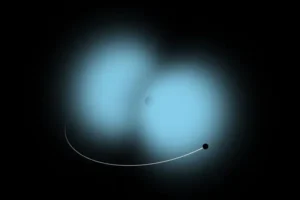
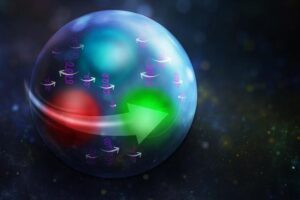
A gravitational atom. Just as electrons can orbit around the nucleus of an atom, a cloud of previously undiscovered ultralight particles can orbit around pairs of black holes.

Black Hole Mergers Could Reveal Elusive Ultralight Particles

The Short-Baseline Neutrino Detector collaboration celebrated the moment the detector began running at 100% voltage.

Neutrino Detector Marks Milestone in Hunt for Elusive Particle

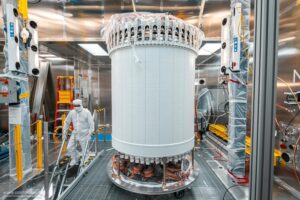
LUX-ZEPLIN Experiment Narrows the Search for Elusive Dark Matter

LUX-ZEPLIN Experiment Narrows the Search for Elusive Dark Matter

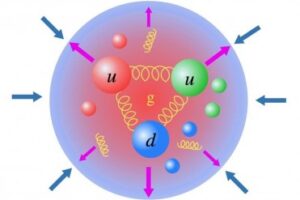
Scientists Discover Energy and Pressure Analogies Linking Hadrons, Superconductors, and Cosmic Expansion

Quantum Anomalies Link Subatomic Particles to Cosmic Expansion

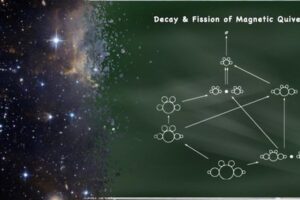
The decay and fission of magnetic quivers provides insights into the physical and mathematical foundations of quantum field theories. QFTs are the framework for the description of countless physical phenomena: from subatomic particles to the universe.

Unveiling the Secrets of Mass: Physicists Use “Magnetic Quivers” to Rethink the Higgs Mechanism

A global analysis of experimental data and lattice Quantum Chromodynamics calculations provides insight into the role of the gluons (purple squiggles) contributing to the spin of the nucleon. Gluons are manifestations of the

Theory and experiment combine to shine a new light on proton spin

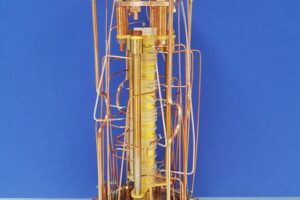
PENTATRAP

Scientists Take a Step Closer to Solving the Mystery of Neutrino Masses

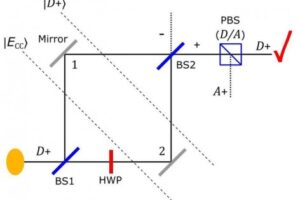
THE SIMPLE INTERFEROMETER USED IN THE QUANTUM CHESHIRE CAT SCENARIO, WHERE A PHOTON IS PREPARED IN THE PATH-POLARISATION ENTANGLED STATE ECC, BUT IS ONLY CONSIDERED IF IT ARRIVES ON OUTPUT PATH + WITH POLARISATION D. THE PARADOX ARISES WHEN WE CONSIDER THE PHOTON’S PATH, POLARISATION, AND PATH-POLARISATION CORRELATION, WHILE IT IS INSIDE THE INTERFEROMETER.

Quantum particles can’t separate from their properties, after all

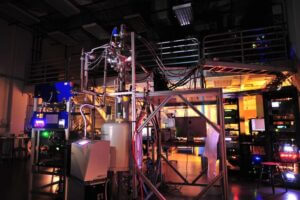
Cyclotron Radiation Emission Spectroscopy (CRES), seen here, is the key to a totally new method that aims to pin down the mass of the elusive neutrino.

Closing in on the Elusive Neutrino

Ohio State logo

Using supernovae to study neutrinos’ strange properties

Older posts
Page1 Page2 Next →
Substack subscription form sign up

Comments

  • brenojames on Global warming reduces available wind energy
  • Kidreadytobreed on Global warming reduces available wind energy
  • James on Global warming reduces available wind energy
  • James on Global warming reduces available wind energy
  • Booklet AI on Key to online education: Test early and often
© 2026 ScienceBlog.com | Follow our RSS / XML feed