Skip to content
ScienceBlog.com
  • Featured Blogs
    • EU Horizon Blog
    • ESA Tracker
    • Experimental Frontiers
    • Josh Mitteldorf’s Aging Matters
    • Dr. Lu Zhang’s Gondwanaland
    • NeuroEdge
    • NIAAA
    • SciChi
    • The Poetry of Science
    • Wild Science
  • Topics
    • Brain & Behavior
    • Earth, Energy & Environment
    • Health
    • Life & Non-humans
    • Physics & Mathematics
    • Social Sciences
    • Space
    • Technology
  • Our Substack
  • Follow Us!
    • Bluesky
    • Threads
    • FaceBook
    • Google News
    • Twitter/X
  • Contribute/Contact

particle physics

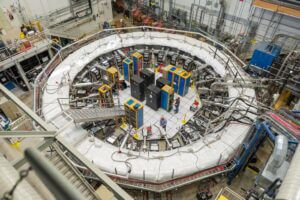
The announcement on Aug. 10, 2023 is the second result from the experiment at Fermilab , which is twice as precise than the first result announced on April 7, 2021.

Muon g-2 doubles down with latest measurement, explores uncharted territory in search of new physics

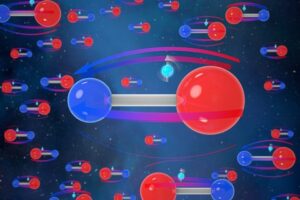
Electrons are made up of a negative electrical charge, and scientists at JILA have been trying to measure how evenly that charge is spread between the north and south pole of the electron. Any unevenness would indicate that the electron is not perfectly round, and that would be evidence of an asymmetry in the early universe that led to the existence of matter. The Cornell Group at JILA studied how the electrons in molecules behaved as they adjusted the magnetic field around them to look for any shift in the electrons. Credit: JILA/Steven Burrows

Why Does Matter Exist? Roundness of Electrons May Hold Clues

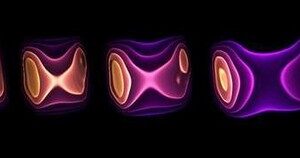
This graphic shows the energy density (yellow is high; purple is low) at different times during the hydrodynamic evolution of matter created in a collision of a lead ion (moving to the left) with a photon emitted from another lead ion (moving to the right

Hitting nuclei with light may create fluid primordial matter

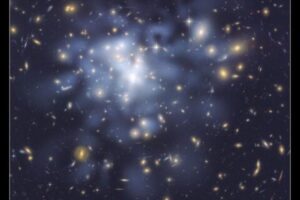
This NASA Hubble Space Telescope image shows the distribution of dark matter in the center of the giant galaxy cluster Abell 1689, containing about 1,000 galaxies and trillions of stars. Dark matter is an invisible form of matter that accounts for most of the universe’s mass. Hubble cannot see the dark matter directly. Astronomers inferred its location by analyzing the effect of gravitational lensing, where light from galaxies behind Abell 1689 is distorted by intervening matter within the cluster. Researchers used the observed positions of 135 lensed images of 42 background galaxies to calculate the location and amount of dark matter in the cluster. They superimposed a map of these inferred dark matter concentrations, tinted blue, on an image of the cluster taken by Hubble’s Advanced Camera for Surveys. If the cluster’s gravity came only from the visible galaxies, the lensing distortions would be much weaker. The map reveals that the densest concentration of dark matter is in the cluster’s core. Abell 1689 resides 2.2 billion light-years from Earth. The image was taken in June 2002. Image credit: NASA, ESA, D. Coe (NASA Jet Propulsion Laboratory/California Institute of Technology, and Space Telescope Science Institute), N. Benitez (Institute of Astrophysics of Andalusia, Spain), T. Broadhurst (University of the Basque Country, Spain), and H. Ford (Johns Hopkins University)

A new model for dark matter

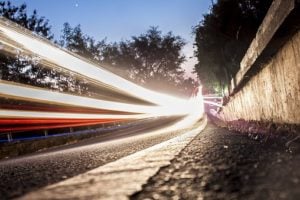
Light streaks along a railroad

Fast-traveling observers could witness a lot of cray-cray physics

In Borromean rings, each circle holds the pattern together by passing through the other two circles.

A peculiar protected structure links Viking knots with quantum vortices

Newer posts
← Previous Page1 Page2
Substack subscription form sign up

Comments

  • Josh Mitteldorf on Red States and Blue States Are Becoming the Same Unhappy Country
  • Josh Mitteldorf on Scientists Have Written the Rules for First Contact, and Step One Is Don’t Panic
  • John E on A New Theory Says DMT Entities Might Be Real, and Proposes How to Test It
  • ScienceBlog.com on A New Theory Says DMT Entities Might Be Real, and Proposes How to Test It
  • John E on A New Theory Says DMT Entities Might Be Real, and Proposes How to Test It
© 2026 ScienceBlog.com | Follow our RSS / XML feed