Skip to content
ScienceBlog.com
  • Featured Blogs
    • EU Horizon Blog
    • ESA Tracker
    • Experimental Frontiers
    • Josh Mitteldorf’s Aging Matters
    • Dr. Lu Zhang’s Gondwanaland
    • NeuroEdge
    • NIAAA
    • SciChi
    • The Poetry of Science
    • Wild Science
  • Topics
    • Brain & Behavior
    • Earth, Energy & Environment
    • Health
    • Life & Non-humans
    • Physics & Mathematics
    • Social Sciences
    • Space
    • Technology
  • Our Substack
  • Follow Us!
    • Bluesky
    • Threads
    • FaceBook
    • Google News
    • Twitter/X
  • Contribute/Contact

physics

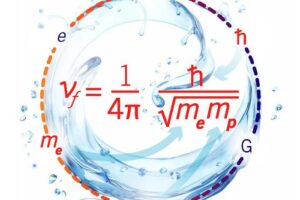
The image shows how fundamental constants of nature set the fundamental lower limit for liquid viscosity.

How a cup of water can unlock the secrets of our Universe

Researchers have discovered Pines' demon, a collection of electrons in a metal that behaves like a massless wave.

Demon Hunting: Physicists confirm 67-year-old prediction of massless, neutral composite particle

Ohio State logo

Using supernovae to study neutrinos’ strange properties

Despite doubts from quantum physicists: Einstein's theory of relativity reaffirmed

Despite doubts from quantum physicists, Einstein’s theory of relativity reaffirmed

How the humble neutron can help solve some of the universe’s deepest mysteries

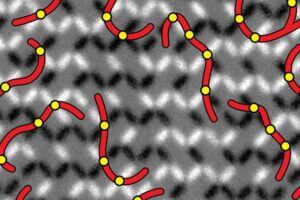
A snapshot of a lattice of frustrated nanomagnets.

Nanomagnetic strings that wiggle and hook up

A University of Chicago study found links at the atomic level between photosynthesis and exciton condensates—a strange state of physics that allows energy to flow frictionlessly through a material. The finding is scientifically intriguing and may suggest new ways to think about designing electronics, the authors said.

Scientists find link between photosynthesis and ‘fifth state of matter’

Cosmic April Fool

An artistic representation resembling a cosmological wormhole if one existed in nature.

Quantum breakthrough paves way for world-first experimental wormhole

A student takes a shot at Bartels Hall.

Physics model could optimize basketball player positioning

Superconductivity at Ordinary Temperatures

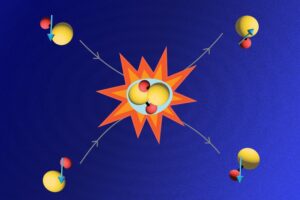
Two identical molecules that are colliding form an intermediate complex when they are in resonance. The intermediate complex sets off a reaction to transform the molecules into a new state. Credits:Credit: Juliana Park

Physicists observe rare resonance in molecules for the first time

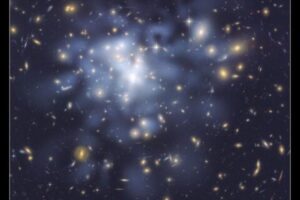
This NASA Hubble Space Telescope image shows the distribution of dark matter in the center of the giant galaxy cluster Abell 1689, containing about 1,000 galaxies and trillions of stars. Dark matter is an invisible form of matter that accounts for most of the universe’s mass. Hubble cannot see the dark matter directly. Astronomers inferred its location by analyzing the effect of gravitational lensing, where light from galaxies behind Abell 1689 is distorted by intervening matter within the cluster. Researchers used the observed positions of 135 lensed images of 42 background galaxies to calculate the location and amount of dark matter in the cluster. They superimposed a map of these inferred dark matter concentrations, tinted blue, on an image of the cluster taken by Hubble’s Advanced Camera for Surveys. If the cluster’s gravity came only from the visible galaxies, the lensing distortions would be much weaker. The map reveals that the densest concentration of dark matter is in the cluster’s core. Abell 1689 resides 2.2 billion light-years from Earth. The image was taken in June 2002. Image credit: NASA, ESA, D. Coe (NASA Jet Propulsion Laboratory/California Institute of Technology, and Space Telescope Science Institute), N. Benitez (Institute of Astrophysics of Andalusia, Spain), T. Broadhurst (University of the Basque Country, Spain), and H. Ford (Johns Hopkins University)

A new model for dark matter

Light streaks along a railroad

Fast-traveling observers could witness a lot of cray-cray physics

Newer posts
← Previous Page1 … Page3 Page4
Substack subscription form sign up

Comments

  • Karoly Mirnics on Common Prescription Drugs May Disrupt Cholesterol Pathways in the Womb and Raise Autism Risk
  • Aizen on Laziness helped lead to extinction of Homo erectus
  • Norwood johnson on Electrons in New Crystals Behave as If They Live in Four Dimensions
  • ScienceBlog.com on Hidden Geometry Could Finally Fix Quantum Computers
  • Theo Prinse on America Is Going Back to the Moon. This Time, It Plans to Stay
© 2026 ScienceBlog.com | Follow our RSS / XML feed