Skip to content
ScienceBlog.com
  • Featured Blogs
    • EU Horizon Blog
    • ESA Tracker
    • Experimental Frontiers
    • Josh Mitteldorf’s Aging Matters
    • Dr. Lu Zhang’s Gondwanaland
    • NeuroEdge
    • NIAAA
    • SciChi
    • The Poetry of Science
    • Wild Science
  • Topics
    • Brain & Behavior
    • Earth, Energy & Environment
    • Health
    • Life & Non-humans
    • Physics & Mathematics
    • Social Sciences
    • Space
    • Technology
  • Our Substack
  • Follow Us!
    • Bluesky
    • Threads
    • FaceBook
    • Google News
    • Twitter/X
  • Contribute/Contact

physics

Still image of trapped gas atoms

Scientists trap krypton atoms to form one-dimensional gas

brain cell networks

Surprisingly simple model explains how brain cells organize and connect

Optical tweezers, shown here trapping a nanoparticle, are among the systems impacted by a type of uncertainty that physicists have long missed. (image: Steven Hoekstra/Wikipedia CC BY-SA 4.0)

Physicists identify overlooked uncertainty in real-world experiments

To simplify the solving of massive numbers of partial differential equations (PDEs) for computational modeling, new data-driven surrogate models compute the goal property of a solution to PDEs rather than the whole solution. Credits:Image: Joshua Sortino/Unsplash

Technique could efficiently solve partial differential equations for numerous applications

ice illustration

Even far below freezing, ice’s surface begins melting as temperatures rise

Laser setup for cooling, controlling, and entangling individual molecules. Photo by Richard Soden, Department of Physics

Physicists ‘entangle’ individual molecules for the first time

Ohio State logo

Agostini is awarded Nobel Prize, while Ohio State cheers

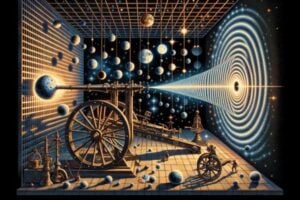
The image depicts an experiment in which heavy particles (illustrated as the moon), cause an interference pattern (a quantum effect), while also bending spacetime. The hanging pendulums depict the measurement of spacetime. The actual experiment is typically performed using Carbon-60, one of the largest known molecules. The UCL calculation indicates that the experiment should also be performed using higher density atoms such as gold. The other two images represent the two experiments proposed by the UCL group, both of which constrain any theory where spacetime is treated classically. One is the weighing of a mass, the other is an interference experiment.

New theory unites Einstein’s gravity with quantum mechanics

Passive Rydberg-atomic transducer

Physicists create new form of antenna for radio waves

Microscopic image

Superlensing without a super lens: physicists boost microscopes beyond limits

While errors are normally hard to spot in quantum devices, researchers have shown that, with careful control, some errors can cause atoms to glow. Researchers used this capability to execute a quantum simulation using an array of atoms and a laser beam, as shown in this artist's concept. The experiment showed that they could discard the glowing, erroneous atoms and make the quantum simulation run more efficiently.

A new way to erase quantum computer errors

Plot thickens in hunt for ninth planet

Plot thickens in hunt for ninth planet

Ohio State logo

Ohio State’s Agostini wins Nobel Prize in Physics

An artist's conceptual rendering of antihydrogen atoms falling out the bottom of the magnetic trap of the ALPHA-g apparatus. As the antihydrogen atoms escape, they touch the chamber walls and annihilate. Most of the annihilations occur beneath the chamber, showing that gravity is pulling the antihydrogen down. The rotating magnetic field lines in the animation represent the invisible influence of the magnetic field on the antihydrogen. The magnetic field does not rotate in the actual experiment.

Down goes antimatter! Gravity’s effect on matter’s elusive twin is revealed

Older posts
Newer posts
← Previous Page1 Page2 Page3 Page4 Next →
Substack subscription form sign up

Comments

  • Mark Mellinger on Living Plastic Can Self-Destruct on Command
  • Marie Feret on The Silent Frequency That Makes Old Buildings Feel Haunted
  • Dax on The Silent Frequency That Makes Old Buildings Feel Haunted
  • Karoly Mirnics on Common Prescription Drugs May Disrupt Cholesterol Pathways in the Womb and Raise Autism Risk
  • Aizen on Laziness helped lead to extinction of Homo erectus
© 2026 ScienceBlog.com | Follow our RSS / XML feed