Skip to content
ScienceBlog.com
  • Featured Blogs
    • EU Horizon Blog
    • ESA Tracker
    • Experimental Frontiers
    • Josh Mitteldorf’s Aging Matters
    • Dr. Lu Zhang’s Gondwanaland
    • NeuroEdge
    • NIAAA
    • SciChi
    • The Poetry of Science
    • Wild Science
  • Topics
    • Brain & Behavior
    • Earth, Energy & Environment
    • Health
    • Life & Non-humans
    • Physics & Mathematics
    • Social Sciences
    • Space
    • Technology
  • Our Substack
  • Follow Us!
    • Bluesky
    • Threads
    • FaceBook
    • Google News
    • Twitter/X
  • Contribute/Contact

quantum physics

illustration of new type of entanglement

Researchers Discover a New Type of Quantum Entanglement

By building a unique, advanced machine, Rutgers scientists have created a structure with quantum qualities. The green window (right) is the main growth chamber where synthesis of the quantum "sandwiches" occurs. Within the amber window (left) are advanced characterization tools that uncover chemical and electronic properties of the grown quantum thin films without exposing them to air.

Scientists Merge Two “Impossible” Materials Into New Artificial Structure

A new study finds that new quantum particles form by pairing quasiparticles that carry fractional charges. Courtesy of Demin Liu.

Scientists Discover New Quantum Particles That Break Classical Rules

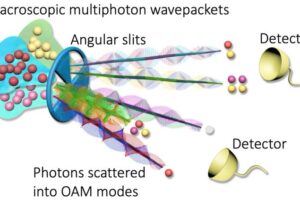
The diagram illustrates the process of multiparticle scattering mediated by twisted paths endowed with orbital angular momentum (OAM). The number of photons in each twisted path is measured and correlated using photon-number-resolving (PNR) detectors.

Quantum Secrets in Classical Light: How Pseudothermal Systems Defy Physics’ Boundaries

Abstract colourful lines Credit: gremlin via Getty Images

Simulations Simplify Mystery of Elusive Quantum Particles

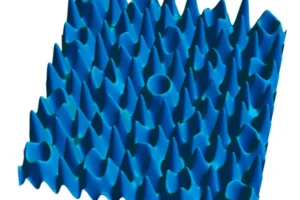
The quasiperiodic landscape in which the new Bose glass forms, similar to a Penrose tiling.

New Phase of Matter Discovered in 2D: Bose Glass Challenges Statistical Mechanics

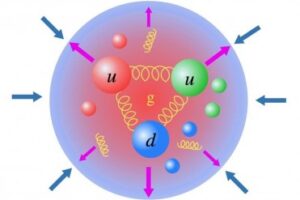
Scientists Discover Energy and Pressure Analogies Linking Hadrons, Superconductors, and Cosmic Expansion

Quantum Anomalies Link Subatomic Particles to Cosmic Expansion

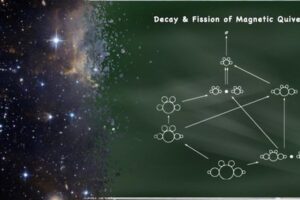
The decay and fission of magnetic quivers provides insights into the physical and mathematical foundations of quantum field theories. QFTs are the framework for the description of countless physical phenomena: from subatomic particles to the universe.

Unveiling the Secrets of Mass: Physicists Use “Magnetic Quivers” to Rethink the Higgs Mechanism

Rendering of the photonic topological insulator developed in the study

How a tiny device could lead to big physics discoveries and better lasers

PENTATRAP

Scientists Take a Step Closer to Solving the Mystery of Neutrino Masses

Subwavelength grated waveguide supporting polariton droplets (visualization: Antonio Gianfrate, source: CNR Nanotec).

Scientists Create Stable Quantum Droplets of Light for Advanced Simulations

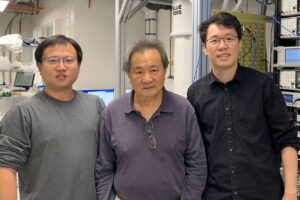
From left: Professor Sanfeng Wu, Professor Nai Phuan Ong and Dicke Fellow Tiancheng Song. Photo by Yanyu Jia

Researchers discover an abrupt change in quantum behavior that defies current theories of superconductivity


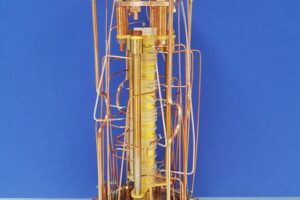
A trapped nanoparticle in vacuum at Wright Lab. (Credit: Tom Penny)

What goes up, must… be quantum? Experiment to test gravity’s quantum chops

This NASA Hubble Space Telescope image features a bright spiral galaxy known as MCG-01-24-014, which is located about 275 million light-years from Earth.

Hubble sights a galaxy with ‘forbidden’ light

Older posts
Page1 Page2 Next →
Substack subscription form sign up

Comments

  • Karoly Mirnics on Common Prescription Drugs May Disrupt Cholesterol Pathways in the Womb and Raise Autism Risk
  • Aizen on Laziness helped lead to extinction of Homo erectus
  • Norwood johnson on Electrons in New Crystals Behave as If They Live in Four Dimensions
  • ScienceBlog.com on Hidden Geometry Could Finally Fix Quantum Computers
  • Theo Prinse on America Is Going Back to the Moon. This Time, It Plans to Stay
© 2026 ScienceBlog.com | Follow our RSS / XML feed