Skip to content
ScienceBlog.com
  • Featured Blogs
    • EU Horizon Blog
    • ESA Tracker
    • Experimental Frontiers
    • Josh Mitteldorf’s Aging Matters
    • Dr. Lu Zhang’s Gondwanaland
    • NeuroEdge
    • NIAAA
    • SciChi
    • The Poetry of Science
    • Wild Science
  • Topics
    • Brain & Behavior
    • Earth, Energy & Environment
    • Health
    • Life & Non-humans
    • Physics & Mathematics
    • Social Sciences
    • Space
    • Technology
  • Our Substack
  • Follow Us!
    • Bluesky
    • Threads
    • FaceBook
    • Google News
    • Twitter/X
  • Contribute/Contact

quantum physics

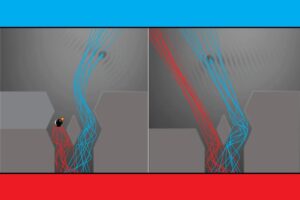
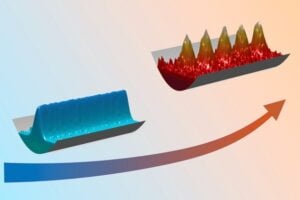
MIT mathematicians tracked a droplet as it bounced through a structure inspired by the theoretical “quantum bomb test.” The shows the droplet’s trajectories when the "bomb" is present, and the right panel shows the trajectories taken when the "bomb" is absent. Credits:Credit: Courtesy of the researchers

Classical Droplets Mimic Quantum Wonders: Bridging Worlds in Bomb-Detecting Behavior

The race is on for a new internet

When some ultrathin materials undergo a “nematic transition,” their atomic lattice structure stretches in ways that unlock superconductivity (as this conceptual image shows). MIT physicists have identified how this essential nematic switch occurs in one class of superconductors.

A new switch for superconducting

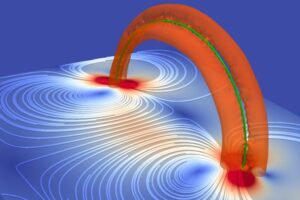
Visualization of quantized vortex ring above the plane (green curve), normal-fluid vortex rings (reddish half circles)

Scientists Unravel Mystery of Quantum Vortex Interaction in Superfluid Helium

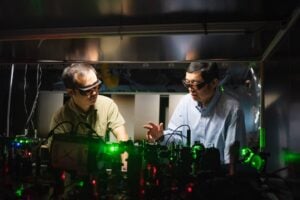
Using a "spooky" phenomenon of quantum physics, Caltech researchers have discovered a way to double the resolution of light microscopes.

Quantum Entanglement of Photons Doubles Microscope Resolution

It’s about time!

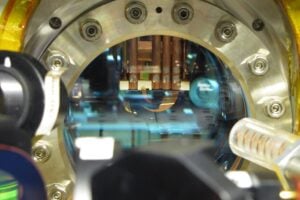
Vacuum chamber containing the atom chip

Paradoxical quantum phenomenon measured for the first time

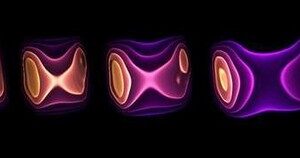
When a quantum liquid is heated, crystalline structures can appear.

Quantum liquid becomes solid when heated

This graphic shows the energy density (yellow is high; purple is low) at different times during the hydrodynamic evolution of matter created in a collision of a lead ion (moving to the left) with a photon emitted from another lead ion (moving to the right

Hitting nuclei with light may create fluid primordial matter

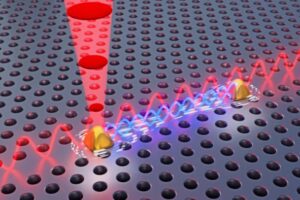
Researchers have found a way to create much stronger interactions between photons and electrons, in the process producing a hundredfold increase in the emission of light from a phenomenon called Smith-Purcell radiation. Credits:Courtesy of the researchers

A new path toward ‘quantum light’

Illustration of two a chip comprising two entangled quantum light sources

Quantum physicists make major advance in entanglement

Series Title: Algorithms for Construction of Reality in Physics - Vol. 2 Schrödinger’s Cat Smile Volume 2

All in our heads? Physics book calls for better description of reality

Newer posts
← Previous Page1 Page2
Substack subscription form sign up

Comments

  • John E on A New Theory Says DMT Entities Might Be Real, and Proposes How to Test It
  • Simon on A New Theory Says DMT Entities Might Be Real, and Proposes How to Test It
  • Sue Ann Hayes on Hidden Nuclear Protein Fuels Pancreatic Cancer’s Deadly Aggression
  • Curtis Webber on The GPS-Killer? This Quantum Device ‘Feels’ Motion Like a Brain—Down to the Atomic Level
  • Ran on How the Age You First Had Sex Could Shape How You Age Decades Later
© 2026 ScienceBlog.com | Follow our RSS / XML feed