Skip to content
ScienceBlog.com
  • Featured Blogs
    • EU Horizon Blog
    • ESA Tracker
    • Experimental Frontiers
    • Josh Mitteldorf’s Aging Matters
    • Dr. Lu Zhang’s Gondwanaland
    • NeuroEdge
    • NIAAA
    • SciChi
    • The Poetry of Science
    • Wild Science
  • Topics
    • Brain & Behavior
    • Earth, Energy & Environment
    • Health
    • Life & Non-humans
    • Physics & Mathematics
    • Social Sciences
    • Space
    • Technology
  • Our Substack
  • Follow Us!
    • Bluesky
    • Threads
    • FaceBook
    • Google News
    • Twitter/X
  • Contribute/Contact

schizophrenia

glowing blue brain

Puberty Triggers Brain Rewiring in Genetic Condition Tied to Autism

Police car lights

Improving Police Interactions for People with Schizophrenia

The brain has about 100 billion cells called neurons. It’s made up of distinct parts, that developed though human evolution. copyright American Heart Association

Blood Fat Profiles Reveal Why Some Cannabis Users Develop Schizophrenia While Others Don’t

The study used imaging data from more than 6,000 people in 22 countries. By comparing several thousand patients with schizophrenia and healthy individuals, the variability of brain structure could be studied with a high degree of reliability. (Image: iStock.com/Jolygon)

Common Psychiatric Medications Silently Sabotage Brain Function in Psychosis Patients

eyes

Simple Eye Test Could Help Identify Risk of Paranoid Thinking

brain illustration

Multiple Sclerosis Drug Shows Promise for Boosting Working Memory

Infographic: Myran et al. JAMA Psych. 2024

ER Visits for Hallucinogen Use Linked to 21x Higher Schizophrenia Risk

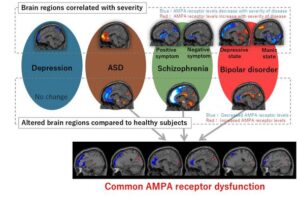
In this study, researchers used positron emission tomography and a special tracer to study the relationship between the distribution of an important neuronal receptor (AMPA) and the occurrence and severity of different psychiatric disorders.

Breakthrough Brain Imaging Technique Reveals New Insights into Psychiatric Disorders

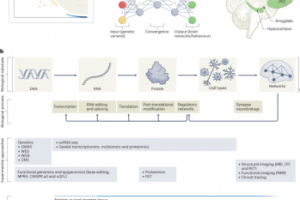
Fig. 2: A pathway from genomics to an aetiological theory of schizophrenia.

Genetic Complexity of Schizophrenia Unveiled in Comprehensive Review

People with psychosis have trouble filtering relevant information (mesh funnel) and predicting rewarding events (broken crystal ball), creating a complex inner world.

How Brain Dysfunction Fuels Hallucinations and Delusions in Psychosis

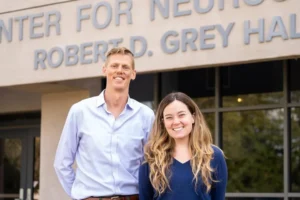
Prof. Alex Nord, right and graduate student Tracy Warren have discovered genetic variants linked to some symptoms of schizophrenia that are currently hard to treat. The work could lead to new insights and treatments for the disease. (Sasha Bakhter, UC Davis College of Biological Sciences)

Unraveling the Puzzle of Schizophrenia: Study Links Genes to Symptoms

A computer terminal looking ominous

It’s getting harder to distinguish between reality and delusion, thanks to technology

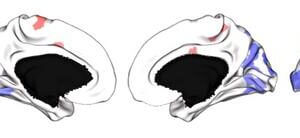
Brain areas with the greatest difference between individuals with and without schizophrenia, with a pronounced negative effect in visual areas of the brain.

Brain connectivity is disrupted in schizophrenia

Brain illustration

Placenta Plays Crucial Role in Schizophrenia Risk

Older posts
Page1 Page2 Next →
Substack subscription form sign up

Comments

  • Norwood johnson on Electrons in New Crystals Behave as If They Live in Four Dimensions
  • ScienceBlog.com on Hidden Geometry Could Finally Fix Quantum Computers
  • Theo Prinse on America Is Going Back to the Moon. This Time, It Plans to Stay
  • george w on Hidden Geometry Could Finally Fix Quantum Computers
  • Tom Hughes on Years of Exercise, Blood Pressure Drugs Failed to Slow Cognitive Decline in Seniors at Dementia Risk
© 2026 ScienceBlog.com | Follow our RSS / XML feed