Skip to content
ScienceBlog.com
  • Featured Blogs
    • EU Horizon Blog
    • ESA Tracker
    • Experimental Frontiers
    • Josh Mitteldorf’s Aging Matters
    • Dr. Lu Zhang’s Gondwanaland
    • NeuroEdge
    • NIAAA
    • SciChi
    • The Poetry of Science
    • Wild Science
  • Topics
    • Brain & Behavior
    • Earth, Energy & Environment
    • Health
    • Life & Non-humans
    • Physics & Mathematics
    • Social Sciences
    • Space
    • Technology
  • Our Substack
  • Follow Us!
    • Bluesky
    • Threads
    • FaceBook
    • Google News
    • Twitter/X
  • Contribute/Contact

solar behavior

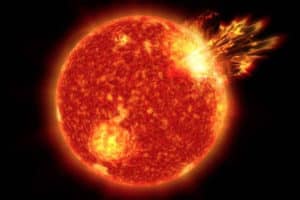
In the simulations, a tight ring of polar vortices forms at around 55 degrees latitude, the equivalent of Earth’s Arctic circle. After forming, the vortices head toward the poles in a tightening ring, shedding vortices as the circle closes, eventually leaving only a pair of vortices directly abutting the poles before they disappear altogether at solar maximum. How many vortices form and their configuration as they move toward the poles changes with the strength of the solar cycle.

Computer Models Reveal Solar Polar Vortices for First Time

Substack subscription form sign up

Comments

  • Marie Feret on The Silent Frequency That Makes Old Buildings Feel Haunted
  • Dax on The Silent Frequency That Makes Old Buildings Feel Haunted
  • Karoly Mirnics on Common Prescription Drugs May Disrupt Cholesterol Pathways in the Womb and Raise Autism Risk
  • Aizen on Laziness helped lead to extinction of Homo erectus
  • Norwood johnson on Electrons in New Crystals Behave as If They Live in Four Dimensions
© 2026 ScienceBlog.com | Follow our RSS / XML feed