Skip to content
ScienceBlog.com
  • Featured Blogs
    • EU Horizon Blog
    • ESA Tracker
    • Experimental Frontiers
    • Josh Mitteldorf’s Aging Matters
    • Dr. Lu Zhang’s Gondwanaland
    • NeuroEdge
    • NIAAA
    • SciChi
    • The Poetry of Science
    • Wild Science
  • Topics
    • Brain & Behavior
    • Earth, Energy & Environment
    • Health
    • Life & Non-humans
    • Physics & Mathematics
    • Social Sciences
    • Space
    • Technology
  • Our Substack
  • Follow Us!
    • Bluesky
    • Threads
    • FaceBook
    • Google News
    • Twitter/X
  • Contribute/Contact

Spacetime

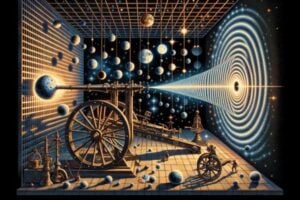
The image depicts an experiment in which heavy particles (illustrated as the moon), cause an interference pattern (a quantum effect), while also bending spacetime. The hanging pendulums depict the measurement of spacetime. The actual experiment is typically performed using Carbon-60, one of the largest known molecules. The UCL calculation indicates that the experiment should also be performed using higher density atoms such as gold. The other two images represent the two experiments proposed by the UCL group, both of which constrain any theory where spacetime is treated classically. One is the weighing of a mass, the other is an interference experiment.

New theory unites Einstein’s gravity with quantum mechanics

Substack subscription form sign up

Comments

  • Marco Messina on More Than a Third of Americans Have Lost Relationships Over Politics
  • Anon on Why Fructose Behaves Less Like a Calorie and More Like a Hormone
  • Mark Mellinger on Living Plastic Can Self-Destruct on Command
  • Marie Feret on The Silent Frequency That Makes Old Buildings Feel Haunted
  • Dax on The Silent Frequency That Makes Old Buildings Feel Haunted
© 2026 ScienceBlog.com | Follow our RSS / XML feed