Skip to content
ScienceBlog.com
  • Featured Blogs
    • EU Horizon Blog
    • ESA Tracker
    • Experimental Frontiers
    • Josh Mitteldorf’s Aging Matters
    • Dr. Lu Zhang’s Gondwanaland
    • NeuroEdge
    • NIAAA
    • SciChi
    • The Poetry of Science
    • Wild Science
  • Topics
    • Brain & Behavior
    • Earth, Energy & Environment
    • Health
    • Life & Non-humans
    • Physics & Mathematics
    • Social Sciences
    • Space
    • Technology
  • Our Substack
  • Follow Us!
    • Bluesky
    • Threads
    • FaceBook
    • Google News
    • Twitter/X
  • Contribute/Contact

stem cells

Blood cells in the bone marrow

Regular Blood Donors Develop ‘Super Cells’ That Could Help Fight Disease

Pathological phosphorylation (yellow) of Tau proteins (red-orange) leads to disintegration of microtubuli in the neuron axon an aggregation of the tau proteins. The transport of synaptic vesicles (orange-blue) is interrupted. Credit: selvanegra on iStock

Achilles’ Heel of Alzheimer’s: Scientists Pinpoint Crucial Protein Variant Driving Brain Cell Damage

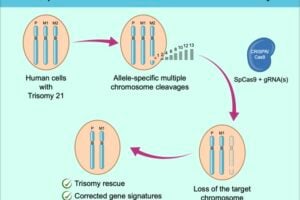
A graphical abstract summarizes the approach.

Using CRISPR to remove extra chromosomes in Down syndrome

Closeup of a woman's cheek and lips

Stem Cells Help Engineer New Path to Facial Nerve Repair

Lead researcher Ashok Shetty has filed a patent on the intranasal application of neural stem cell-derived extracellular vesicles for treating Alzheimer’s and other neurological and neurodegenerative disorders.

Simple Nasal Spray Could Help Slow Alzheimer’s Disease, Study Shows

ISS

Space-Grown Stem Cells Show Promise for Revolutionary Medical Treatments

A dormant human blastoid.

Scientists Discover Mechanism to “Pause” Early Human Development

An astrocyte cell grown in tissue culture stained with antibodies to GFAP and vimentin. © GerryShaw / Wikipedia

Astrocytes Reprogrammed into Brain Stem Cells: A New Hope for Regenerative Medicine

Red blood cells

Blood stem cell breakthrough could transform bone marrow transplants

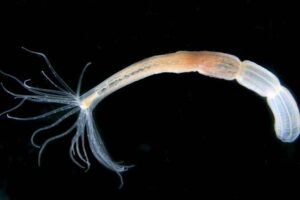
A single Nematostella polyp.

Sea Anemone’s Stem Cells May Hold Key to Immortality

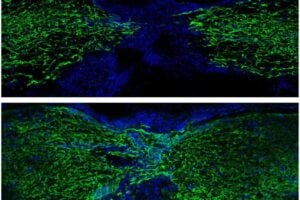
The top image shows fluorescently labeled cells in the spinal cord of a zebrafish recovering one week after an injury, and the bottom image shows recovery four weeks after an injury. Researchers at Washington University School of Medicine in St. Louis describe the dramatic changes within nerve cells that make regeneration possible. Such findings could inspire the development of new therapies for spinal cord injuries in people.

Zebrafish use surprising strategy to regrow spinal cord

One of just two vertebrates without a jaw, sea lampreys that are wreaking havoc in Midwestern fisheries are simultaneously helping scientists understand the origins of two important stem cells.

Jawless Lampreys Reveal Ancient Secrets of Vertebrate Evolution

Julia Aguade Gorgorio (left) and Dr. Hanna Mikkola (right)

Scientists identify ‘missing piece’ required for blood stem cell self-renewal

A computer-generated image depicting a microscopic view of Mycobacterium abscessus bacteria, with a background showing a world map and a red marker pointing to Mexico.

CDC Investigates Highly Drug-Resistant Outbreak Linked to Stem Cell Injections in Mexico

Older posts
Page1 Page2 Page3 Next →
Substack subscription form sign up

Comments

  • Karoly Mirnics on Common Prescription Drugs May Disrupt Cholesterol Pathways in the Womb and Raise Autism Risk
  • Aizen on Laziness helped lead to extinction of Homo erectus
  • Norwood johnson on Electrons in New Crystals Behave as If They Live in Four Dimensions
  • ScienceBlog.com on Hidden Geometry Could Finally Fix Quantum Computers
  • Theo Prinse on America Is Going Back to the Moon. This Time, It Plans to Stay
© 2026 ScienceBlog.com | Follow our RSS / XML feed