Skip to content
ScienceBlog.com
  • Featured Blogs
    • EU Horizon Blog
    • ESA Tracker
    • Experimental Frontiers
    • Josh Mitteldorf’s Aging Matters
    • Dr. Lu Zhang’s Gondwanaland
    • NeuroEdge
    • NIAAA
    • SciChi
    • The Poetry of Science
    • Wild Science
  • Topics
    • Brain & Behavior
    • Earth, Energy & Environment
    • Health
    • Life & Non-humans
    • Physics & Mathematics
    • Social Sciences
    • Space
    • Technology
  • Our Substack
  • Follow Us!
    • Bluesky
    • Threads
    • FaceBook
    • Google News
    • Twitter/X
  • Contribute/Contact

stem cells

Blood cells illustration

Arthritis drug may turn old blood young again

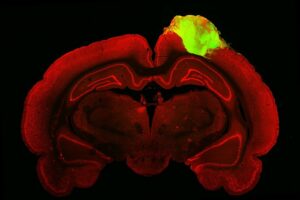
This is a histological image of a rat brain with a grafted human brain organoid.

Human brain tissue responds to visual stimuli when transplanted into rats

3D Organoid Models Show Brain Mechanisms of Tourette Syndrome

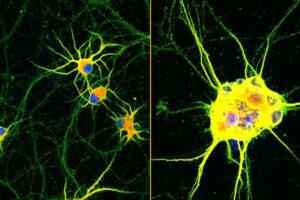
Fluorescent images of human neurons (stained with red, green and blue) growing on coatings with fast-moving molecules (left) or conventional laminin (right) for 60 days. Neurons spread homogenously and showed more complex branching on the highly mobile coating developed at Northwestern.

Lab-grown neurons hold promise for neurodegenerative disease

David Gamm’s laboratory developed a way to grow organoids that resemble the retina. UW–MADISON

Lab-grown eye cells connect with neighbors, paving way for blindness treatments

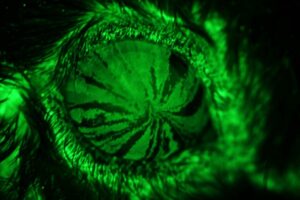
When eyes are dry, the cornea is more susceptible to injury. By tracking the movements of stem cells (in fluorescent green) in a mouse eye, researchers were able to trace the cells as they differentiated into corneal cells and migrated to the center of the cornea, providing clues about how the cells work to help corneal injuries heal.

New targets for treating dry eye disease and preventing cornea injuries

Pregnant woman with doctor

Effects of antidepressants in pregnancy are poorly understood

Newer posts
← Previous Page1 Page2 Page3
Substack subscription form sign up

Comments

  • Karoly Mirnics on Common Prescription Drugs May Disrupt Cholesterol Pathways in the Womb and Raise Autism Risk
  • Aizen on Laziness helped lead to extinction of Homo erectus
  • Norwood johnson on Electrons in New Crystals Behave as If They Live in Four Dimensions
  • ScienceBlog.com on Hidden Geometry Could Finally Fix Quantum Computers
  • Theo Prinse on America Is Going Back to the Moon. This Time, It Plans to Stay
© 2026 ScienceBlog.com | Follow our RSS / XML feed