Skip to content
ScienceBlog.com
  • Featured Blogs
    • EU Horizon Blog
    • ESA Tracker
    • Experimental Frontiers
    • Josh Mitteldorf’s Aging Matters
    • Dr. Lu Zhang’s Gondwanaland
    • NeuroEdge
    • NIAAA
    • SciChi
    • The Poetry of Science
    • Wild Science
  • Topics
    • Brain & Behavior
    • Earth, Energy & Environment
    • Health
    • Life & Non-humans
    • Physics & Mathematics
    • Social Sciences
    • Space
    • Technology
  • Our Substack
  • Follow Us!
    • Bluesky
    • Threads
    • FaceBook
    • Google News
    • Twitter/X
  • Contribute/Contact

sustainability

A 3D rendered image depicting a wastewater treatment plant with a futuristic, glowing pipeline leading to a clean water droplet and a green energy symbol, representing the transformation of sewage sludge into clean water and renewable energy.

From Sewage Sludge to Clean Water and Energy

An artistic rendering of a copper oxide crystal, with electrons moving diagonally through the cube-shaped structure. The crystal is bathed in sunlight, symbolizing its potential for solar energy conversion and clean hydrogen fuel generation.

Twisting Copper Oxide Crystals Boosts Sustainable Fuel Generation

Particle counts of petroleum-based (EVA) and plant-based (TPU-FC1) microplastics show that, over time, EVAs exhibit virtually no biodegradation, while the TPUs have mostly disappeared by day 200.

Plant-Based Plastics Biodegrade in Months, Not Centuries

water battery

New water batteries stay cool under pressure

Rooftop garden growing produce

Urban agriculture has carbon footprint 6 times larger than conventional produce

Bowl full of algae based curry

Algae as a surprising meat alternative and source of environmentally friendly protein

Infographic

A new force of nature is reshaping this planet

Jeremy Snyder/Berkeley Lab

Analysis Confirms California’s Salton Sea Region to Be a Rich Domestic Lithium Resource

Man about to enter waves with surfboard

Mental health of surfers creates US$1trillion wave for economy

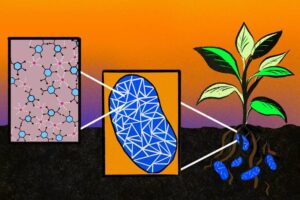
MIT chemical engineers devised a metal-organic coating that protects bacterial cells from damage without impeding their growth or function. These coated bacteria could make it much easier for farmers to deploy microbes as fertilizers. At left, the inset shows the components that create the protective shell of the microbes, as represented in the center inset by triangular formations. Credits:Image: Jose-Luis Olivares, MIT based on figures courtesy of the researchers

Microbes could help reduce the need for chemical fertilizers

Vineyards of the future will produce more than wine

A city at night seen from a distance glowing orange

Cities’ energy use to change dramatically

Cocoa pods, like this one with parts of the husk removed for analyses, could be a useful starting material for flame retardants.

Cocoa pods — a source of chocolate, and potentially, flame retardants

AI helps Japanese buildings save big on HVAC costs

AI helps Japanese buildings save big on HVAC costs

Older posts
Newer posts
← Previous Page1 Page2 Page3 … Page5 Next →
Substack subscription form sign up

Comments

  • Karoly Mirnics on Common Prescription Drugs May Disrupt Cholesterol Pathways in the Womb and Raise Autism Risk
  • Aizen on Laziness helped lead to extinction of Homo erectus
  • Norwood johnson on Electrons in New Crystals Behave as If They Live in Four Dimensions
  • ScienceBlog.com on Hidden Geometry Could Finally Fix Quantum Computers
  • Theo Prinse on America Is Going Back to the Moon. This Time, It Plans to Stay
© 2026 ScienceBlog.com | Follow our RSS / XML feed