Skip to content
ScienceBlog.com
  • Featured Blogs
    • EU Horizon Blog
    • ESA Tracker
    • Experimental Frontiers
    • Josh Mitteldorf’s Aging Matters
    • Dr. Lu Zhang’s Gondwanaland
    • NeuroEdge
    • NIAAA
    • SciChi
    • The Poetry of Science
    • Wild Science
  • Topics
    • Brain & Behavior
    • Earth, Energy & Environment
    • Health
    • Life & Non-humans
    • Physics & Mathematics
    • Social Sciences
    • Space
    • Technology
  • Our Substack
  • Follow Us!
    • Bluesky
    • Threads
    • FaceBook
    • Google News
    • Twitter/X
  • Contribute/Contact

Sustainable Technology

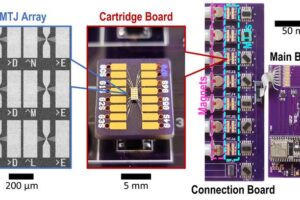
A custom-built hardware device plans to help artificial intelligence be more energy efficient. Credit: University of Minnesota Twin Cities

Energy-Efficient AI: New Hardware Could Slash Computing Power Needs by 1000x

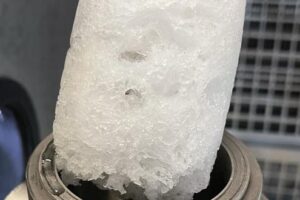
Carbon capturing hydrates created in Vaibhav Bahadur's lab.

Team Develops Fastest Carbon Storage Tech Without Harmful Chemicals

A simple, compact system first collects moisture from the air (left) and then releases the trapped liquid (right) when heated, which results in potable water.

Small, adsorbent ‘fins’ collect humidity rather than swim through water

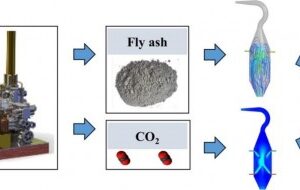
reactor process

Chinese reactor mineralizes CO2 with help of coal waste

Engineered yeast-containing hydrogel capsules could be used to remove lead from contaminated water rapidly and inexpensively. The work, from MIT and Georgia Tech researchers, could be especially useful in low-income areas with high lead contamination.

Repurposed beer yeast may offer a cost-effective way to remove lead from water

miassite superconductor illustartion

Scientists Discover First Naturally Occurring Unconventional Superconductor

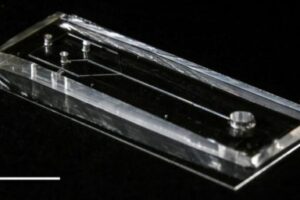
microfluidic device

Look out Spider-Man: Naturalistic silk spun from artificial spider gland

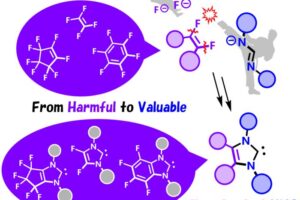
The conversion was achieved by simply removing two fluorine atoms from 1,2-difluoroalkene derivatives

Converting PFAS “forever chemicals” into valuable compounds

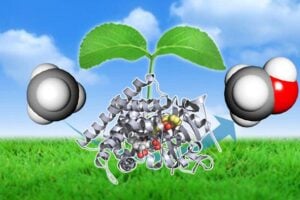
New technology converts a component of natural gas, methane (left), to methanol (right), using the P450BM3 enzyme (middle, grey) with a decoy molecule (middle, colored). This method can be a cheap and effective mean of reducing the carbon footprint of natural gas.

Reducing the carbon footprint of methane by converting it into methanol with a new enzyme

A fully recyclable transistor

Taming AI’s Outsized Electricity Appetite

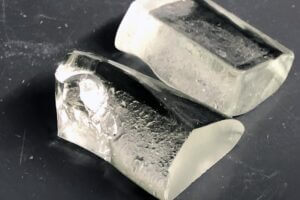
A sample of LionGlass, a new type of glass engineered by researchers at Penn State that requires significantly less energy to produce and is much more damage resistant than standard soda lime silicate glass. Credit: Adrienne Berard / Penn State. Creative Commons

New glass cuts carbon footprint by nearly half and is 10x more damage resistant

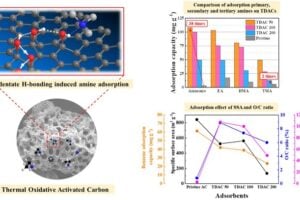
Adsorption mechanisms of heat-dried activated carbon and adsorption performance of nitrogen-containing odorous compounds

New technology for dramatic reduction of smelly air

UVB has many uses today but requires inefficient and toxic sources to produce. A collaborative effort involving Kyushu University and Johannes Gutenberg University Mainz developed a system where blue LED light is upconverted to UVB light. Moreover, the system uses only organic materials, opening the door for a more sustainable and ecofriendly method of generating UVB light.

Turning blue light into useful UVB

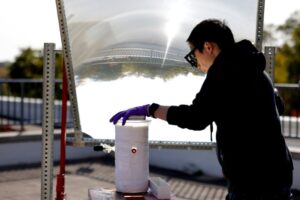
Peng Zhou uses a large lens to concentrate sunlight onto the water-splitting catalyst. Outdoors, the device was ten times more efficient than previous efforts at solar water splitting. Image credit: Brenda Ahearn/Michigan Engineering, Communications and Marketing

Cheap, sustainable hydrogen through solar power

Substack subscription form sign up

Comments

  • Norwood johnson on Electrons in New Crystals Behave as If They Live in Four Dimensions
  • ScienceBlog.com on Hidden Geometry Could Finally Fix Quantum Computers
  • Theo Prinse on America Is Going Back to the Moon. This Time, It Plans to Stay
  • george w on Hidden Geometry Could Finally Fix Quantum Computers
  • Tom Hughes on Years of Exercise, Blood Pressure Drugs Failed to Slow Cognitive Decline in Seniors at Dementia Risk
© 2026 ScienceBlog.com | Follow our RSS / XML feed