Skip to content
ScienceBlog.com
  • Featured Blogs
    • EU Horizon Blog
    • ESA Tracker
    • Experimental Frontiers
    • Josh Mitteldorf’s Aging Matters
    • Dr. Lu Zhang’s Gondwanaland
    • NeuroEdge
    • NIAAA
    • SciChi
    • The Poetry of Science
    • Wild Science
  • Topics
    • Brain & Behavior
    • Earth, Energy & Environment
    • Health
    • Life & Non-humans
    • Physics & Mathematics
    • Social Sciences
    • Space
    • Technology
  • Our Substack
  • Follow Us!
    • Bluesky
    • Threads
    • FaceBook
    • Google News
    • Twitter/X
  • Contribute/Contact

Wearable Technology

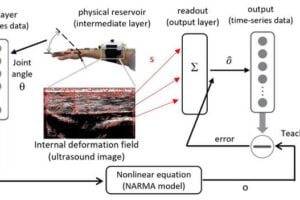
Information processing via human soft tissue

Human muscle tissue can perform complex calculations

A research group, led by Chalmers University of Technology in Sweden, presents an ordinary silk thread, coated with a conductive plastic material, that shows promising properties for turning textiles into electricity generators. Here, a button is sewn with the new thread.

Scientists Create Electric Thread That Turns Body Heat into Power

This illustration shows a future vision of assemblies of molecules formed by peptides and miniature molecular segments from a plastic material to create ferroelectric structures that switch polarity to store digital information or signal neurons.

Peptide-Plastic Material Paves the Way for Next-Gen Wearables, Medical Devices

Artsy black and white photo of an airliner. Pixabay

Aircraft Noise at Night Disrupts Sleep Quality, New Study Reveals

Mother Mererid and baby Mabli were volunteers in the study

Seeing Through a Baby’s Eyes: New Wearable Brain Scanner Maps Infant Brain Activity in Real-Time

Black strip of fibre is coated with MXene that allows the fabric to absorb sunlight and body heat and convert it to energy.

Solar-Powered Smart Fabric Heralds New Era in Wearable Tech

From Wearables to Swallowables: USC Engineering Researchers Create GPS-like Smart Pills with AI

Smart Pill with Wearable Tracking System Offers New Frontier in Gut Health Monitoring

A waterproof e-glove makes it easier for scuba divers to communicate underwater.

Underwater “E-Glove” Translates Divers’ Hand Gestures into Messages

This flexible and conductive material has “adaptive durability,” meaning it gets stronger when hit.

Hitting this stretchy, electronic material makes it tougher

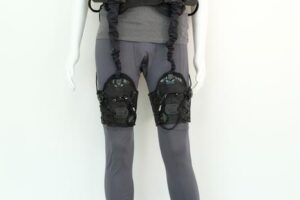
The robotic garment (above), worn around the hips and thighs, gives a gentle push to the hips as the leg swings, helping the patient achieve a longer stride.

Soft robotic, wearable device improves walking for individual with Parkinson’s disease

Astronaut. Pixabay

Wearable Vibrotactors Fight Astronaut Disorientation

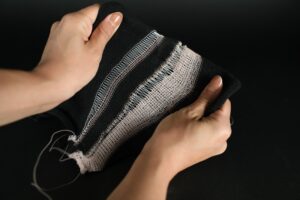
Researchers from MIT and Northeastern University developed a liquid crystal elastomer fiber that can change its shape in response to thermal stimuli. The fiber, which is fully compatible with existing textile manufacturing machinery, could be used to make morphing textiles, like a jacket that becomes more insulating to keep the wearer warm when temperatures drop.

Shape-shifting fiber can produce morphing fabrics

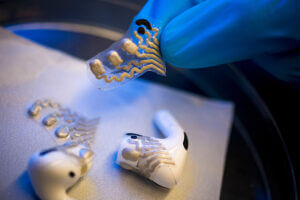
The screen-printed, flexible sensors are attached to the earbuds on a flexible, stamp-like surface.

Earbuds Record Brain Activity and Exercise Levels

Man wearing smart glasses

‘Smart’ glasses skew power balance with non-wearers

Older posts
Page1 Page2 Next →
Substack subscription form sign up

Comments

  • Marie Feret on The Silent Frequency That Makes Old Buildings Feel Haunted
  • Dax on The Silent Frequency That Makes Old Buildings Feel Haunted
  • Karoly Mirnics on Common Prescription Drugs May Disrupt Cholesterol Pathways in the Womb and Raise Autism Risk
  • Aizen on Laziness helped lead to extinction of Homo erectus
  • Norwood johnson on Electrons in New Crystals Behave as If They Live in Four Dimensions
© 2026 ScienceBlog.com | Follow our RSS / XML feed