

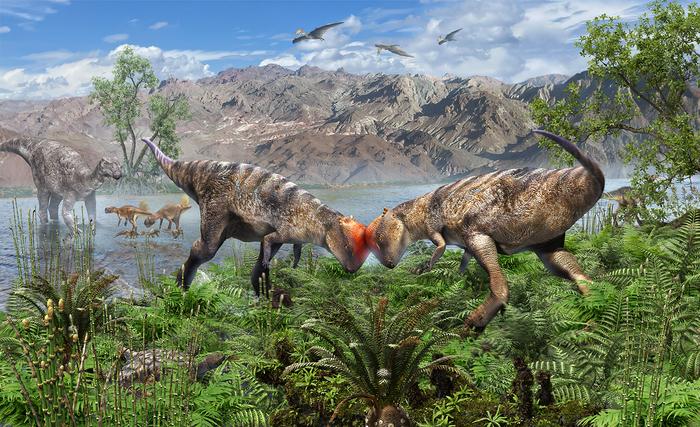
A teenage pachycephalosaur from Mongolia’s ancient landscape has upended long-held assumptions about when these iconic dome-headed dinosaurs first appeared on Earth. The remarkably complete 108-million-year-old fossil, named Zavacephale rinpoche, pushes back evidence of the characteristic skull dome by at least 15 million years while revealing unexpected insights about adolescent dinosaur development.
The diminutive specimen, measuring just three feet long, was discovered by Tsogtbaatar Chinzorig from the Mongolian Academy of Sciences in the Khuren Dukh locality of Mongolia’s Eastern Gobi Basin. What makes this find particularly intriguing is that despite being a juvenile when it died, Z. rinpoche already sported a fully formed dome – a discovery that challenges conventional wisdom about how these distinctive cranial features developed.
“Z. rinpoche is a spectacular find because it has limbs and a complete skull, allowing us to couple growth stage and dome development for the first time,” says Lindsay Zanno, head of paleontology at the North Carolina Museum of Natural Sciences.
Pachycephalosaurs have long puzzled paleontologists. These plant-eating dinosaurs, whose adults could reach 14 feet in length and weigh up to 900 pounds, are famous for their thick, domed skulls adorned with various ornamental features. Scientists widely believe these structures served social and mating purposes rather than defensive ones, leading to frequent depictions of dinosaurs engaging in dramatic head-butting contests.
A Juvenile With Adult Features
The research team’s analysis revealed a compelling paradox in Z. rinpoche’s development. By examining thin cross-sections of the specimen’s leg bone and comparing them to skull microstructure, researchers determined the animal was still actively growing when it died. Open skull sutures, unfused vertebrae, and bone tissue patterns all indicated an immature individual. Yet the dome showed advanced development typically associated with older animals.
This finding suggests these dinosaurs developed their signature headgear early in life, possibly to begin practicing social behaviors before reaching full size. The implications extend beyond individual development to broader questions about dinosaur behavior and evolution.
“If you need to headbutt yourself into a relationship, it’s a good idea to start rehearsing early,” Zanno explains.
The specimen also preserved unprecedented details about pachycephalosaur anatomy. Z. rinpoche represents the first discovery of pachycephalosaur hands, complete with sturdy metacarpals and clawed digits. A mass of stomach stones found near the skeleton provides the earliest evidence of how these dinosaurs processed their plant-based diet, though the relatively sharp-edged stones suggest a more varied diet than purely herbivorous modern birds.
Rewriting The Timeline
Beyond its anatomical revelations, Z. rinpoche forces a reconsideration of pachycephalosaur evolutionary history. Previous fossil evidence suggested dome development was a relatively late innovation in the group’s evolution, appearing only in more recent species. The discovery of a fully domed skull in such an ancient specimen indicates this distinctive feature evolved much earlier than previously thought.
The fossil also sheds light on how dome development proceeded. Rather than growing uniformly, Z. rinpoche’s dome shows a “frontal-first” pattern, with the front portions of the skull thickening before the rear sections became fully incorporated. This matches proposed developmental sequences in later species, suggesting this growth pattern remained consistent throughout pachycephalosaur evolution.
Living 108 million years ago during the Early Cretaceous period, Z. rinpoche inhabited a landscape of lakes and valleys in what is now Mongolia’s Gobi Desert. The environment supported diverse plant life that sustained these early dome-heads alongside other dinosaurs of the era.
The research, published in Nature, represents a collaboration between institutions in Mongolia, the United States, and Japan. The specimen remains housed at the Institute of Paleontology of the Mongolian Academy of Sciences, where it continues to yield insights about these enigmatic dinosaurs.
The discovery of Z. rinpoche demonstrates how single fossils can reshape understanding of entire evolutionary lineages. By combining advanced imaging techniques with traditional paleontological analysis, researchers continue uncovering the complex stories written in stone across millions of years of Earth’s history.