

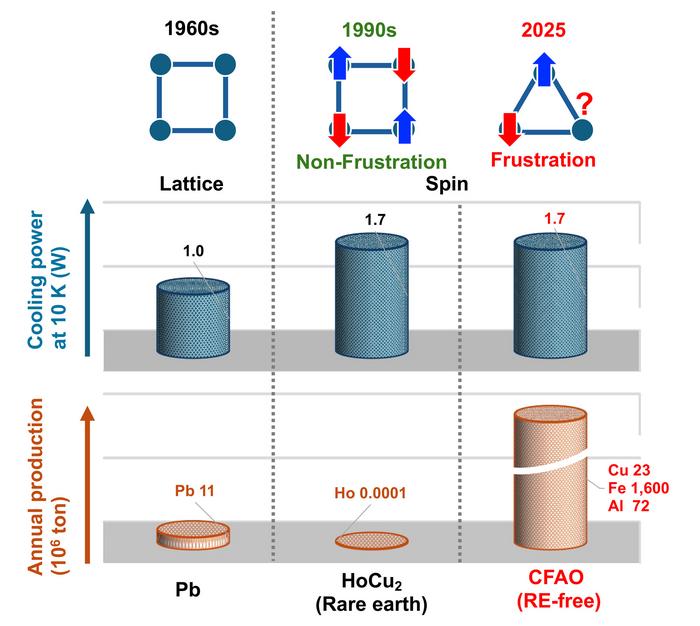
The numbers tell an uncomfortable story. There are roughly 100,000 MRI machines operating worldwide, and each one depends on extreme cold to function properly. Converting them all to helium-free cooling systems would require about 100 tons of holmium, a silvery rare-earth metal. Global production? Ten tons per year.
It’s this sort of math that has material scientists rethinking the periodic table. At Japan’s National Institute for Materials Science, a research team led by Noriki Terada has been exploring whether we might break free from our dependence on scarce materials. And they’ve found an answer in the quantum quirks of frustrated magnetism.
The breakthrough centres on a rather ordinary-sounding compound: copper, iron and aluminum oxide. Nothing exotic, nothing rare. But what this material does is extraordinary; it achieves cryogenic temperatures below 4 kelvin without a drop of liquid helium or a speck of rare earth elements. The team’s best sample hit 3.13 K, delivering 0.117 watts of cooling power at the helium condensation temperature. That matches the performance specifications of commercial refrigeration systems that cost millions and depend on vanishing resources.
The secret lies in something physicists call “frustration,” though the term has nothing to do with human emotion. Picture a triangle where each point contains a tiny magnet, and neighbouring magnets want to point in opposite directions. At two corners, you can satisfy this preference easily enough – one up, one down. But the third magnet? It faces a dilemma. Point up and you annoy one neighbour; point down and you upset the other.
This geometric impossibility — spins unable to simultaneously satisfy each other’s orientations in a triangular lattice — keeps the material magnetically disordered down to temperatures where most substances would have long since settled into rigid patterns. In the compound CuFeO₂, iron atoms arrange themselves in triangular layers, separated by copper and oxygen. The iron atoms’ magnetic fields interact strongly, with energy scales around 95 K. Without frustration, such strong interactions would typically force magnetic ordering at similar temperatures, making the material useless for cryogenic applications.
Instead, the frustrated triangular arrangement suppresses that ordering until much lower temperatures: 14 K and 11 K, where the material undergoes phase transitions. These transitions produce exactly what refrigeration engineers need: high specific heat capacity at the temperatures where conventional materials fall silent. Below 10 K, most substances exhibit negligible heat capacity, rendering them ineffective. The frustrated magnet sidesteps this limitation entirely.
The research team didn’t stop at pure CuFeO₂. By substituting a small amount of aluminum for iron, creating CuFe₀.₉₈Al₀.₀₂O₂, they broadened the material’s useful temperature range and enhanced its cooling capacity. The substitution alters the magnetic structure at low temperatures, boosting performance precisely where it matters most for practical applications.
There’s more to this than just replacing one material with another. Current cooling systems using holmium compounds face another problem in MRI environments: ferromagnetism. When placed in the powerful magnetic fields generated by MRI superconducting magnets, ferromagnetic materials experience substantial forces that can cause wear, deformation or outright failure. The new copper-iron-aluminum compound is antiferromagnetic with only weak field-induced magnetization – even at several tesla, it shows minimal response. Less magnetic noise, less mechanical stress, more reliable operation.
The path from laboratory to clinic isn’t instantaneous, mind you. The team’s current samples achieve a 55 per cent filling ratio in the refrigerator chambers. Spherical granulation processes could boost that to 65 per cent, improving efficiency further. Particle size matters too – balancing gas flow resistance against thermal conductivity – and the optimal dimensions may differ from those used with holmium compounds. Perhaps more interestingly, combining this frustrated material with other compounds that excel at different temperature ranges could extend performance across a broader spectrum.
What makes this development particularly timely is the convergence of supply constraints and surging demand. The transition away from fossil fuels is expected to reduce natural gas extraction, and helium – a byproduct of that process – will become scarcer still. Meanwhile, quantum computing’s explosive growth is creating entirely new demand for cryogenic cooling, amplifying pressure on systems already stretched thin by medical imaging needs.
The team’s work represents something more fundamental than a materials swap. For three decades, rare-earth compounds have dominated cryogenic cooling specifically because transition metals seemed inadequate. Their stronger magnetic interactions typically produce phase transitions well above useful temperatures. By exploiting frustration – a phenomenon physicists have studied since the 1950s but rarely harnessed for practical purposes – Terada and colleagues have opened a new avenue. The principle isn’t limited to this particular compound; other frustrated systems might offer different advantages.
Copper ranks among the most abundantly produced metals worldwide, with annual output in tens of millions of tons. Iron? Similar story. Aluminum? Even more plentiful. Compare that with holmium’s 10-ton annual production and uneven geographical distribution, and the strategic calculus becomes clear. A technology built on abundant elements doesn’t just solve supply problems; it redistributes who controls critical infrastructure.
The researchers published their findings in Scientific Reports in December 2025, but the implications ripple forward. Quantum computers, which require even more extreme cooling than MRIs, represent the next frontier. As these machines transition from laboratory curiosities to industrial tools, cooling capacity becomes a limiting factor. A solution that works with abundant materials, produces less magnetic interference and costs less to manufacture isn’t merely convenient. It might be necessary.
This is where physics meets geopolitics meets supply chains. Every technological revolution eventually collides with the reality of what Earth provides. Sometimes the answer isn’t finding more of a scarce resource but remembering that nature’s cleverness, quantum mechanical frustration, in this case, can be more powerful than rarity.
Study link: https://www.nature.com/articles/s41598-025-29709-5