

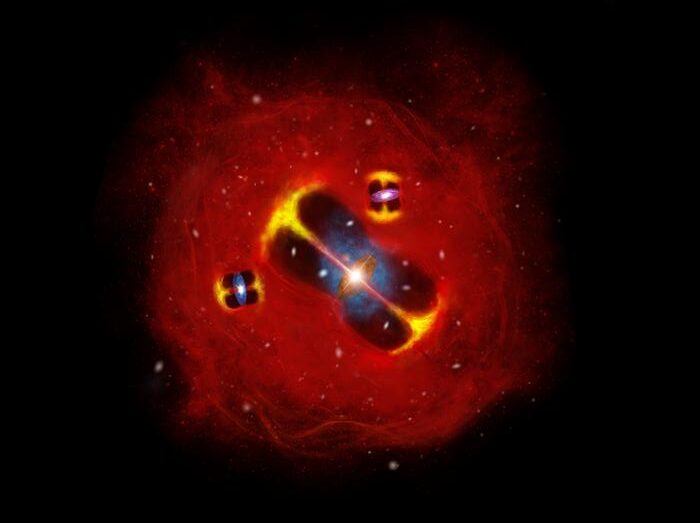
Astronomers hunting through signals from the early universe have stumbled onto something that shouldn’t exist: a baby galaxy cluster already burning at temperatures that current models say it has no business reaching for several billion more years.
The object, cataloged as SPT2349-56, sits 12 billion years in the past, formed just 1.4 billion years after the Big Bang. At that cosmic age, galaxy clusters are supposed to be cool, messy assemblages still gathering themselves together. This one decided to skip ahead. The gas threading between its galaxies is at least five times hotter than theory predicts, with total thermal energy roughly ten times what gravity alone could generate.
Dazhi Zhou, a PhD candidate at the University of British Columbia who led the study published in Nature, admits he didn’t believe the readings at first.
“In fact, at first I was skeptical about the signal as it was too strong to be real,” Zhou explains. “But after months of verification, we’ve confirmed this gas is at least five times hotter than predicted, and even hotter and more energetic than what we find in many present-day clusters.”
The team measured the heat using the Atacama Large Millimeter/submillimeter Array, detecting what’s called the Sunyaev-Zeldovich effect. In plain terms, the cluster’s electrons are so energetic they give passing cosmic microwave background radiation a measurable energy boost. The signal was unmistakable, and it revealed an atmosphere that looks decades into its own future.
Packed, Violent, and Racing Through Star Formation
SPT2349-56 is not just hot. It’s absurdly crowded. More than 30 galaxies are jammed into a core spanning about 500,000 light years, roughly the size of the Milky Way’s halo. Together, they’re forming stars at a rate 5,000 times faster than our galaxy manages. Embedded within this chaos are at least three supermassive black holes actively feeding on surrounding material.
In mature clusters today, most ordinary matter doesn’t live inside stars. It floats between galaxies as diffuse plasma called the intracluster medium, typically heated to tens of millions of degrees by the slow crush of gravity as the cluster settles. Young clusters should still be pulling themselves together, their gas relatively cool and sparse. SPT2349-56 looks like it skipped that entire phase.
The black holes appear to be the key. As they feed, supermassive black holes can launch jets and winds that pump enormous amounts of energy into their surroundings. In the dense, high-pressure environment of the early universe, that energy had nowhere to escape. It stayed trapped, superheating the gas and creating what amounts to a cosmic pressure cooker.
What This Means for Cluster Assembly
The discovery challenges a core assumption built into cosmological simulations: that intracluster gas heating follows a predictable, gradual timeline tied to the cluster’s growth. If black holes can dominate the heating this early, the sequence gets scrambled. Clusters may pass through brief, intense phases of energy injection that current models simply don’t account for.
Scott Chapman, a co-author from Dalhousie University, points to the black holes as the likely drivers. The young cluster, he suggests, was already being shaped by forces beyond gravity alone, forces that left a thermal signature we can still detect 12 billion years later.
Whether SPT2349-56 represents a rare outlier or a common but overlooked phase remains unclear. The researchers are continuing to study the cluster, trying to understand how its extreme star formation and black hole activity fit together. For now, the finding leaves open a different picture of the young universe: one where some of its largest structures grew up fast, turbulent, and far hotter than anyone expected.