

In Anchorage, Alaska, the memory of the 2018 magnitude 7.1 earthquake is still raw. While over 750 homes were damaged or destroyed, countless others stood firm. Why did some houses fail while others survived? New research spanning political science and civil engineering offers a stark answer: the most effective, disaster-proof building methods are already known. The crisis isn’t a lack of engineering knowledge, but a total breakdown in making sure three simple, cheap components actually get installed.
Notre Dame political scientist Susan Ostermann partnered with engineers Maria J. Echeverria and Abbie Liel. Their goal wasn’t to invent new materials, but to identify which two or three elements in the vast American building code truly determine a home’s hazard resilience. The National Science Foundation-funded study, which appeared in the International Journal of Disaster Risk Reduction, translated this academic insight into a tangible, high-impact checklist for regulators and builders.
The Political Barrier: When Rules Are Too Big To Follow
Ostermann and Liel argue that a resilient home requires both governance and good engineering. The technical specifications for durable construction are sound; the trouble lies in local enforcement and how those rules are applied. “Regulations support the goals of safe, resilient housing, but they can also get in the way,” Ostermann said. “We need to understand how culture and local building practices interact with regulatory processes.”
Alaska was the perfect, complicated case study. It’s a remote, independent region where citizens often deeply distrust government oversight. Despite the sheer number of houses lost in the 2018 tremor, many Alaskans resisted strengthening regulations. This presents the core paradox: simply writing a tougher, more complex code changes absolutely nothing if the community refuses to adopt or comply with it.
Ostermann developed a concept called regulatory pragmatism. It is a way for government to enforce standards in places where traditional, top-down mandates are prone to failure. She argues regulators must stop imposing a complex, uniform template, and instead tailor the law to the local context and climate.
The building code’s sheer volume is itself a massive problem. “If you were to print it out, it’s multiple volumes,” Ostermann observed. “It’s too big to be comprehended by almost anybody, whether it’s the government using it or a contractor trying to meet the code.”
Since enforcing the entire code is impossible, Ostermann and Liel insist local officials must stop trying. Instead, they must identify and focus solely on a small, high-priority list of features that are most critical for saving lives and property in their specific environment.
People everywhere share a desire for safe housing, but communities vary in the degree to which they regulate and enforce building codes.
To produce this targeted checklist, the researchers interviewed nearly 40 Anchorage experts, including engineers, builders, regulators, and inspectors. They needed to find out, on the ground, what truly separates a disaster from a near-miss.
The Three Simple Parts That Save A House
The computational analysis led by Echeverria and Liel consistently identified the main cause of structural failure: builders neglected critical, known elements due to poor compliance. When a house failed, it wasn’t because of a lack of knowledge, but a lack of follow-through.
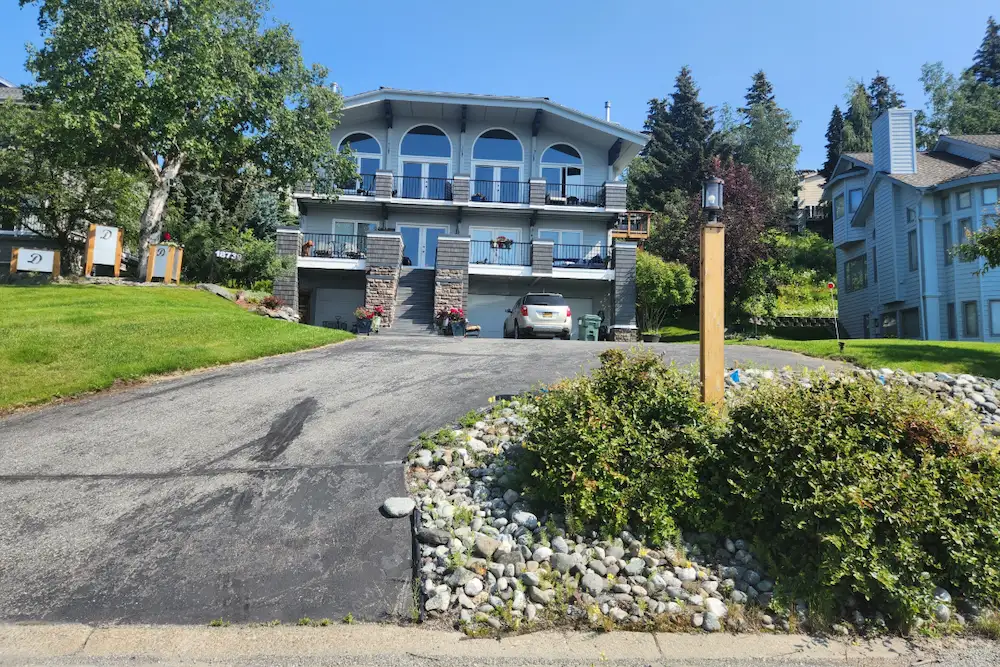
Consider the typical two-story Alaskan home built over a wide, open garage-a popular but fundamentally weak design. That heavy second floor rests on a first floor that inherently lacks lateral support. Liel described the situation starkly: “You’re basically missing one side of that box,” noting that the missing support overstrains the remaining structure. “That creates a twisting torsion problem, so these homes do not perform as well during an earthquake.” Walk down a post-quake street and the pattern is obvious: intact homes have their garages standing; failed ones have their second stories punched straight through the concrete slab.
The solution, after all the talk of the thousand-page code, is shockingly simple. It comes down to just three components. That’s it. Builders must prioritize shear walls, which are structural walls designed to withstand horizontal forces like wind or seismic shaking. They must also ensure proper framing is installed around those massive garage openings to prevent collapse, along with hold-downs, basic steel connectors that physically anchor a wall to its foundation, preventing the structure from lifting off or twisting during an intense tremor.
Liel stresses that these fixes are not expensive or esoteric-they are standard building practice. The core difficulty isn’t cost or technology; it’s getting homeowners and builders to grasp the fundamental, life-saving significance of these few parts. This short list provided the hard, technical data Ostermann needed to inform her regulatory model.
When communities, engineers, builders and policymakers work together, resilience stops being an abstract ideal and becomes a place people can safely make their home in.
Their team is now applying the same principles to rebuilding efforts in Puerto Rico after Hurricane Maria and in Lahaina, Maui, following the 2023 wildfire. What they find is the same everywhere: regardless of whether the hazard is wind, water, or fire, the essential engineering failures are nearly identical. The conclusion holds fast across diverse disasters: by abandoning complex regulatory dogma and focusing on simple, critical components, we can deliver families the secure, stable homes they desperately need to plan for a future.
International Journal of Disaster Risk Reduction: 10.1016/j.ijdrr.2025.105878