

The mouse’s heart stops beating normally just minutes after the surgical thread tightens around its coronary artery. But something else happens almost instantly that nobody expected: deep in its brain, neurons flicker to life. The heart attack, it turns out, is making a phone call.
For decades, we’ve treated heart attacks as plumbing problems. Arteries get blocked, blood flow stops, heart tissue dies. The solution? Bypass surgery, angioplasty, blood thinners—all focused squarely on the heart itself. But researchers at the University of California San Diego have discovered that this view misses three quarters of the story.
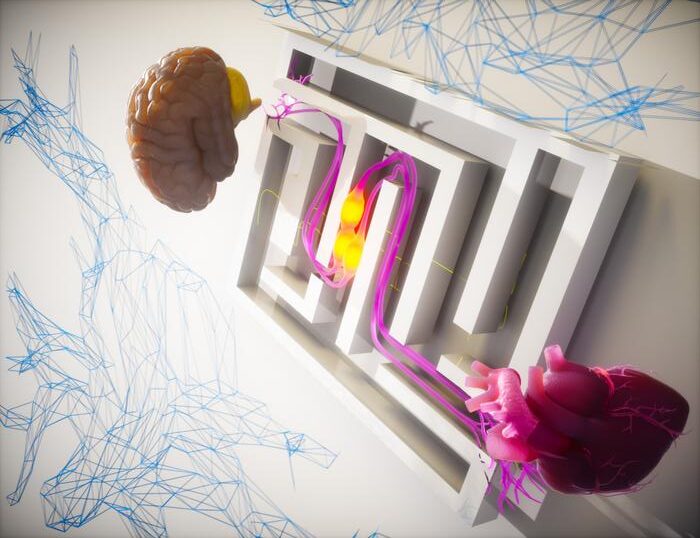
Working in mice, Saurabh Yadav and Vineet Augustine have mapped out what they call a “triple node” system linking the heart, brain and immune system in a continuous feedback loop. When things go wrong in one part, the others respond—often making the situation worse rather than better.
The first node sits in the vagus nerve, that wandering highway of fibres connecting your organs to your brain. Tucked inside are specialised sensory neurons studded with a protein called TRPV1, best known for detecting chilli peppers and other painful stimuli. These neurons, it turns out, also serve as the heart’s distress beacon.
When Yadav and his colleagues induced heart attacks in mice and then looked at their vagus nerves two weeks later, they found something striking. The number of TRPV1-expressing neurons had increased, and their fibres had infiltrated deep into the injured heart tissue, wrapping around the border zone between healthy and dying muscle. The neurons were essentially rewiring themselves to monitor the damage.
But here’s where things get interesting. When the team used a potent toxin to eliminate these TRPV1 neurons before inducing heart attacks, the mice fared dramatically better. Their hearts pumped more efficiently, the electrical patterns looked healthier, the scar tissue was smaller. “Blocking this heart-brain-neuroimmune system was shown to stop the spread of the disease,” says Yadav. “If you think of a heart attack as the epicentre, the blockage of the signals stopped the spread of the injury.”
The neurons, it seems, were part of the problem rather than the solution. But why? The answer lies in node two.
The TRPV1 neurons don’t just detect trouble—they report it to a region deep in the hypothalamus called the paraventricular nucleus, or PVN. This thumbnail-sized cluster of cells regulates everything from stress hormones to blood pressure. When the researchers examined PVN neurons after heart attacks, they found heightened activity in cells expressing receptors for angiotensin II, a hormone that constricts blood vessels and jacks up blood pressure during emergencies.
The team tested whether these activated brain cells mattered by using designer drugs to temporarily silence them. The results mirrored the vagus nerve experiments: better heart function, preserved electrical patterns, smaller scars. The mice even showed improved heart rate variability, a sign that the chaotic swings between sympathetic and parasympathetic nervous activity had calmed down.
What the PVN neurons were doing, Augustine and his colleagues found, was amplifying the body’s stress response through a third node: the immune system and the sympathetic nervous system working in tandem.
They traced nerve fibres from the brain down to a structure called the superior cervical ganglia, a pair of nerve clusters in the neck that help control the head and heart. After heart attacks, these ganglia showed a spike in interleukin-1β, a pro-inflammatory molecule that normally helps fight infections but can damage tissue when overproduced. The sympathetic nerve fibres projecting from these ganglia to the heart also multiplied, creating a web of connections that kept the heart in a state of high alert.
When the researchers injected an antibody to block interleukin-1β in the ganglia, cardiac function improved. Heart attacks in healthy mice given extra interleukin-1β, conversely, led to worse outcomes. The inflammatory signal was actively promoting damage.
The picture that emerges is one of catastrophic miscommunication. The heart sends an SOS through its sensory neurons. The brain, treating the heart attack like an infection or injury, marshals the immune system and cranks up sympathetic activity. But there are no bacteria to fight, no external threat to flee from. The overactivated immune cells and stress hormones only add insult to literal injury, expanding the zone of dying tissue and interfering with healing.
The findings suggest a radically different approach to treatment. “Current treatments for heart attacks focus on repairing the heart, including bypass surgery, angioplasty and blood thinners, which are all invasive,” says Augustine. “This research is showing that perhaps by manipulating the immune system we can drive a therapeutic response.”
The work involved an unusual degree of collaboration, bringing together neurobiologists, cardiologists, immunologists and bioengineers over four and a half years—a necessity given how the traditional silos of medical research had obscured these connections. The team used single-cell RNA sequencing to identify exactly which neurons were involved, spatial transcriptomics to map how heart tissue changed at the cellular level, and light-sheet microscopy to visualise nerve fibres infiltrating the damaged heart in three dimensions.
One particularly clever experiment involved implanting tiny electrodes to record the hearts’ electrical activity in conscious, freely moving mice over two weeks. This revealed that mice with blocked vagus nerve signals or silenced PVN neurons maintained normal heart rhythms after their heart attacks, whilst untreated mice showed dangerous irregularities.
The findings may also explain some puzzles in human cardiology. Heart attack patients often develop anxiety, depression and cognitive problems in the months afterwards—symptoms that seem odd for what we think of as a heart problem. But if heart attacks are triggering sustained changes in brain circuits, those connections make more sense. The brain, after all, remembers what the heart went through.
There are obvious caveats. Mice are not humans, and their cardiovascular systems differ in important ways. The toxin used to eliminate TRPV1 neurons works well in rodents but hasn’t been tested for safety in people. And whilst blocking immune signals helped in the immediate aftermath of heart attacks, the immune system does play beneficial roles in healing. Timing and dosing will matter enormously.
Still, the therapeutic possibilities are tantalising. Drugs that dampen vagus nerve activity, calm overactive brain stress circuits, or modulate specific immune signals might all reduce heart damage without requiring a catheter or scalpel. Some of these approaches already exist in different contexts: vagus nerve stimulators treat epilepsy, PVN-targeting drugs manage blood pressure, and interleukin-blocking antibodies treat autoimmune diseases.
What the research really does is reframe how we think about heart attacks. “Heart attacks are obviously centred in the heart,” says Augustine, “but we’re flipping the switch on heart attack research to show that it’s not just the heart itself that is involved.”
Your heart and brain have been talking to each other your entire life, coordinating the response to every sprint, every fright, every moment of excitement. Usually, this conversation keeps you alive. But when a heart attack strikes, the dialogue can turn destructive. Understanding that conversation might be the key to interrupting it at just the right moment.
Study link: https://www.cell.com/cell/fulltext/S0092-8674(25)01506-5